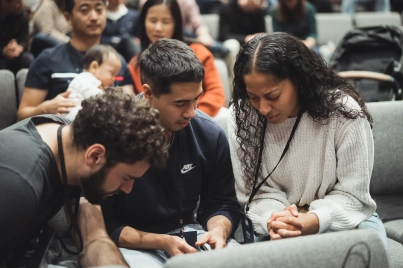
Eugene Hor discusses the diversity underlying his ABC-focussed church.

Transcript
This transcript has been generated, and can contain errors. Please refer to the original recording for the definitive language used.
Read transcript
[0:00]
Hey, my name's Adam Cheung and I'm the pastor of Cross and Crown in Melbourne. And you're listening to a Reach Australia podcast focused on cross-cultural ministry. If we want to think about reaching Australia with the gospel, we also want to be able to reach all tribes, nations and tongues in this country with the gospel as well. And today we're joined by Eugene Hoare, who's the lead pastor of Grace Point Presbyterian Church here in Sydney, and also an adjunct lecturer in preaching at Christ College as well. Eugene, it's so good to have you here. Pleasure. And we also have Iggy Wong from CPE Church up in Brisbane.
[0:31]
Iggy, it's great to have you here as well. Thanks, Adam. We're talking about Asian-Australian ministry largely, but it can be overly simplistic, I think, sometimes to say, well, I guess all Asians look the same, don't they? We're all the same no matter where we live. You've been pastoring a church that's largely Asian-Australian, but do you want to tell us about some of the complexities that might be within that when we double-click on that term? Look, I've been the pastor of Grace Point for about 20 years. So we're a church plant. And I think when we planted 20 odd years ago, it was predominantly with the Australian-born Chinese university student group.
[1:07]
I mean, the church is now made up of a whole range of people, from children, students, to 50-year-olds, mums, dad, parents, 85-year-olds. So it's fairly large, but we're still predominantly Australian-born Chinese or Australian-raised Chinese. So that's the church that I'm involved in. We do have Chinese-speaking congregations. I'm not the pastor of those congregations, but we work in partnership with them. So we've also got Cantonese-speaking congregations, Mandarin-speaking congregations. So it looks Chinese, but it's fairly diverse because, as you know, it's not just…
[1:44]
All Asians do look the same, but they do come out of different cultural backgrounds. It's funny, isn't it? Because if you go on the website or the Facebook page and you look at the photo, you think, well, it must be a homogenous unit. Everyone's exactly the same. Correct, correct. But it's not that simple. But it's not. It's not. Because, I mean, so one example I often give is even if you think of the Mandarin speaking congregation, most of our Mandarin speakers, most of them are from mainland China. And, you know, some of your heroes might be aware that mainland Chinese Mandarin speakers are different from Taiwanese born Mandarin speakers.
[2:18]
In our Cantonese congregation, most of them are actually from Hong Kong. But obviously, if you're Hong Kong Cantonese from Singapore and Malaysia, that would be culturally different as well. And it's the same with our English speaking congregation. Not all ABCs are the same. So I'm Australian raised. So I was the I'm the son of a migrant family. My children are actually ABCs. They're actually born here and they're not children of migrant family. And so they would be different. But we also got people in our church who are Vietnamese.
[2:48]
who are children who are born here, but who are children of parents who fled persecution. And they would be different as well because they used to live in the Capramatta area and then they've moved here. But we've also got kids who are parents who come out of the North Shore, eastern suburbs. And that's different as well because they're a lot more middle class in their background. So it's quite diverse culturally. And there's the funny thing, right? Because we often, even when you mentioned that, we might think, okay, there's different groups of Asians, but maybe the worst kept secret,
[3:19]
there can also be conflict within and among those groups, can't there? I mean, in my old church, at the height of some of the tensions politically, it was actually quite difficult between some of the mainland Chinese and the Taiwanese. Oh yeah, absolutely. Or more recently between Hong Kong Chinese and the mainland Chinese. So how has that played out in Grace Point? I mean, I think we're quite fortunate at Grace Point because I think our Chinese speaking congregations actually haven't let politics get in the way. But you know, occasionally, I don't even know whether I can say this on the podcast or podcast, but on the odd occasion,
[3:50]
I'll speak to someone from Hong Kong and then they'll say something privately to me about how bad the Chinese government is. Then I'll speak to someone from the Mandarin congregation and they'll talk about how it's so bad, these riots, because it's a usurping of authority. And so people have different opinions, but I think in a church like ours, we've worked very hard not to let politics divide us. Why? Because I think in our church, you know, we've made it clear that what unites us is the gospel of the Lord Jesus Christ. It's got to transcend politics.
[4:23]
It's got to transcend culture as well. And even within the Chinese church, there are cultural differences and people have to recognize that. Is multiculturalism even within the Asian church? Yeah, I think so. Rather than just multiculturalism that's skin deep. Correct. I think so. I think, but people don't realize that because, I mean, they look at the three of us here, you know, and they go, oh, three Asian guys. But Iggy, you're ABC, is that right? I was born in Malaysia and I came when I was three years old. Okay. Essentially ABC culture. That's right. Raised, yeah. That's right. So you're ABC more than I am.
[4:53]
I came when I was 15. And where are you from, Adam? Surprisingly ABC, but everyone thinks I was born in Malaysia. But I am actually from here. That's because I think we've, you know, a lot of people on the odd occasion when you, I notice when we speak to you, sometimes you'll bust out in your Malaysian-Singapore accent. Not bust out, I'll lapse into it. Yes, that's right. But I've heard you as well, you. Only if I need to. Only if you need to. All things to all people, right? That's right. We change the way we use our English. Yes, that's right. Contextualization. You know, sometimes we're talking about Asian-Australian ministry and the problems and the struggles that people have about going into ministry.
[5:29]
Is that always just an Asian-Australian thing? I mean, it's very easy to go, oh, it's because that's their culture. Yeah. Is it more than that? That is fascinating, isn't it? You know, sometimes the myth is it's harder for people of Asian background to take the step into full-time Christian ministry or to do a ministry training apprenticeship or leave their careers. And more and more, I'm thinking that's simply not true. I think it's just as hard for people who belong to any culture. I think the challenge, I think, for Asians going into ministry would be the same for any middle class background person going into ministry.
[6:04]
so so it is interesting um you know obviously i've come out of a migrant family and so my parents objection to me going to ministry was because i think for them it would be a waste of the opportunities that you know they've sacrificed you know for me but i i don't think that'd be too different for a caucasian family who are middle class as well um they've made sacrifices as well. So I think the challenges are there. I mean, obviously there are cultural nuances.
[6:35]
If you've come out of a family that made incredibly huge sacrifices, it might be harder for you to actually want your son or daughter to go into ministry. But I think it's true across all cultures. That's always going to be the challenge. How do you think the, I guess, that more individualistic Western viewpoint versus that community, family, sort of Eastern sort of culture, Do you think that plays into it? Oh, I think there are cultural nuances.
[7:06]
I mean, obviously, those of us who come out of Asian background, we are less individualistic. And so how, you know, even if you're a second generation, what your family thinks is probably, I suspect, more important. So I suspect that that's there. That would be a cultural nuance. but even in the west i'd be hesitant to say that you know if i came out of a caucasian family that i you know my parents would be happy for me to do whatever i want yeah yeah so i think of
[7:41]
parents who live in maybe the eastern suburbs of sydney or the north shore of sydney i think middle class families always have high aspirations for their children which is why they send them to the schools that they send them to so i think they would have the same aspirations but whether the second generation whether asian or caucasian respond how they respond i suspect might be different so i think in western culture we're probably more individualistic but in asian culture even with second generation i suspect we are a lot more filial so what our
[8:14]
families think i suspect we we would take that on board a lot more yeah and that's where the pressure comes isn't it so it's funny isn't it because sometimes what we nail as a cultural problem. There might be legitimate cultural issues there, particularly, as you said, from the second generation responding to the first generation. But sometimes it's an aspirational class matter. Yeah. That there actually might be more consistency between a Caucasian aspirational middle class person and an Asian person in the same class versus an Asian person who is working
[8:46]
class from a refugee family. Correct. So what would it look like or what have you seen it look like from a working class background? How is that different? Oh, that's a tough one because it's never simplistic, right? And that's the problem when we have these discussions. We always speak in extremes or we generalise too much. But, you know, if you've come out of a persecuted background, let's say a persecuted background, you've made incredible sacrifices.
[9:17]
So I think of one of our MTSs whose family fled Vietnam. They came on the boat. She was born on a boat. Obviously, for her to go into ministry, the challenges were a lot harder because she knows the sacrifices her family have made. And so you've got that pressure. And she feels that obligation to… Yeah, so there is an obligation to, like, my parents have made these sacrifices for me. and here I am, you know, I've done my university degree, I climb as it were the corporate ladder
[9:53]
and then I'm putting it all aside. So there is a sense of obligation to family and but I think that's a cultural thing but that's the pressure as well. Now I'm not saying the pressure is not there, I think if you're a family or middle class but I do think it's there but I think the pressure is different for my children because it's not like they look at us and go, oh you guys have fled persecution so we can have an education, you know, whereas our kids probably work really differently, you know, our kids are more like, oh, you know, can I use your credit card?
[10:25]
You know, or here's a list of things I found on Amazon. Can you pick it up for me on your Prime account? So it's just, you know, it's different. And some of that, as you said, might be a cultural thing, but it might be the fact that actually you're the generation that actually benefited from your parents' sacrifice, and then they're the generation after that who benefit even more still. That's right. That's right. And so subsequent generations might be A, B, C, but there's different cultural pressures that they experience. So the impact of that migrant sort of mentality will be less and less
[10:56]
as the generations go on. Correct. And their pressure is different. So I'll give you an example. The pressure for my children, I've not said to them, don't go into Christian ministry. But the pressure for them will be life is good and if I go into Christian ministry, I might miss out on the good life. Whereas for my generation, it's like, or for me, my parents have made sacrifices. If I go into Christian ministry, who will look after them? So it's different pressure.
[11:28]
Do you think then the risk is that we end up continuing to encourage the next generation of people going to ministry to enter Christian ministry, but on the assumption that they're us. I think that could be the danger. So we speak to them as if they occupy our position, but actually they're the next generation and they're in a very different class position. And we're speaking in one sense to ourselves, but to the wrong people. Yes, that's right. So we've got to work out what sort of ABC or second generation are we talking about. Do they come from the eastern suburbs of Sydney?
[12:01]
Here in Sydney, it's more of a middle class, upper class suburb. Do they come from the Western regions of Sydney, which is more of a working class background? So who are we actually talking about? And it's not just true of ABCs. It's true of all cultures. So it may be the case, for example, that as migration from mainland China continues to come in, their children might face the challenges that we face when we enter ministry, but the children of the third generation Singaporean Malaysian migrants…
[12:32]
Yeah, it'd be different. Actually, a totally different situation. Yeah, totally different. Yeah, totally. And those challenges are not uniquely Asian migrant challenges. No. They're just challenges of the upper middle class. They're just challenges of the upper middle class. That's right. Do you think that's why, for example, when we think about an apprenticeship and the challenges and the cultural greatness of an apprenticeship, it might not actually be a cultural thing, but it's actually, well, you should be university educated, go get an accounting degree, work in the big four. It's actually, it's an aspirational thing. It's an aspirational thing. Yeah.
[13:02]
I mean, what are you going to get out of two years of apprenticeship? you might as well go to university, get a degree, and then go into ministry after that. It's not productive. It's seen as producing something tangible at the time. There's no accreditation from the government at the end of that. Maybe that's what you need to do, right? Have an accreditation. Okay, so how actually do you think then we should go about ministry training when we think about that cultural perspective of a traineeship, for example, with zero accreditation, and at the end it's like, well, thank God a few churches in the country might think you're worthy to win.
[13:34]
Well, I don't know, man, because I'm always happy to print like a certificate and say, you've graduated two years ministry apprenticeship. With a printer with Laura Toner and you're just building it at the end. And with a seal down the bottom as well. You can start peeling off after a week. Absolutely. You can get them at Officeworks, apparently. I don't know, Adam. I think that's a really challenging one because obviously when people do apprenticeship and they train for ministry, it's not a university accredited thing. And those of us in ministry will know that ministry is not just the acquisition of knowledge.
[14:07]
It's also hands-on practical experience where that knowledge is actually synthesized under a mentor or a coach. And I think that's a very foreign thing. And Asian culture in, I suspect, any generation, because of our aspiration, we value higher education. the classroom. And I think that's the challenge with the upper middle class. Yes, but Chinese people invented the exam
[14:37]
historically. That's our contribution to the world. That's why my kids are suffering because of that. Is that true, Adam? It is true. I'm pretty sure that's historically accurate. Our one and only contribution to the world was we created the exam. He watched it on horrible histories. Just on the topic of apprenticeships, just want to dig into, I guess, different learning styles also, which we haven't really talked about in terms of migrant culture. Traditionally in
[15:08]
Asian culture, even now in many Southeast Asian countries, or not just Southeast Asia, but Asia in general, it's a very didactic sort of one-way learning. Here's information, you download it, whereas, and the concept of apprenticeship is quite a foreign thing. So how do you think that's impacted the way that I guess Asians have taken to training? Do you think that's had much of an impact? Has it been difficult to adapt? Not so much for us, Iggy, because our guys that come train with us, most of the people who train with us are raised within Grace Point. So I think,
[15:44]
you know, if you if for us, you know, it's it's not like someone who we don't know, it's normally someone from within, they've, they've gone through the leadership pathway, as it were, They've been involved in Sunday school. They've been involved in serving in the life of the church, so we know them. And obviously, people from Asian background, especially those who come from high aspiration families, which is almost every Asian background family, they tend to, you know, which is why they go to university, because it's an education. Or at school, they just learn, right?
[16:16]
So I think it's in the mindset of most people, and certainly apprentices, we come and we study. but apprenticeship is not just about growing in conviction, knowledge of the Bible, it's also about growing competency and alongside that also growing in character as you do the work of ministry, the skills that you acquire. So for us at Grace Point, I think when we think of the training for people in ministry, it's really those three components coming together and making sure that they're well balanced. Now obviously every ministry apprentice is different.
[16:49]
Some people are more geared to skills-based training, more tactile. Others are more geared to reading. And I think the challenge is always trying to balance the two. You don't want to go down one and then not have the other. Because I think in ministry, you do need those three things when we think of the training people ministry. I think now that you've asked me, I think as I reflect on apprentices we've had in the past, I think if I were going to say anything to someone who wants to train people for ministry,
[17:19]
it's actually working out what would work best for a ministry apprentice and then tailor the training to them. So, you know, people who are more academic, I suspect you don't have to actually tell them to read because they'll do it. People who don't like spending as much time with people, well, maybe you need to push them to spend more time with people rather than spending time with the books. Yeah, so just adapting to what would best be helpful.
[17:51]
Yeah, I think you need to do that for their growth. Do you tend to find in Grace Point that there's a particular priority on one versus others? So do you get more people who would value the academic side and in one sense look at that and say, well, if I'm theologically sound, then that is a good reason to go into ministry, maybe even if they are lacking in the other areas? I think ministry training has changed in Grace Point over the years. I think now we are trying. I think we push very hard to have a balance in all three.
[18:22]
You know, Carl Marshall used to say that those three C's that every ministry apprentice needs to work on, right? They need to work on their character. They need to work on their conviction, their knowledge of the Bible. They need to work on their competency and skills. And I think that would be true of us as trainers in our church. We want all three. Now, obviously, we have to tailor to each individual that comes because different people have got different levels of knowledge, different skills they need to acquire. And so I think that's how we've been doing it at Grace Point.
[18:53]
In your context, either because of, as we said, culture or class, or maybe a mix of the two, what has it looked like for finances to be either a barrier or a facilitator for ministry training? Is it something that people go, well, I don't want to do it because either my parents think it's too low pay or I'm thinking about getting married and therefore I want to provide for and prepare well for that. So what place do finances have when it comes to ministry training? I think that's always the worry, isn't it?
[19:26]
My parents, their great worry when I went into Christian ministry, I think one of their concerns was whether we would have enough to live on. And, you know, I never did ministry apprenticeship. but I did Bible college at a time when there was no fee help. And so there were times when there was like $100 in the bank. We were married, we were living in a new town. But the crazy part was we never starved. And when we planted the church, I was also $100 a week for the first year
[19:57]
with 30 people when we planted the church, but we never starved. And so money is always the concern and the worry. and it remains a concern worry I suspect for ministry apprentices today, for church planters today, but God has always provided. I think because we've raised in a culture that is so, I think we're raised to be self-sufficient and so we don't want to put ourselves into a position
[20:29]
where either we're dependent on other people or whether we are forced to truly depend on God. because it's so much easier to depend on God if I've got $15,000 put aside in the bank each year, set aside to do a ministry apprenticeship. But if I have nothing and I have to raise it, I have to do one or two things. I have to depend on people who will partner with me in the ministry of the gospel, and I've got to depend on God to provide for me so that I can actually do the apprenticeship or even plant a church. And so, you know, that's a challenge.
[21:02]
It will always be a challenge. I mean, I guess fundraising for ministry training is never anyone's favourite part of the job. Do you think it's particularly great for, is it particularly difficult for Asian Australians to fundraise? Yeah, I think it is because if you've been taught to be self-sufficient and to depend on no one, you know, to be independent as it were, independent in achieving your goals and your ambitions in life, but always dependent on your parents because you're Asian and always coming under their instruction and guidance,
[21:36]
then it's hard to ask people for money. It's very hard, which is why one of my friends is a missionary and when he wanted to go into ministry, his in-laws actually said to him, you're a doctor, we want to support you doing Christian ministry, but what we think you should do is you should actually stay as a doctor, um buy a buy a house uh set your family up your children up and after you've done all that when
[22:07]
you've retired then you should go into christian ministry because then you'd be ready because you would provide it for your family that's the effectively the mindset and the mentality that's what's being said to me well there you go so i was having flashbacks as you were saying that i thought you were my dad for a moment uh it's particularly difficult isn't it because actually you're right with particularly the aspirational agents the jobs that they're quitting are as a lawyer in a top tier firm yeah yeah you know auditor in one of the big four that's right and after that you have to go from that to saying please support me in this ministry training
[22:40]
that's right and and it's uh it's the you know uh bishop gary koo here in sydney says it's the big three right the big three for for asians uh especially asian mums and dads is you know doctor lawyer engineer or maybe you can throw an accountant if you know maybe accounting someone told me it was doctor lawyer or failure so it was one of those three yeah that's right yes if you you know if you get the third one don't come home and so it's true if you've trained to be a doctor or lawyer engineer accountant or someone in a professional degree and then suddenly to depend
[23:15]
on others. I think for parents, that's also a measure of shame because we've invested in you and you're asking people for money. You're begging. That's what you're doing. So from a church perspective then, is that either, how should we respond to that? Because I can imagine there's two general ways you can respond. You could say, okay, here's the financial challenge that's there. As a church, we're going to step in and step up to allay that in some sense. Absolutely. Or you could also take the total opposite Christ counterculture approach and go, well, this is an opportunity for discipleship.
[23:50]
So suck it up and go fundraise. Is there somewhere in between that? I actually think there is. I think so. One of the things we do with our ministry apprentices is we say to them, this is a growing opportunity for you to speak to individuals because it's teaching you to depend on others to partner with you in the ministry of the gospel, which will go on for a lifelong ministry. it's also an opportunity for you to actually depend on God. So it's a discipleship lesson for the individual. But it's also a discipleship lesson for the church.
[24:21]
And this is why I think senior leadership, that's where senior leadership needs to step up. You've got to have conversations with people's parents. You've got to explain to them that, you know, your son or daughter isn't going to starve. They've got the support of the church family. You've got to actually see it as a discipleship opportunity for the church. And so at Grace Point, what we say is, God's mission and raising the next generation of gospel workers is a community affair. It's not the individual. It involves us. And we see that from the New Testament.
[24:55]
And so we have opportunity to partner with individuals in the gospel, and that is our privilege. It is a privilege for us to do that. And we partner in three ways. We partner in prayer, we partner in practical encouragement, and we partner in giving financially. and we've got to call people to do those three things. So I think for us that's the middle. That's the middle ground. As you think about Asian Australians whose parents are churched, the experience of a lot of pastors and ministry workers
[25:28]
in migrant churches is quite different to a lot of the mainline established churches if you're Sydney Anglican or Presbyterian or FIEC. Generally speaking, at some level, you're reasonably well looked after. Do you think that there are reasons, some Asian parents don't want their kids to go into ministry because of their experience of what pastors go through in migrant churches growing up? I mean, I suspect if you're Anglican or you're Presbyterian, you're right.
[26:01]
You're well supported. It's not like you're going to starve. You know, years ago, and I don't know whether it's true today because I work in Presbyterian ministry, but in a lot of the independent migrant churches, the myth was the mark of spirituality was poverty. Only true for the pastor, though, and those in ministry, not true of everyone else in the church. So if you want to go to ministry, then the mark of your spirituality is your poverty.
[26:31]
and I remember Bishop Gary Koo actually saying that's absolute rubbish right he would say that you know the fact that you we have migrant churches who think that the mark of a pastor's spirituality is his poverty is absolutely rubbish the mark of poverty is poverty that's what he used to say and and I think that could be true of some places I would hope is no longer true today I think gospel workers, you know, the New Testament actually encourages us and reminds us that a worker deserves his wage.
[27:04]
Those who actually are preachers of the gospel should actually be supported. And I think we need to actually encourage that. I think that's really, really important to actually do. Now, obviously, that's a fear that migrant families have. You know, my son or daughter goes into ministry. He's going to be, he or she is going to be a beggar for the rest of their life. How are my grandchildren going to survive? And so I understand that that's the fear, but if the church is truly a partner in the gospel, then they would support their gospel workers appropriately.
[27:39]
Talk to us about marriage and ministry as it relates to young Asian Australians or aspirational Asians who are thinking about going to ministry and might not yet be married, but as those two things kind of cross over at the same time. So in our church right now, we've got quite a few people who are thinking about ministry and also thinking about marriage. And sometimes they line up, but they don't always line up in the ways that they would hope. What's the experience been at Grace Point as you think about young people thinking about marriage and ministry?
[28:11]
I think for some people, if you ask me who you, if the question was, is who I marry critical in ministry? My answer would be yes, because not everyone you marry is going to be able to have the emotional capacity to actually support you in the work of Christian ministry. And so the reality is that Christian ministry is hard. So anyone who actually says, come to Christian ministry because it's going to be easy, it's
[28:42]
going to be a fun ride, is wrong. They have not read the New Testament. Colossians chapter 1, I think, you know, we all know Colossians 1, 28, those of us in pastoral ministry because we know the goal is to present people mature in Christ. But if you read the verses before that, Paul actually says, I rejoice in suffering in my service to the church. And no one ever tells you that. Or you read 2 Timothy chapter 1, where Paul actually says to Timothy, join with me in suffering for the cause of the gospel. And so I think who you choose
[29:16]
to marry matters if you're going into Christian ministry, because they would actually need the the resilience to support you and to walk with you in ministry that will not be easy, that will be hard. And so, yeah, who you marry actually matters. And I caution individuals who want to go into Christian ministry, men and women, because without a spouse that's going to support you, you would not be able to do long-term Christian ministry. So Yuji, you were talking about the three C's before
[29:49]
You've mentioned to us before that you have two other C's as well Yeah, I do have two other C's I think Cole Marshall is right When we think of training people for ministry We do want to grow them in character Character is always king We do want to grow them in conviction So they need to grow in a knowledge of the Bible Chris Chair, who is Senior Minister of Adam Road Presbyterian Church one of the most profound things he said to me that I'm incredibly thankful for. I remember sitting at a board meeting with him and he actually said,
[30:20]
we need, as we have this discussion, he said, we need God's Word to show us God's way. And we must always do God's work God's way, and therefore we always need God's Word. And this is in a board meeting, right? And so we do need to actually train and raise men and women who have a deep, clear knowledge of the Bible, so they can actually think theologically about ministry. Then the third one is conviction, obviously. You need skills to do the work of ministry.
[30:50]
But one of the things I've noticed is there are two other C's that we need to grow people in. We need to grow people in capacity. The nature of ministry has changed. It's not like, okay, I'm going to go into Christian ministry and I'm just going to be a preacher and teacher of the Bible and I don't have to worry about everything else. Well, that's not true. you guys in ministry, you know that if you're the lead of your ministries, gee, it'd be nice just to sit all week and just read a commentary, read the Bible, prepare a sermon, but there's so many other
[31:23]
things to do. There's pastoral care, there's people to call, people to care for, there's administration, there's crisis you deal with, there's long-term planning. So it requires a range of skills and because there's a lot of pressure it requires capacity and so we need to grow people in capacity or people need to under God humbly understand their level of capacity so that they know what they can and can't actually do in ministry so I think we need to grow people in capacity so I think that's the fourth C the fifth C and I've seen this more I suspect as I've looked
[31:59]
at people who are training for ministry and people in ministry, you've got to grow people in courage because in ministry, you don't just face hardship, you make tough decisions. And the decisions you make actually do require courage. And you will only have that courage to make tough decisions and to do hard things and to love people and love people well and sacrificially if you truly understand your identity, who you are in Christ
[32:29]
because there you will have security and that will give you courage. And so I do think there are five C's. I know others in Sydney have added other C's. I know Iggy had mentioned before chemistry, how you work in the ministry team. Bishop Gary Koo has said another C that I think people in ministry need is charisma. They need to actually be able to work well with people which could be similar to chemistry. But yeah, I think those additional two C's, capacity and courage I think is what we look for what we want to grow in people do you think
[33:01]
capacity is something that uh can be grown significant I can't say the word sorry significantly significantly or is it also part of looking for people I think you can I think you can always grow people in capacity it's like because I get asked this question right uh frame it another way. Can you actually go from being a mediocre preacher to a genius preacher, right? Or this is a big compliment to Sam Chan, right? Can you go from a mediocre preacher to being
[33:34]
like Sam Chan, okay? Or David Cook or Mike Rader? And the answer is, and I said this to students in class. No, you cannot go from a mediocre preacher to being a genius preacher because somewhere in that spectrum, there is a level of giftedness, correct? But you can go from a medium preacher, a mediocre preacher, to being a good preacher, an acceptable preacher, one who's preaching week in, week out, will feed the flock, who will grow the flock. You can. And that's what
[34:11]
we need to work towards. It's the same with capacity. So I think you can grow someone who is low capacity to increasing the capacity, but whether you can grow them from being low capacity to being the kind of pastor who can read like 10 books a week and who can churn out a journal article, produce three sermons for the different sermons for the Sunday, and then meet 15 people in the week, sit on a board. Well, no, because at that point, you're talking about genius level
[34:45]
capacity, which many of us are just not there. Is there a threshold in terms of, you talk about low capacity, is there a threshold of capacity where you think actually below this, it actually may not be a good idea to go into gospel ministry? Well, I think this is the reason why those of young men and women who are thinking of Christian ministry, this is why working in some industry is a helpful thing before they go into ministry. Not because, you know, they used to say, look,
[35:17]
go out into the real world and find work so that you work out what the real world is like. Well, again, that's a nonsense, isn't it? Because those of us who are involved in the life of church, the church will know that the church is the real world. We see sinful people, we deal with brokenness, we deal with deceitfulness, we deal with sin because the church is the place where God's people come in all their sinfulness and where they're living in a community of brokenness and sinfulness where mutual love and forgiveness has to be practiced under the
[35:52]
Word of God. So the church is the real place. What's the value of sending someone into the workplace? Well, to help them grow in capacity, learning to manage life, learning to manage work, learning to relate to a range of people. So that's a life skill thing more than anything else. So that will actually show you whether someone has got capacity. It's almost a bit like pre-ministry stress testing. Correct. It's stress testing. Can you handle it? That's right. That's why for me, and I said this to Adam, I said, when I see first, second year university students who are enthused about ministry,
[36:27]
who are really involved in ministry, and people actually say to me, wow, you know, these guys are on fire. you know, I'm happy, I rejoice in that, right? But I'm also sitting there and I'm thinking to myself, I want to see what you're like in five and 10 years' time. Will you still have the capacity when you have work, when you have sick parents perhaps that you've got to look after, when you have other stresses in life, will you still have the capacity?
[36:57]
Will you still have that joy? Will you still be engaged and involved in the lives of people at church? And so I'm going, okay, first year enthusiasm, it's not tested. You've got to wait five years, 10 years, and then you'll see it. I don't know what it's like for you at your church, but we've got a lot of young guys who are keen on ministry, which is great, and they want to go straight, do a ministry traineeship after uni, which isn't necessarily in itself a bad thing. But sometimes I think to myself, just go get slaughtered at work for two years and let's see how you cope with that first.
[37:28]
And then that'll show, reveal the capacity constraints. Do you think we're representing well, so on the capacity and courage questions, when we encourage people into ministry, are we well and accurately representing the demands and costs of ministry so that people know what they're signing up for? I don't think we do it well because I think a lot of people don't, they don't see the breadth of ministry involved in leading a church or leading any ministry because your only public ministry is really when you get up there to preach on Sunday, right? Isn't that? That's what pastors
[38:03]
do. That's what pastors do, right? They just do one sermon a week. So unfortunately, that's the myth, isn't it? But we all know that's not true. So unfortunately, that's the myth. It's a great life, isn't it? Six days invisible, one day incomprehensible. Yes, that's right. One would hope that we're not incomprehensible on Sunday because we've had six days to work on that sermon. That's indeed what we've been doing. Yeah, that's right. Yuj, when you talk about courage, ministry takes courage. Yes, it does. You planted a church.
[38:34]
Planting a church with not much money and not many people, that takes courage. I don't know whether it was courage or it was naivety. well lean into it right yeah it was night i think it was naivety because i came home after meeting with a group of elders who wanted to plant a second generation ministry they were starting the chinese speaking ministry i started the english speaking ministry and i came home and and this is a this is what you should not do and i came home from the interview and i said to
[39:04]
my wife, Pauline, I said, guess what we're doing next year? It was actually, I think it was October. I was supposed to do my fourth year and more, but it was in my third year. I said to her, guess what we're doing next year? We're planting a church. So I'm not doing fourth year. And I hadn't really discussed it, right? And so I worked out as we were. I think we'd only been married for about three years then. I worked out, consult with your wife. It's good to actually
[39:37]
pray about these things when you make decisions like planting a church. You did? Yes, we did. You went ahead with it? Yes, we did go ahead with it. And so when you think however many years on now, I'm curious, I always like to ask this question and think about it for myself starting out, what would you do differently? every church plant i think is different i have never sought to reproduce our first plant at grace point so in that sense i wouldn't do anything differently because our vision and
[40:12]
our mission remains so we planted with a very clear theological vision and a theological mission to build God's people to reach God's will for God's glory. And that has not changed in 20 years. Now, obviously, we articulate things differently now, but in essence, that was it. And every subsequent plant we've landed, I think five, six years after the Burwood Evening Congregation, we planted the Granville Morning Congregation,
[40:43]
which is now the Lidcombe Morning Congregation. It was the same vision, but it was different. Why? Because we had different kinds of people. So about six years in, we had families. So then you're planting with families, and families were different because families were time poor, they've got other responsibilities. So it's different. So I don't think I would have done anything differently because the vision mission is different, but we did contextualize because the core team was different. So to what extent, then, if the vision and the mission stayed the same,
[41:16]
To what extent did culture have an impact on each of those different plants? Or to what extent did actually the cultural background of your congregation and your church shape the way in which you church planted? From day one, we were always a church planting church. And we made that very clear, which means that every subsequent plant was never a surprise for the congregation. It also meant that people were willing to make those sacrifices.
[41:46]
People were willing to actually be part of a core team, move into new congregations. But I think that's how the culture shapes a church planting movement within the church. So it's not a shock, you know, it's like when you ask people, you know, we want to start a new church here, a new congregation here in a different site, different geographical region. People are not thinking, why are we doing this? people are then thinking, should I be part of this new church community? Or if I'm not going, how can I support the planting of this new church community?
[42:18]
So I think that culture has shaped Grace Point and that's been a helpful thing. So there's been a very strong church planting culture in the church from day one. Yeah, we keep talking about it. It might take four or five years before we do one. But because we keep talking about it, it's always on the agenda. Yeah. Do you think there's been any unique challenges in terms of planting with a demographic which is mainly Asian-Australian that maybe Caucasian church plants don't have as much, just to think into it, or is it much of a muchness?
[42:50]
I'm convinced like attracts like. And so I think that's the reason why when we've landed congregations, new congregations, they tend to attract people who are like that congregation. And so if the face of the congregation is predominantly Australian-Asian, that's what you tend to attract. I'm not saying you won't have others who are not Australian-Asian. That's what you tend to attract. I do notice we tend to attract people who are middle class because that's the cultural background. Even though the face might be Asian, that's the cultural background.
[43:21]
More recently, though, I think we're moving into different areas of church planting. So, you know, you guys are aware we've engaged Kamal Warakud. He's a Sri Lankan. So suddenly we've got a Sri Lankan on staff. And then we'll have Dinesh next year. He's an Indian. He'll be on staff. And we're actually hoping to land something in the Granville area, Granville-Harris Park, which, again, is a different area. It's not a build class area. It is being gentrified, probably be gentrified,
[43:51]
more gentrified in the next decade. and so obviously once you have a different pastor on staff who reflects a different ethnicity it will begin to actually we believe attract a different kind of face as it were but again that's an experiment for us we're stepping out and seeing what we can do in that space yeah that's that's an interesting comment just dig into the the different faces on staff you want to speak into that a little bit more so you know as we think about reaching multicultural Australia, reaching Asians. Can churches only do that well if they have someone of that ethnicity
[44:29]
on staff? No, I don't think, you know, it's not like you want to reach Asians so you find an ABC to work on staff. I don't think it works that way. I think it's understanding the cultures we want to reach into and being prepared to be all things to actually reach them. Now, being all things to reach in doesn't mean that we do an English service where we have five languages present and you know spoken in the service with a PowerPoint that has got like five languages on screen I think that's called confusion that will only attract people who want to do services like
[45:01]
that and it will always be small it will never grow so I think what you need to do is to think about how do you just reach people in their different cultural groups right so I know a couple, amazing couple. They've been doing, they're Americans, they've been here for well over three decades. They've been doing ministry to Indian people in the Holmbush area and Parramatta area, and they've been having a tremendous ministry with them. And that actually tells me that the color of your skin, it doesn't, it's not a barrier to you reaching across cultures. You know, it isn't.
[45:38]
It's whether you're prepared to actually cross those cultures, whether you're prepared to study and learn those cultures. It's whether you're prepared to contextualize, to reach those cultures. You made an observation before about like attracts like. I can imagine that different Christians and different gospel ministers would have different approaches and responses to the observation. Absolutely. So you could respond to it saying like attracts like. That is a bad thing and we want to push against that. you could say we're going to acknowledge it as a reality or we're going to lean in on it as
[46:11]
a missional opportunity. What's your attitude? We actually do both, right? I don't think it's a negative thing. For us, it's leaning in and seizing it as a mission opportunity. Not actually saying, you know, like attracts like, if you're not like us, you're not welcome. No, I think the gospel actually demands that we have to be welcoming to all people and we've got to embrace all people, right, across cultures. But we are not ashamed enough to say that we do have a unique culture in the life of our congregation, depending on our congregations. And so we're not
[46:43]
trying to actually, you know, I'll give you an example, right, the evening congregation, we've said in the evening congregation, this is a student congregation. So we will not have family ministry Sunday school in the evening congregation. It's not that we don't love families, but we want to minister here to students as a mission strategy. And if you have families, we've got lots of other congregations at Grace Point that actually cater for families. But if you come to Grace Point and you want to come to the four o'clock slot and you want the four o'clock slot to cater for your families, we'll say no, because this is a mission opportunity for us to reach students. So that's
[47:17]
how we've actually operated in the life of our church. It's a mission strategy. Is it unrealistic for churches to say, we want to be a Revelation 7 church and to fully express that in our gathered congregation on Sunday? Yeah, this is where Adam's really pushing me because he knows my views on this. Views I share, don't worry. Yeah, you know, look, I don't know what it means. You know, when people say we want to be a Revelation 7 church, what they actually mean is we want to be a church where we've got all the nations present, where we're all speaking our own language, where the
[47:52]
sermon is basically in multi-language and that's just confusing. It's just not helpful for the growth of the congregation. So I don't believe that's what a Revelation 7 church looks like. I think that is the eschatological reality to come, which we seek to reflect here, but it doesn't mean that in our present gatherings we're going to have like seven, eight, nine, ten languages. I don't think that's what it means. I do think we need to be embracing reaching all people, but the gospel is communicated in culture, in a language. And it's got to be a
[48:26]
language people understand. It's got to be in the heart language of the people. You know, if I actually attempted to translate Cantonese, right, or even if someone translated me in Cantonese, there are still nuances that would appeal more to the English listener than the native Cantonese Hong Kong-born listener, right, that I can't accomplish. Whereas someone who can speak fluent Cantonese raised in Hong Kong, who understands the idioms, the background of the people,
[48:59]
would be much better communicating the gospel and growing them in the gospel than I would. And I want to recognize that. So often we say that we're okay with the homogenous unit principle, provided that it's confined to the sphere of language. But you're saying culture is a bit more expansive than that. Absolutely. You know, it's crazy, right? People come to our church and they say, you're all Chinese. And I go, I say, well, I go to your church. You're all white. No, no, no, no, no. We have Asians in our church. How many? Okay, you have 100 people.
[49:32]
You have five Asians. That doesn't make you a multi-ethnic church. That makes you like us. I have 180. I have four Caucasians. Does that make me a multi-ethnic church? well I want to argue that I am a multi-ethnic church not because I have four Caucasians because in my English congregation I have Asian people from Cambodia I have Asian people from Vietnam I have Asian people from Singapore I have Asian people from Malaysia I've got Asian people from Taiwan and they do come out different cultural backgrounds right it's like you're going to it's funny
[50:06]
right it's like it's going to imagine going to a Caucasian church and saying All of you are English. Well, if you have German people there, they'd be fairly offended. You've got French people there, they're fairly offended because you don't put them all in the same basket, do you? Because even within a particular group of people, there is a diversity, there is a cultural difference. So the risk is then you get almost a tokenistic multiculturalism that's skin deep. Yes, that's right. What do you think motivates that?
[50:36]
I mean, I know we can't peer into our hearts or other people's hearts, And I can imagine there's a very well-intentioned motivation behind that. But what do you think drives that? I think it's a failure to understand culture. I think it is. It's too simplistic to go, all Asian people are the same. It would also like me being simplistic and saying all white people are the same. Well, they're not. And that's why I think there's diversity in our city. One of the retired ministers who serves with us, Pastor Joe Mock, this year and last year, he would go to a German church.
[51:09]
I didn't even know German churches existed in our city. I'm staggered, right? German church. And who goes to a German church? Well, German-speaking people, right? And that's just the level of diversity in our city. They're white, but they're German. And I wouldn't want to call them French. That would upset them, wouldn't it? So why would you do the same when it comes to people of Asian background? So how can church planting speak into this?
[51:40]
Because we also say new churches reach new people. Can new churches reach new people groups? I think they can reach new people groups, but you've got to understand their background. Don't just look at the colour of their skin. Look at their background. look at their you know you and I have talked Adam and I have talked about this don't just look at the color of the skin look at their socioeconomic background so so because I think there's a lot more things in common with us middle class Asian Australian background there's a lot more things
[52:15]
in common with us us and people who share that same background and I think if you if you if you you're moving into a suburb and a community, that's what you want to look at, not just the color of the skin, the socioeconomic background of the people you're trying to reach. And in that sense, you do have a multi-ethnic church, you see, because you can actually have people who Indian descent, Chinese descent, but because they come out of the same socioeconomic background, you're pitching there, they might be different ethnicity, but they share the same
[52:49]
struggles, which means that the gospel speaks to them in those struggles, even though they are ethnically different. Can I ask a question just about evangelism in churches more broadly? So churches which are predominantly white, Caucasian, Aussie churches, how much should they be pushing themselves to reach a group that doesn't look like them, if that is not their strength area? Should they just be leaving that to the Asian churches? Is that a wise strategy to take? If you lived in a suburb where there are no Asians, it would be silly for you to try to build a ministry in your church to reach Asian people or Indian people, right?
[53:29]
So I've said to churches, look, you've got to look around at your community and work out who's actually in this community. Many years back, I did a consultation for a church in Sydney because the suburb was changing. and they were trying to work out what can we do to reach Asians in this community because the suburb's changing and and I said look before you even look at what your church might want to do to reach Asians can I ask you a question and so I said to the bunch of elders do you know any Asians and no one said anything okay and I said okay do you know any Asians on your street right your
[54:08]
neighbors well and i said well that's where you should start so so if leadership in the church is not engaging people of other cultures where they are at you will never see them the life of the church right so it's so you know take the suburb of woronga in sydney right predominantly why if woronga wants to start a mission reaching subcontinentals i'll go why why why do you want to reach subcontinentals i know you want to reach the nations but you're better off trying to work out who are the nations in our suburb who are the people in our suburb and that's where you should
[54:41]
start who are my neighbors and i think that's that churches actually fail to actually do that yeah so great ambition but they haven't looked at the context in which they live yeah that's great advice i remember one church asking me how can we get the asians to come to us yes why aren't they coming i've heard that one and i thought to myself well why don't you go to them yes that's right Absolutely. Let me pitch an observation that my former pastor made to me, and I'm keen to hear what you think about it. He said at the church that I was previously at before we planned it,
[55:12]
he said each year for every 10 mainland Chinese people that come to faith, one Caucasian comes to faith. But the effort that it takes to convert that one Caucasian is 10 times the amount that it takes for the 10 Chinese people to come to faith. Why do you think that is? This is an interesting one because I think we've had a chat with our missions pastor. Kamal is actually our missions pastor. And he makes this very useful distinction, right? And I don't just think it's true of Sydney. I think it's true of Melbourne. And it might also be true of our other cities.
[55:44]
He said, when you look at our city, he says, you've got non-religious secular people. But then when you look at our city, in some suburbs, you have religious unbelievers. and you've got to work out where do people fall. Now, I actually think migrant families, Asians, they fall within the religious unbelievers category. There is still a sense of the transcendent.
[56:16]
There is still a, yeah, I think there is a God. I believe in a morality. And so you're not really dealing with secular. You're dealing with religious unbelievers as opposed to secular unbelievers. and that depends on where you live in our city. So which is why, and most I suspect, most Caucasians are secular unbelievers and so the type of evangelism I suspect we do is going to have to be different, you know, New York City style, Keller type engagement intellectually
[56:48]
but when you deal with religious unbelievers because it could be because they've been raised in religious families so they've got exposure to the Christian faith, maybe because they're religious because they come out of a Hindu background, a Buddhist background, they believe in a sense of a transcendent. We're dealing with religious people. So in a place like Granville, it's interesting because Kamal's doing that work, he said to me, when you speak to religious unbelievers, you don't have to convince them that there is a right or wrong or truth or morality. Evangelism is different, right? You don't have to tell them that there is such a thing called
[57:24]
sin because they believe yes there is a sin right just that they don't believe that jesus is the solution right or they don't know that jesus is the solution whereas you're dealing with secular unbelievers and there is no truth so the evangelism is different because where we start from in terms of engaging them the assumptions are different yeah yeah i don't want to make a massive generalization here but we've tended to find with our evangelism that when we're reaching Asian Australians, the place of evidentialist apologetics is just not as significant there.
[58:00]
Yes. Because there are fewer apologetic objections to the gospel. Yes, that's right. They're not hostile. They're actually reasonably empathetic. Yes, that's right. And sympathetic. But it's just a matter of presenting the gospel to them in a way that they understand. Whereas when we've had Anglo-France visitors, they are starting from a different starting point. That's right. That's right. So it's very different in that sense. Do we then need to have different evangelistic strategies based on who we want to reach?
[58:33]
I mean, that presumes that we actually know who we want to reach. Yeah, I think we do. I think we do. And Kamal, who's been with us for a year, made the observation coming to Grace Point that most of our type of evangelism at Grace Point, because our church is a place in Burwood, because it's middle class, people's friends are more secular, tends to lead more towards, you know, we speak more in terms of reaching secular unbelievers and our preaching style tends to lend towards that. And he's remarked
[59:06]
that should we start doing work in the Granville area, reaching different kinds of people, the way we speak and the way we do our apologetics and evangelism, he says that would have to change. What final advice would you have for churches that feel like they're not reaching cross-culturally enough, but they want to? They have a genuine gospel heart to reach the nations and the nations around them, but they just don't know where to start with that? I think you start where you are. Start with your neighbours. I think that's the advice
[59:41]
I've always said to given people, who lives next door to you? I think when I've thought of evangelism, I've never thought of who are the ethnic people I want to reach, because that's kind of bizarre, like who are the ethnic people I want to reach now? And even with my kids, it's not like I say to them, you know, oh we've got to be reaching the nations, who are the ethnic peoples you know that you should be reaching? No, no, no, no, I don't think that works that way. It's who are the people around you that you know? Who are the people around you that you rub shoulders you with?
[1:00:13]
And so this is what we say at church, right? Look at your footprints during the week. Where are you most during the week? You know, if you're a university student, if you're a worker, and where you leave your footprints during the week, that is your mission field. So who are the people there where you leave your footprints during the week? And I think that's where evangelism starts. So before we even think of programs, we've got to work out, or even before we think reaching the nations, reach people around you. That's it, right? So I think it's crazy. Sometimes,
[1:00:44]
you know, we want to reach the nations and we can't even speak to our neighbor, which is nuts, right? Why do you want to do that for, you know? So you want to be a multi-ethnic church? Well, that'll look after itself, reach people around you, look at where you leave your footprints during the week and who you rub shoulders with and seek to reach them, pray for them and seek to reach them. That's what I would say. Thanks so much for that, Eug. Pleasure. You've been listening to a Reach Australia podcast on cross-cultural ministry, and we've been joined today by Eugene Haldop, a pastor of Grace Point Presbyterian Church. Reach Australia wants to see
[1:01:17]
thousands of healthy, evangelistic, and multiplying churches right across our country, and you can find out more at reachaustralia.com.au.