
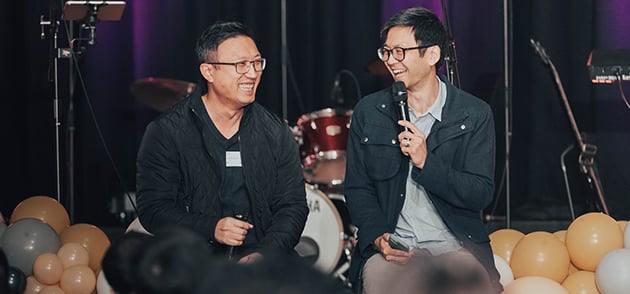
Chis Ekins is part of a team that planted Coast Evangelical Church (Coast EC).
- The challenges of ministry in regional, tourist town
- Success and hardships in planting in nearby regional centres
- Engaging young adults who want to move the city
- Working with other churches to plant more churches
- Strategies for planning for the future
SHOW NOTES:
If you are interested in planting in Kemsey, email us ([email protected]) and start with our Assessment Tool
CREDITS:
The Reach Australia Podcast is brought to you by Reach Australia.
For ideas or questions please email [email protected]
To support the Reach Australia Online Library head here.

Transcript
This transcript has been generated, and can contain errors. Please refer to the original recording for the definitive language used.
Read transcript
[0:00]
I like it. I like the hustle and bustle of brings. Many of the locals don't. They call them terrorists, not tourists. And yeah, a lot of people who are removed. That was the voice of Chris Eakens. You've clicked on the Reach Australia podcast and I'm Pete Hughes. I've been thinking about how are we going as a network in producing healthy, evangelistic and multiplying churches all over our country. Recently I had the opportunity to go and visit some of those churches. I had the great privilege
[0:30]
of heading two and a half hours north of Sydney to Foster. Now if you've never been to Foster, it's beautiful. It's one of the most beautiful towns on the Mid-North Coast of New South Wales. And it has everything. It's got surf, it's got rivers, it's got everything that you would want for a family holiday. What it doesn't have is big high rise, it doesn't have Hollywood stars. It's not a huge big town, but it is fantastic. In 2009, Chris Eakens headed north from Sydney permanently and planted coast evangelical church. He has been working there ever since trying to make the gospel known in Foster, but also beyond. However, Foster is a regional town. It comes with all the challenges that a regional town has. And so I sat down with Chris to talk about how is he going at creating a healthy, evangelistic and multiplying church.
[1:29]
Chris Eakens, welcome. How are you? Yeah, good. Welcome. Mate, Foster, it's a beautiful place. What makes Foster Foster? Mate, it is an absolutely gorgeous part of God's World on the Mid-North Coast of New South Wales. Makes it a popular holiday destination. There's a lot of nice beaches, beautiful coastline, good fishing, all that kind of gear, good restaurants.
[1:59]
And then that also makes it a popular retirement destination as well. So people basically tell their caravians are in Australia and then land in Foster and stay here. OK, but there are a lot of tourists that come through. Yeah, but tourist season. Yeah, a tourist season. Is a tourist a blessing or a curse? A blessing, mate. Yeah, we get the local economy obviously gets cranked along by that. The town would pretty much die in a bunch of ways without the tourist economy, but also it's good that brothers and sisters love in for church on their break.
[2:34]
I like it. I like the hustle and bustle it brings. Many of the locals don't. They call them terrorists, not tourists. And yeah, a lot of people who are who moved here for the kind of more chilled out life don't like those busy seasons, but I move from narrow bean and I kind of miss a bit of the hustle and bustle. So I like it. Because yeah, I can just imagine it be a curse as well. And you know, you're trying to run a church and you get all these people coming and they're using all your resources and going, you know, what man? I'm trying to run a church here, but I'm glad you see it as a blessing or a sense of honor. Well, sometimes we get clubbed like in Christmas, if a lot of our volunteers go away for holidays, and we end up with another 50 holiday makers at church, you know, that puts a strain on our kids, kids program on Sundays.
[3:16]
They're probably the guys that feel at most at kids team. Let's go back a bit. You planted here in 2009. What, why did you choose foster? I mean, okay, it's a beautiful place to live. Why did you choose foster or planted church? I'll be lying if I didn't say the fishing was good. You know, that was not it. But I've always loved the coast, always holidayed up the Mid-North Coast and visited churches while on holidays. And just noticed that in those churches, either there weren't many young families or young people present in the gatherings or what was being taught wasn't overly helpful.
[3:54]
So it's always been on my heart to, you know, check out the Mid-North Coast as a potential place to plant. I've had mates move up the coast and fall out of fellowship because I couldn't find a church to be part of, which kind of grieve me as well. And yeah, so it's kind of been on my heart for a while. So we started holiday and up here, kind of intentionally in places to scope out. So yeah, foster was kind of one of them. And Bukka was another cough was another, but we just landed in foster because we figured they'd be a good fit for our ministry experience and life experience. My wife had lived out in Wilkenia for a couple of years teaching.
[4:30]
And there's a large Aboriginal population here in town. So she's just experienced with that. She's a teacher. So that works fairly transportable. So yeah, we came to try and particularly try and connect with the young adult, young families of the town because there's plenty of churches here just not overly connecting well with that younger demographic. So what, what, tell us about how the church has gone over that period of time?
[5:00]
Oh, it's been a cool ride mate. See my God, God's done amongst our fellowship. So yeah, 2009 we planted. There's a small group of us. We all came from the same church at Narrowbeen, St. Fates. And how many were there? Like how many were in you to me? That was seven of us. Right. And my, my boy who was a couple of weeks old. So yeah, we basically just started as a group in the lounge and had a few others join us there. And then at Easter we just started renting the local school hall. And mate, we've just been ticking away since then. It's been really kind of slow, steady trickle of growth and conversions, which has been really exciting.
[5:38]
That's it. That is exciting. And you're still meeting in the same school as a location, the whole time. Yes, yes, same location. Okay, exciting. Now you wanted to come in and particularly go for young adults, younger people. How's that going? What are you doing at the moment? What are we doing at the moment for that? Well, we meet Sunday afternoons as we're now service time is a lot of young families. They support on Saturdays. Sunday morning is either very, that's the quiet morning for the family or they're involved in nippers or surf and or fishing or boating or whatever.
[6:12]
So Sunday afternoon is a bit of a, bit of a quiet time in our town, which gives us opportunity to connect with a fairly busy stage of life. Those guys. And our Sunday gathering is particularly geared to this, the 4pm service is particularly geared to young families. We've got a kids church program along with that. And then for the young adults and youth, we've got a 6pm service. So we just rebooted a couple of months ago, particularly geared to the youth and young adults who a lot of them serve at the 4pm service and then just kind of stick around for the 6pm service.
[6:47]
So tell us about the reboot. What, what, what did you feel like you needed to do to reboot that? Well, when we first launched, it was many years ago now. We would not, we would tend to close it down over winter. Because when all the, well, the holiday makers go home, there's like substantially less people in the gatherings. So doesn't feel as vibey. Winter doesn't feel very vibey in town. You know, there's just no much action going down. There's tumbleweeds rolling down Main Street. And as you know, dogs hailing the distance and all that kind of stuff. Now it's quite a quiet time of year.
[7:18]
So we tended to recombine our gatherings for winter, just to, and they maintain a bit of the vibe and feel of that, that Sunday gathering. And we'd kind of done that for many years, just reboot for day life savings, shut down for winter, we call winter first. But this year we decided we're just going to like keep it rolling and let it have its own kind of identity and be more targeted toward particularly youth and young adults.
[7:49]
Yeah. And also we think it's going to be a bit more sustainable now because over the last, I'm not sure how many years now, but one of the other pastors with us devs done a great job with a gap year program, particularly geared toward young adults, many young adults leave. You know, after school, they go off to get work or you go see the bright lights of the city. So there's a constant drain out of town of young adults. And so the ones we train up through through youth, they end up leaving, which is, that's really costly in a town like ours.
[8:22]
But the gap year programs helped, helped us maintain fellowship with those young guys, part of our leadership pipeline. And so now there's a bit of critical mass of young adults who've stayed in town who are equipped and they're keen. So we kind of well poised now to kind of have a gathering geared toward maturing them and reaching out to their, their peers. But that's taken a long, long time. Do they stick around after you've done the gap or do they still lose them to the bright lights of the city eventually?
[8:55]
50, 50. Yeah, some of them will get a taste for gospel ministry and a heart for the kids or youth in town. And then kind of pivot in their career directions, so maybe instead of going somewhere to go to uni, they'll do uni online or or port McCory where they can just go for a couple of days face to face, but still live in town. So that's actually stemmed the flow of a number of young adults. And it's really robust, young, young group, which is just beautiful to see.
[9:26]
Good. Now, you talked about some great, like there's been a trickle of conversions. I think that's the way you put it. What's been, give us one of those stories. Have you got a story? I got it. I got it. Yeah, a cool story. Actually, a recent one. Probably the most recent one was, yeah, Rowan and Lisa. They're both employed at the local school where we gather. But one of the ladies from church is a scripture teacher at the school. No teacher scripture. And their daughter, he's bad Jesus, got lots of questions.
[9:59]
Keen ends up at the kids club for our afternoon. And then gets excited about going there. It's got lots of questions. The parents get a bit interested in what's going on. And they end up coming to our life course, which is four nights at the local club. Put on an open bar, some food, present the gospel. And then another lady from church, they know did babysitting for them. Oh, right. And then from there, they rolled into a bit of a follow-up course, Christiana Explored.
[10:31]
And that was in February this year. Then they both, you know, Jesus grabbed hold of them. They made them his. And that was beautiful. Then we baptised them. And then after that, they've plugged into church, their regular church. Last Sunday, they had a couple of friends with them at church. So they invited a couple of friends to church now. And this week, coming up, we're starting a new Bolesody group at their house. They're going to host.
[11:01]
And we're trying to end up some other mature believers, but also a bunch of other people at church just checking things out or new to the faith. So, yeah, they've gone from being outside the kingdom to next week host and a gospel-shaped group, which is cool. That is awesome. That's an awesome story. Isn't that exciting to see? You see God out work in people's lives. And you go, yeah, that's that moment where it's all worth it, isn't it? Absolutely. And it's just a great encouragement to me to see the whole church body working together.
[11:32]
Yeah, scripture teachers, the kids, the club leaders, those who put on the evangelistic courses and you know, so that's been beautiful to see that. Yeah, that's awesome. Now, you're a church plant, but you also planted some churches or you talk us through what's happened there. Yeah, we've always wanted to plant. And so Foster's like a regional center with satellite suburbs. So we always wanted to work out how to plant into those suburbs. We took on a church plant or apprentice, Joel Hill, who's now pastor at NBC at Tari.
[12:04]
And he helped us plant a campus 20 minutes north at Halliday's point. And we've got a bunch of people who live up there, a couple of bowls of the group. So they formed the core of that. And that was intended to be a bit of a beachhead to get up to Tari, which is a further 20 minutes north. So we started that campus and that went pretty good. And the invitation to Joel was, we said, mate, raid the cupboard, you can take whoever you want to take with you to Tari. Ask whoever you want. No one's off limits. Just go for it. Okay, that's pretty brave.
[12:35]
Like you're saying, take whoever you want. Will you sure you wanted to do that? Yeah. That's a big cost. That's a big sacrifice for a church to go take whoever you want. But Tari was always going to be a hard plant. Tari is pretty tough. And so it was, yeah, I think the invitation to the generous invitation is what I was needed. We needed a hipster for people to get there to form a good strong core. And Joel did a great job of that.
[13:06]
He's a great guy. He's easy to like. He's easy to follow. And many people got excited about the mission and went, which is fantastic. Tari was able to start pretty strong. But the kind of the costless, the costless side of that was obviously people. So that's not just, you know, numbers. They love brother and sisters that we love that we've journeyed with. So the cost of relationship that comes with that is also the financial cost as people who were giving to support the ministries of the church.
[13:36]
Now, given the ministries of that, that church up at Tari. And there's also the staff cost too. We're closer to Joel for three years and to say, see you later, mate. To a brother. That's probably the one that hurt the most. A little Joel. And so, you know, having him start an independent church at Tari. So there's costs to it. But then the other cost to our ministries was the Halliday's point. Campus plant became unsustainable.
[14:06]
There's a lot of people left. We had to make the tough call to shut that down. And so then a few more people who were part of the remaining congregation left to get out to Tari. So more cost. And then the others came back down to foster. And so that was painful for a bunch of reasons. Those guys living locally and poured their selves into the campus plant. It's disappointing for a lot of them to have to shut it down. So how was Morale with the mother church, so to speak, in all of that? Because on one hand, they're bearing a lot of the costs for the plants.
[14:39]
One of them doesn't work. How are they feeling? What's their morale? It's kind of what's exciting to get to Tari. And it's discouraging to close down Halliday. So a mixed bag there. Yeah. Yeah, bit of a mixed bag, I suppose. Yeah, again, everyone felt the cost of friendships and finances and staffing and all that. But that's right when you give your mother doing a mother daughter plant, you give birth. You know, Labor is painful.
[15:09]
We hemorrhaged a bit afterwards. And I think what made it particularly challenging was after we closed it down, that's when COVID hit. So it was really fun to do the kind of the pastoral work, the reconnecting, having people re-gather was really tricky. So it's taken a few years to, for the dust to settle, I think on that. And for those people who were part of the launch team, for the campus plant, to find their way back into the fellowship and ministry with us.
[15:40]
So I think we found our mojo again recently. It's fun, are we? I feel like we've got a bit of momentum going now, but that's taken a long time to feel that way. I'm just so impressed that you've got a church that's looking to plant other churches. Things haven't, there's been costs, but people are still wanting to make sure that goes ahead. That's incredible. Yeah, thanks. Good. Relation, you've got some relationships with other FIEC churches in the area.
[16:13]
Tell us through that. Yeah, well, there were North Coast of New South Wales, some of some geographical, kind of distinct region. There's a bunch of churches in our network, the FIC. And so one of the things we're keen to explore is how to band together to do ministry well, like planting. So we want to plant other churches in the district, like Nambaka, or Google, or Campsi, or wherever it might be, some of these other larger regional centres.
[16:44]
And from our experience, we know that one church planting, another church is very costly. But if there's a better way, we can do it together. But we share the cost, where we share the training of the planter, where we share the financial cost and work together. So yeah, the passes get together and we're kind of kicking around a few plans. And the next one we're looking at most seriously is Campsi, plant-hate campsi. And with Port McCory, the point church, up to the point community church,
[17:14]
being like the base church, the mother church for that. So they're looking for either a church planter apprentice, or someone who's ready to plant, to plant from the exeggota crew from Campsi, travelling to Port McCory for church. So there's a small call ready to go. So is your biggest obstacle to that finding the planter? Absolutely. Yeah. Okay. The finances, you know, I'm pretty sure we'll be able to work that out together. But the critical piece will be the right man under God.
[17:44]
If you are a church planter and you're looking to plant a church and you want to get in contact with Chris, come and go through our website, registraray.com.au. And we'll make sure that you get in contact with him and make sure that that's all connected. Because we want to see more and more churches planted around our country. And that would be great to see this church, Campsi planted. Get him, Pete. Yeah, absolutely. And, um, uh, make what's the future plans for Coast DC? Okay. Well, yeah, we're still in a bit of a consolidating phase.
[18:15]
So we're keen to see our 6 p.m. service really get some traction. It's got a little bit of, um, bit of a vibe going on at the moment. It's really nice. So we look at the build on that. We're looking to grow our staff team, particularly looking to find someone to head up our kids and youth ministry. It's a great need for that. And, um, yeah, we've been advertising for a few years really. And just can't really find a suitable person for that. Right. It's pretty hard to staff a new position in a small original town because, um, the staff position might naturally start as a part time thing.
[18:48]
But it's hard to get someone to move here for part time work. So you've got a stretch to be, um, full time. And then so that's just tricky to juggle that. So if you know any good kids youth pastor types who want to give us a call, maybe just give them a number. I'll be happy to chat. Sure. Absolutely. Yeah. And I'm sure there'll be, look, I am sure that there's somebody out there who's gone, you know, I don't want to live in Sydney anymore. I don't have to anymore because now we're doing this work from home thing. So I can work somewhere else and somebody else in my family can be involved with it.
[19:20]
Do the kids a new thing. So I reckon there's a possibility there. We'll pray that that'll happen. But, uh, yeah. Yeah. No, that'd be exciting. Thank you. Yeah. A big thing on the radar is a building. Right. So we own a block of land next to the school where we gather, which is great that that land was gifted to us by a friend, very generous, uh, gift. And, um, so now we're trying to work out a build on it. Right. So that's, that's been a long process to make the whole building thing. Yeah. I never thought I was signing up for that when I planted a church. I don't think anyone does.
[19:50]
I think everyone, you know, it builds is going, um, what was I thinking? But you need some buildings that are actually really helpful. They're great places. It's going to be a great tool. And we get to go on. So the big, the big thing there really is going to be trying to work out how to, um, finance, finance that, uh, Foster's, you know, fairly low socioeconomic part of that part of the country. And, um, buildings, buildings have just got a whole lot more expensive over the last few years. Building costs have gone up 30, 30%. They tell me, um, in some, in some respects, 50% on some of the, um,
[20:21]
stuff like steel and it's like, it just seems to be getting further out of reach. So I kind of lose a lot of sleep over that. I don't really know how to tackle it, to be honest with you. Right. But Foster's, you're right. It's a regional kind of area, isn't it? Is the socioeconomic, uh, status of people? Is that the, is that a big thing? Is that the, how much is that shape the town? Yeah, it's, it's a massive challenge. So because the, um, holiday season is so strong here, that means work for a lot of people is very seasonal.
[20:52]
So a lot of the shops have to try and make pretty much their whole years worth of money over the summer break. Right. And that doesn't go well. That doesn't go well for them. So economically, this, you know, this challenge is in town for, um, under employment and seasonal work like that. Um, so a lot of people end up leaving town to pursue, you know, better-paid jobs, secure jobs, all that kind of stuff. Do you, do you have workers who come in for that tourist service? So that tourist season and the leave with the tourists as well? Um, not really.
[21:22]
Not really. Not really. Okay. No, but, um, the, the housing costs have gone up a lot too. So a lot of the locals are getting priced out of the market. Rentals are hard to find. Um, so they put some more pressure on, on cost of living for people, which is the cost of accommodation. And, um, yeah, so, um, with the drain of, um, professionals out of town too, like, um, people who want to go to union, work in a professional industry, there's not really that industry here.
[21:52]
So there's also a leadership drain out of church, people who with, um, you know, a lot of competence lead town. So that makes, um, there's some other challenges that come with that, like, um, raising up enough lead, people with leadership gifts and skills for ministries. Cause, um, as I say, now we'll up and go, it gets up and goes. So, um, yeah, there's a bit of that. But we do have a very diverse, um, mix in a church. There are doctors, there are solicitors, there are teachers, there's medical professionals.
[22:24]
So your medical professionals, teachers, hospitality and retail, probably the biggest industries we got. Okay. So you've got the, the building project underway. Got to find a kids and youth pass. Anything else for the future for you guys? Um, just so we can work out how to work together with those other FIC churches to do, um, good ministry together in our region.
[22:54]
So that might be combining training of our, um, get the guys, our MTSs, working out how to do some of that stuff, better together rather than all just trying to work it out by ourselves. So yeah, that's something I'm going to give myself to have the next few years. Um, it's been great chatting to you. Let me pray for you. Thanks. Uh, because we believe God is at work and we want to, um, honour him by, uh, by pray. Father, I want to thank you for the work of KCC. Thank you for the great things that you've done over the last,
[23:25]
well, since it was planted in 2009. We thank you for people like Rowan and Lisa who have turned to you and in our serving you. Um, we, we pray for the church plant in Kempsey and pray that you will raise up a church planter. Um, we pray that you will raise up a kids and youth minister for this church as well. And, um, for the building, again, we pray that you'll give Chris and the staff wisdom. Uh, we pray that they'll be able to, uh, build that building efficiently and effectively.
[23:57]
And Father, we just thank you so much for this church. We pray that you'll continue to work through it to see lots and lots of people in the foster Tunkari area come to know you, to love you and to serve you. And we thank you for all of this in Jesus name. Amen. Amen. I hope you were encouraged by that conversation with Chris. Uh, if you would like to know a bit more about the gap program, maybe you want to actually spend some time in a beautiful part of the world
[24:28]
and learning more about ministry, we'll put that link in the show notes. Uh, Chris is still looking for a church planter, if a kimchi, and also a kids worker. So if you would like to be involved in either of those projects, we'll make sure that you're getting contact with Chris. Um, it is a great opportunity, uh, to take the gospel to other parts of the world. It just happens. This is a very beautiful part of the world. But if you are ever traveling through foster, make sure you spend some time and encourage Chris and his team.
[24:58]
Uh, it's a great, great ministry. And we want to see it grow and thrive. Next week, we're going to be talking to Stu Plastead from Southern Cross Pass Paturian Church in Lismore. Lismore has been a city that has been devastated by some dreadful floods. And we're going to be talking about the effects of the floods that have had on ministry. And some of the other things that have been going on in the meantime, I'm Pete Hughes. Chatsoon.
[25:30]
I'm going to be talking to you. I'm going to be talking to you. I'm going to be talking to you. I'm going to be talking to you. I'm going to be talking to you. I'm going to be talking to you. I'm going to be talking to you. I'm going to be talking to you. I'm going to be talking to you. I'm going to be talking to you. I'm going to be talking to you. I'm going to be talking to you. I'm going to be talking to you. I'm going to be talking to you.