
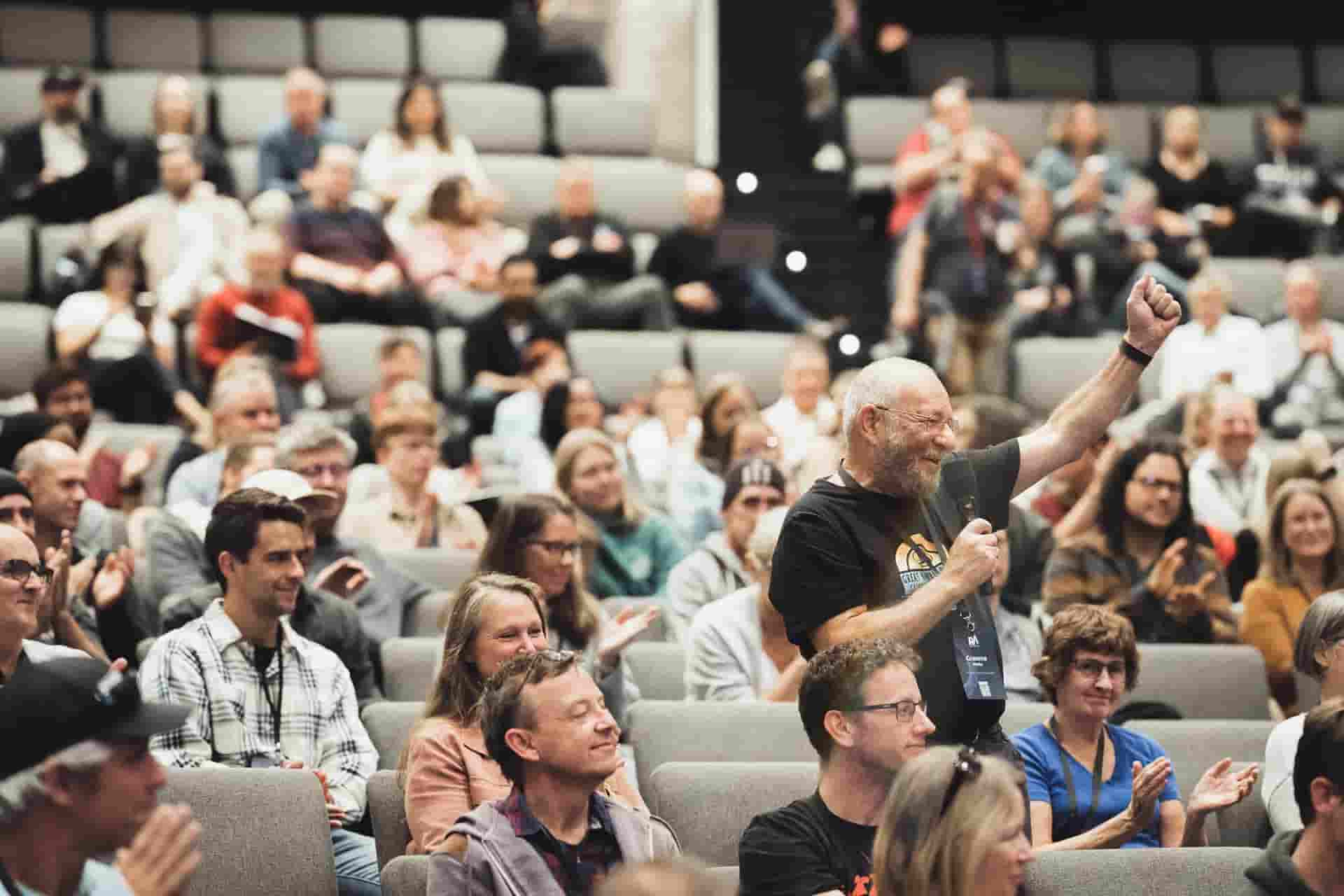
Gary Millar preaches on Isaiah 6 at the 2021 Reach Australia conference. Registrations are now open for the 2022 Reach Australia conference, held at EV Church on the NSW Central Coast, from 17th to the 20th May 2022. Get your discounted earlybird ticket at reachaustralia.com.au

Transcript
This transcript has been generated, and can contain errors. Please refer to the original recording for the definitive language used.
Read transcript
[0:01]
G'day, I'm Scott Sanders and welcome to the Reach Australia podcast. The vision of Reach Australia is to see thousands of healthy evangelistic multiplying churches. We want to see new churches launch and start and not only survive but see evangelistic growth. We also want to see established churches become healthy, seeing lost people won for the first time and also seeing people spiritually mature and grow. great initiatives that we've started over the last few years is the Reach Australia Development
[0:34]
Program. We want to see theologically driven, spiritually vibrant, evangelistically urgent, practically skilled church leaders and this two-year program is all about seeing all those outcomes. The program includes a comprehensive church consultation, monthly gospel coaching and three leadership development intensives. To register your interest go to reachaustralia.com.au This episode is a recording from the 2021 Reach Australia National Conference.
[1:14]
Pursue peace with everyone and pursue holiness, for without it no one will see the Lord. The words of Hebrews 12 don't hold back in telling us just how important deeper holiness is. we're supposed to pursue it or we won't see God and enjoy Him forever. It's pretty blunt, isn't it? And it means that talking about deeper holiness takes us right to the core of what it means to be a faithful follower of the Lord Jesus Christ, to do what God asks of us as His servants
[1:49]
and His children. Nothing matters more than this, for our future life with God somehow depends on it. So, why don't we talk more about deeper holiness? Now, I could be wrong, and please forgive me if this isn't true of you or your church, but I don't think holiness has been very high on our agenda over the past few years. I'm not saying that we don't care about it or don't believe in it. I just think we haven't been talking about it very much. I suspect that, as we've emphasized,
[2:22]
to other things, we've dropped the ball when it comes to holiness. Could that be an issue in your church, on your team, in your relationship with the Lord Jesus? If it is, how do you think this could have happened? I think there could be a whole bunch of reasons. For example, we rightly think it's really important to steer well clear of legalism. We don't want to lay a burden of rules on people. We want to make sure that people get the fact that we're free in Christ.
[2:56]
And sometimes when we talk about holiness, it does start to sound as if we're just telling people to clean up their lives, and we don't want to do that. Or it could be we want to encourage people to make sure they find their security by looking outward to the Lord Jesus rather than inward to the way in which they feel. Sometimes we can be afraid of talking about holiness because We don't want to encourage people to be introspective. Then there's the fact that in recent years, most of us have become more aware that lots of the New Testament texts that speak
[3:29]
about holiness are actually talking about the fact that we're already holy in Christ, positionally holy, if you like. So, we stick to those parts of the Bible and tend to ignore the others where it tells us that we're supposed to grow in holiness. All those things may be factors in our dropping the ball. But for some of us, at least, I suspect the reasons may actually go a little deeper. If we're honest, it may be that speaking about holiness makes us feel like frauds.
[4:05]
There's a sense in which all of us can only speak about the things that we really know, so we quietly avoid speaking about holiness because we don't think we know much about it. To be honest, it's hard not to feel like a fraud when explaining that our God says, be holy for I am holy. Who can live up to that one so instinctively we veer away from it? It may be we've just put speaking about holiness in the too hard basket.
[4:36]
We're all for it. We think it's good. We're just not really sure how to aim for it or how to nurture it. So, we focus on just explaining the text in front of us rather than trying to apply it in a way that confronts people and moves us towards repentance and faith, towards change and holiness. If we're honest, for many of us, it's much easier to focus on important things like strategy and philosophy of ministry and pipelines and pathways and ecosystems,
[5:09]
things that at least we can try to fix than to speak about and aim for the holiness without which none of us will see the Lord. But whether we've silently avoided talking about holiness because we feel like hypocrites or because we've opted to focus on something more achievable, the challenge is clear. God commands us and urges us to pursue deeper holiness. Well, let's press it a little further. What actually is it? I think the best place to start is with that simplest of refrains we bump into repeatedly
[5:43]
in Leviticus. Be holy for I am holy. To be holy is to be like God in every way that finite human beings like us can be. It's to be godly. Or to put an even sharper focus on this side of the cross, us. For us, it is to be like the Lord Jesus in His perfect humanity. Deeper holiness is basically deeper likeness to Christ. This is what we should pursue. Why should we pursue it?
[6:16]
Because the holy God tells us to. Because unless we pursue holiness, we won't see Him. Because unless we pursue holiness, we won't become more like Him. Because if we're not like we won't or can't be effective ambassadors for the gospel. Ultimately, if we're not holy, then we won't love people as God loves them. We won't be passionate about our mission as God is
[6:49]
passionate, and we won't actually be willing to do what it takes to reach our nation. See, to be holy is to be like the God who seeks people like us out and sends people like us out. But more of that later. For now, we need to turn to the most pressing question. If pursuing deeper holiness is pursuing Christlikeness, if there is so much riding on this,
[7:19]
where do we get it? How do we pursue it, to use the language of Hebrews? Well, this afternoon, our aim and the time we have is simply to answer that question. Where do we get this deeper holiness? How do we pursue this holiness without which no one will see the Lord? And to help us in that, we're going to turn to Isaiah 6. In the first five chapters of Isaiah, the prophet provides us with a series of snippets of his preaching over the early years of his ministry as he reels against ungodliness, warns God's people of searing judgment, and paints
[7:53]
vivid pictures of God's soaring salvation. Isaiah 1 to 5 are a disconcerting, fast-moving blast of God acting for His glory in both salvation and judgment. And then suddenly, Isaiah hits pause. What has shaped his preaching and his vision of God? What drives him? He says, come with me to Jerusalem in the year 740. I'll tell you about what happened then, and you'll understand.
[8:27]
Now, of course, Isaiah's experience, as he recounts it in this chapter, is, well, it's Isaiah's experience. None of us has ever been in Solomon's temple or ever will be. None of our words are co-authored by God and will be written down for the good of God's people across the centuries. But there is another sense in which this prophet who lived almost 3,000 years ago was just one of us. This is what it's like when a human being encounters the one and only God. This one-off
[8:59]
experience provides a template which is reflected over and over again through the Bible. But we can say more than that because Isaiah is one who is appointed to speak God's Word. And his experience resonance for those of us who've been set apart by God's people to pour ourselves into word ministry this side of the cross. But ultimately, what happened that day in Jerusalem is a message for
[9:32]
all of us who, in the power of God's Spirit, are enabled and called to speak the gospel. In Isaiah's unique experience, we see how God works to lead people like us into deeper holiness. What does it take? Well, deeper holiness starts with gazing at the God of holiness. You'll see that in these first four verses. Look with me again. In the year that King Uzziah died,
[10:02]
I saw the Lord seated on a high and lofty throne, and the hem of his robe filled the temple. Seraphim were standing above him. They each had six wings. With two, they covered their faces. With two, they covered their feet. With two, they flew. And they called to one another, Holy, holy, holy is the Lord of armies. His glory filleth the whole earth. The foundations of the doorway shook at the sound of their voices, and the temple was filled with smoke. look, let's not allow familiarity with these words obscure or even take the edge of this
[10:35]
stunning and overwhelming experience which is described. King Uzziah, or Azariah, as he's called in 2 Kings 15, was a typical king of Judah. He was kind of godly, but he didn't match up to either David, his ancestor, or the model of a good king that God had given Moses back in Deuteronomy 17. From a divine point of view, he was just okay. Humanly speaking, he had a really long and successful reign, 52 years. It was a golden age for Judah. But his reign was tinged with sadness
[11:07]
for he was a leper. In his case, his illness had a very specific cause. Kings explicitly says that God had afflicted him for some undisclosed sin issue. We'll come back to that in a moment. But the important thing at this stage is to recognize that for Isaiah, everything had just changed. Isaiah, it seems, was a prophet who had a full royal scholarship. Isaiah had set up some kind of prophetic MTS, and Isaiah seems to have been a relatively happy apprentice until the king
[11:43]
passed away. That's when it happens. He's at the temple minding his own business when he saw Lord. I'm actually struggling to think of a more arresting statement in the Old Testament. There he was just doing his thing, and he saw God. For God's old covenant people, it doesn't get any more shocking, any more incredible than this.
[12:16]
Isaiah glimpsed the God of the universe. Now, it's true that as John says in the prologue of his gospel that no one has ever seen God, as in gazed with unprotected eyes on God in all his splendor, but it doesn't mean that no one's ever got a sneaky peek, and Isaiah is one of these guys. eyes. He glimpses the Holy One of Israel. So, what does he see? Now, basically, he sees the God of all creation sitting on a huge throne. Now, the problem is that he sees it from close up.
[12:53]
I've got a bit of a thing about tall buildings. So, you know, over the years, back in the day when it was possible to leave Australia, anywhere I find myself, if there's a tall building in the it. So, the Sears Tower in Chicago, the Rockefeller Center, the Empire State, the Eiffel Tower in Paris, even Centrepoint Tower in Sydney, a giant photo frame, strange thing with a glass floor in
[13:23]
Dubai, and then the Burj Khalifa. Now, the Burj just blows the rest of them out of the water. It's twice the size of the Empire State Building and three times the size of the Eiffel Tower. But all those buildings have got one thing in common. Standing at the bottom, it's very hard to get a sense of how impressive they are, other than the fact they're tall and my neck is sore. Now, that's what Isaiah's vision is like. He's at the base of the throne,
[14:00]
and he knows that God is up there sitting on it and that he can see the throne and presumably, by extension, God are massive, but that's about it. All he can see is that it's really big. Oh, and that's the hem of God's robe, and even the hem is overwhelming the temple. Robes in the ancient world didn't tend to have long flowing trains. I'm guessing the floors just
[14:33]
weren't clean enough for that. But the point is that just the hem, the little sewn bit around the very edge of God's garment completely overwhelmed the temple. The sheer scale of this vision overwhelms description. But that's only the start, because the other thing that Isaiah sees is a pair of seraphim, literally burning ones. On either side of God above him are flying,
[15:04]
flaming attendants who've got all these flaming wings. Isaiah does his best to describe what these things look like, but to be honest, he's fighting a losing battle. Even God's flunkies are mind-blowingly impressive. It's also worth adding, remember, these heavenly creatures are enormous. If the hem of the robe is enormous and the throne is bigger, then it's highly unlikely that the seraphim are kind
[15:34]
flaming mosquitoes buzzing around the Lord of armies. Even the attendants are utterly overwhelming as befits the God of all power and glory. Gazing at this was life-changingly, overwhelmingly huge. Eighty months ago, we took a QTC study tour to Jerusalem and braved the cues into fairly hostile security to make the most of the one hour each day that non-Muslims are
[16:04]
allowed onto the Temple Mount. Well, probably not this week, but up until a couple of weeks ago. As we walked around the Dome of the Rock, we tried to get a glimpse inside. I knew from visiting years ago, there's a very large rock in there, which is purported to be the very spot that Abraham prepared to sacrifice Isaac. But some friendly men with automatic weapons made sure that none of us even got a glimpse of it this time. There is no way that unholy people like us
[16:34]
were even getting a glimpse of what's at the heart of the temple mount, which actually must have been pretty like Isaiah's normal experience. Pretty much every day, I guess, he wandered around the temple precinct, knowing that at its heart, inside the Holy of Holies sat a golden box flanked by two fairly small angelic creatures called cherubim who had two wings. Often they called this box the throne of God. Now, if Isaiah had an inquisitive bone in his body,
[17:06]
he must have wondered exactly what this symbol of God's throne looked like, even longed to see the holy box. But now God in his mercy gives him not a glimpse through the the most holy place off from people like him. He gets a glimpse of the real thing. A little look at God's throne and God himself, although even the hem of his robe is almost too
[17:37]
much to take in. After that, I recognize I looked at the temple a little differently. You know, it's like a Lego version of the Grand Canyon or Uluru. A good effort, out of tiny plastic bricks. Isaiah gets to see the real thing. And he's only getting started because this vision came with Dolby Atmos sound. Having tried to describe the visual impact, in verse 3, Isaiah turns to the soundtrack. One call to another, holy, holy, holy is the
[18:12]
Lord of armies. His glory fills the whole earth. I can only guess how loud that must have been. but volume's not really Isaiah's issue. It's the content. These creatures have invented a super superlative to try to convey just how breathtakingly pure and majestic God is. He's super, super holy, they keep shouting, so utterly holy that the earth isn't even close to being able to contain the outflow of His beauty and splendor. From this moment on,
[18:46]
And Isaiah tends to refer to God as simply the Holy One of Israel, which is perfectly understandable. And as all this is going on, the ground where Isaiah was standing, or probably by this stage, lying face down with his fingers in his ears, quaking, shook. And the temple was filled with smoke. Could be sweet-smelling incense smoke, singed beard kind of smoke, or seraphim odorless smoke.
[19:16]
was surrounded by it. It was a truly immersive experience. And for Isaiah, this is where it all began. This is the beginning of deeper holiness. I hope you can get some sense of just how earth shattering this was for Isaiah. It blew his mind. This is a foretaste of the fulfillment of everything. God created us to know and revel in and bring glory to Him. The entire course of human
[19:48]
history is shaped by God's commitment to make this entire cosmos a place where He is the blazing center of all things and where He is known by the people that He has made and rescued and reshaped. We are made to know this God and enjoy Him forever. and that day in the Jerusalem temple, Isaiah got that. Gradually from this point on, God would start to show him how this might come to reality,
[20:19]
that people like us might know this God as the anointed servant of the Lord would show up and suffer and die and win and rule and straighten all things out. and we have seen that so much more clearly in the coming of the Lord Jesus who comes that we might have life to the full, real life in God and with God that starts now and goes on forever. See, this is why the gospel makes us gasp.
[20:55]
John Piper in his marvelous book, God is the gospel, puts it like this. The ultimate good of the gospel is seeing and savoring the beauty and value of God. God's wrath and sin obstruct that vision and that pleasure. You can't see and savor God as supremely satisfying while you're full of rebellion against Him, and He is full of wrath against you. The removal of this wrath and this rebellion is what the gospel is for. The ultimate aim of the
[21:28]
gospel is the display of God's glory and the removal of every obstacle to our seeing it and savoring it as our highest treasure. Behold your God, Piper says, is the most gracious command and the best gift of the gospel. The gospel is about removing every obstacle for us so that we can gasp at the God of all holiness. This is where it starts. This is the foundation,
[21:59]
gazing at this God. Remember, what Isaiah saw was utterly amazing, but even the least in the kingdom of heaven have seen more than this. Hear these well-known words from the Apostle John. And the word became flesh and dwelt among us. And we have seen his glory, glorious of the only
[22:29]
Son from the Father, full of grace and truth. No one has ever seen God, the only God, who is at the Father's side, has made Him known. God has revealed Himself to us in the Lord Jesus, whose goodness and power and purity we taste and see in the gospel in a way that leaves even what Isaiah experienced here in Jerusalem far behind.
[23:01]
It's in seeing and savoring the Lord Jesus Himself that deeper holiness begins. If we don't feel something of this when we get out of bed in the morning, if we're not gripped by this, if we don't manage to convey to people that this is the God who's revealed Himself to us in the Lord Jesus, then we're missing out ourselves and selling others short. It may be that for us, the next step to deeper holiness is simply by being confronted
[23:34]
again ourselves, or for the first time, by the holiness of God in His blazing purity and overwhelming attractiveness. And shouldn't we know and see something of this every time we open every time we show up on Sundays to hear the gospel explained or explain it to others, a growth group, at school, in our eye classes, every time we open the Bible to read it with
[24:06]
someone who's not yet a Christian. We believe that our God, the Holy One of Israel, reveals Himself to us through His Word to make us gasp as we glimpse Him and to launch us on a lifelong trajectory of pursuing holiness as we pursue Him. This is where we must begin. As we sit and listen across Australia this afternoon, can we honestly say that that's
[24:36]
where we're at. Is there a resonant note of awe at our God in our lives, in our conversations about the Lord Jesus, in our gatherings? You know, over the past 30 years, I think we've done a really good job at stripping away all kinds of obstacles to communicating the gospel to people. Now, our seating and our lighting and our language and our dress sense and our air conditioning and
[25:06]
make it easy for people to join us. Let's not lose sight of the fact that the goal of all this is that people like us, people including us, might marvel and gasp at the God of the gospel, Father, Son, and Spirit, the holy, holy, holy God, and be utterly amazed by His beauty and tenderness and purity, which leads us inexorably to the second thing, which if anything is even more unnerving. Because when we gasp at the God of holiness, it makes us face our own unholiness.
[25:45]
Facing our own unholiness is never much fun. I've been reading Paul Tripp's latest book, it's simply called Lead, and at one point, Paul helpfully provides a 49-point list describing a leader whose life is in gospel balance. His leadership is shaped by faith, not fear. She leads out of humility and neediness, not pride and self-reliance. He's uncomfortable with the dichotomy between his public ministry persona and his private conduct.
[26:18]
That's just three, 46 to go, and I was feeling undone already. But if we're to be more holy, this is what we need. If we are to live with and for this God, we need to be undone, ruined. Verse 5, I said to me, woe to me, for I'm ruined. It's hard to capture the word in English. Ruined's pretty good. Undone's not bad.
[26:50]
Gobsmacked's kind of in the ballpark. But it's actually more serious than that. overwhelmed and exposed that he's just got nothing, nothing to say. I heard Harvey Weinstein interviewed a while ago briefly on his way to a rehab clinic. In the clip that I heard this incredibly powerful man sounded bewildered, confused, and defeated. Eventually, he just muttered, I have real problems. I'm counting on the fact that everybody deserves a second chance.
[27:28]
As the procession of women that he'd abused over the years grew, he realized the game was up. Can't even remember the extent of his mistreatment of women, so he has shut up and stopped protesting. Confounded, undone, ruined. But Isaiah is taken there instantly by this vision of God. I do think it's worth pausing there just for a second to ask if we actually think of ourselves
[27:58]
A couple of weeks ago, we were in College Chapel, and we were singing, O Lord, my rock and my redeemer. I actually found myself balking at the line which says, gracious Savior of my ruined life. My mind started protesting. My life isn't ruined. At the moment, it's actually holding together quite well. Then I realized what I was doing, protesting at the core truth, which is a prerequisite to deeper holiness.
[28:35]
At that moment, I was denying a reality which I've already accepted, that I seek to build my life on. But in the moment, I didn't believe it. I know that you know that we're still unholy. I know that we all know that we're nothing more than forgiven sinners. I'm sure we could all loudly affirm that we'll never be more than unprofitable servants.
[29:07]
But the question we have to keep on asking ourselves is, are we actually living out of this truth? Did we get out of bed this morning with a profound sense of gratitude to the one who gracious Savior of our ruined lives. As human beings, we have a staggering ability to bounce back, to recover our equilibrium. We'll think a bit more about this tomorrow as we look at deeper hope. We have an innate ability to recover our pride, even when there's nothing to be proud of,
[29:41]
to forget that we're deeply unholy, to forget the need to live as those who have been undone, who ultimately have nothing, those whose personalities and plans and abilities and gifts can finally achieve nothing lasting because we are sinful people who have been confronted by an irresistibly, irreducibly holy God. This is the unavoidable, undeniable, unpalatable truth. But this is where we must stand and serve.
[30:16]
But actually, Isaiah's point is a little more specific than that. He doesn't just say he's ruined because he's sinful. He says it's because he's a man of unclean lips who lives among a people of unclean lips, and because his eyes have seen the king, the Lord of armies. Isaiah says he has a problem with his lips. Apparently, as a race, we have an issue with our lips too. So, what on earth does that mean? Now, I've always thought this was just a poetic way of talking about our speech. You know, we all say stupid and sinful stuff, and that's true,
[30:49]
but I don't think that's what this text's about. There's only one place in the Bible where unclean and lips appear in the same context. It's in Leviticus 13, verse 45. The leprous person who has the disease shall wear torn clothes and let the hair of his head hang loose, and he shall cover his upper lip and cry out, unclean, unclean. He shall remain unclean as long as he has the disease. He's unclean. He shall live alone. His dwelling shall be outside the camp.
[31:23]
This is the year that King Uzziah, the leper, died. Isaiah says he has now seen the king, Yahweh of hosts. What is God impressing on Isaiah? Not just that we all say wrong things, but that like Isaiah the leper king, who had to cover his lips every time he spoke because of his leprosy as a dramatic marker of his disobedience, we're all unclean because of the sin problem.
[31:57]
When we see ourselves, when we're confronted by the searing moral purity armies, we have to shut up. The only thing we have to do is say unclean, to stand there and kind of gulp like Shaggy and Scooby-Doo used to in every single episode when they were confronted by the ghost slash monster strike slash axe-wielding murderer for the first time. But the problem here is there will be no relief from this fear because the
[32:29]
person we stand before won't turn out to be the grumpy janitor. The fact that fear will go through the roof as it dawns on us that we are utterly exposed before the flawless maker of all things. Being undone is the realization that we are unholy people standing before a holy God. And Isaiah's response? Ruin. I'm a prophet with nothing to say. A messenger with no message.
[33:01]
No gospel to announce. And this is the place we need to return to again and again if we're to know deeper holiness. It was J.C. Ryle in his classic book Holiness who once famously wrote, a right knowledge of sin is at the root of all saving Christianity. And Ryle was right. There's no point talking about deeper holiness unless we're willing to face the fact that we're sinful to the core, that we have nothing to say until we speak and lead from a place
[33:35]
where we speak and lead as those who have been undone, ruined. isn't this exactly what Jesus said over and over again if we want to live we need to die it's only an abject weakness that we find strength if we want deeper holiness we need a deeper appreciation of our sin that's at the heart of what happens next then verse 6 one of the seraphim flew to me in his
[34:10]
coal that he'd taken from the altar with tongs. So, one of these giant flaming heavenly creatures takes a burning coal, which in the Old Testament always symbolizes judgment and holiness, and approaches Isaiah. It seems that somewhere in the periphery of Isaiah's vision, he also sees an altar of which there were several in the temple, the mini earthly version of God's throne room. What does the creature do? He takes them in a pair of tongs. Now, that's interesting.
[34:41]
I would have thought that a flaming creature would have been able to pick up hot objects in his fingers. Although he may not have had fingers. So, I don't really know why he used the tongs, but he did. And he touched my mouth with it, Isaiah writes, and said, Now that this has touched your lips, your iniquity is removed and your sin is atoned for. the action of this flaming one is so simple and yet so effective what promises to be an excruciatingly painful part of isaiah's vision turns out simply to bring relief
[35:15]
as god finds a way to deal with his inner twistedness and guilt god deals almost effortlessly here with isaiah's unholiness sin is burned away and the prophet now forgiven is freed to speak. The closest the New Testament comes to this kind of language is at the end of Hebrews 12. Therefore, as we're receiving a kingdom which cannot be shaken, let us be thankful by it.
[35:46]
I think that's by the fact that we are given this role by grace. We may serve God acceptably with reverence and awe for our God is a consuming fire. In other words, we are to serve and speak as forgiven sinners, as those whose holiness has been exposed but has been dealt with as we have encountered and are gripped by and stand in awe of our God who is a consuming fire. Many of us are teachers. All of us are committed to the
[36:25]
ministry of the gospel, we must do what we do as forgiven sinners. There is no other biblical stance. There is no other way that we can represent or present a holy God. There is no other way to deeper holiness. This is not rocket science. It's pretty obvious. But this simple truth will invest our teaching with humility and seriousness. Sitting with this reality should be enough to remind us
[36:59]
that what we are doing could not be more serious or more urgent and should lead us in our weakness to throw ourselves into knowing and sharing the message that has been entrusted to us, even as it pushes us into a deeper awareness of the fact that our God tells us to be holy, for He is holy, and that He has done everything it takes to enable us to share in this holiness
[37:31]
without which none of us shall see the Lord. Deeper holiness for us then involves gazing at the God of all holiness and facing our own unholiness. It's a life in which our vision of God is constantly expanding as we pursue this God, and a life in which our view of ourselves is always diminishing, or if we're honest, re-diminishing, as our pride continues to stick its head out of the ashes to be exposed for the joke it is yet again.
[38:04]
The way of deeper holiness is a life of a growing vision of our God and repeated repentance and faith as we kill off sin before it kills us, to paraphrase John Owen. We gaze at God's holiness, we face our own unholiness, and then verses 8 to 13, deeper holiness leads us to a willingness to suffer for the gospel. After he encounters the utterly holy God and faces his own unholiness,
[38:34]
Isaiah's vision takes another unexpected turn because his path to deeper holiness doesn't take him on a tortuous inner journey. It takes him out of himself to speak for and suffer for the God of all holiness. Shouldn't really come as a surprise. If deeper holiness means deeper Christ-likeness, it shouldn't really be a shock that it means getting ready to suffer as we get the message of the gospel out to our world. Now, for the first time in verse 8, God Himself speaks from the throne. God asks a question. I think that's fascinating in and of
[39:08]
itself. The Lord of all glory, the King of the universe speaks. What does He do? How condescending is this? He asks a question. God doesn't actually force us to do anything. Even though our wills are shot through with sin, even though we blew our real freedom at the fall, somehow God finds a way to work in us, which doesn't simply overwhelm our personality and decisions. I heard the voice of the Lord asking, who should I send? Who will go for us? Is anyone prepared to be a spokesperson
[39:44]
for this awesome king? And Isaiah pipes up, squeaks probably. Here I am, send me. It's an incredible moment. The throne of God is looming over us in all his splendor. Flaming beings are flying around with the burning forgiveness of God in their hands. The voices of these flaming ones are booming out, holy, holy, holy. The prophet has faced his utter moral
[40:17]
bankruptcy and inadequacy. God's voice thunders from the throne. Who will go to represent the Godhead, Father, Son, and Spirit. And Isaiah goes, me. Sorry to break it to you, but that's the contribution we make to the work of our God. We add our squeaks to the powerful voice of our God
[40:47]
and King. That in itself is a gentle or perhaps not so gentle rebuke to all our pretensions and self-delusions and kingdom building. All our efforts, all our schemes, all our words are ultimately just a little squeak. But we go on behalf of the Lord of glory. The honor and the power and the kingdom belong to Him. We speak on His behalf. We're simply ambassadors.
[41:17]
It is an immense privilege for any of us to be part of this, to go for Him. Calvin says, this remarkable instance of obedience ought to produce such an effect on our minds that we shall readily and cheerfully undertake any task which He may be pleased to give us, and shall never refuse any task, however difficult we may imagine it to be. See, this is part of what it means to be more holy, more aware of God's greatness, more acutely aware of our sin, and
[41:48]
readier than ever to speak as God's purifying work in our lives propels us out in mission. What are we to say? God said, go, say to these people, keep listening but don't understand. Keep listening but don't perceive. Make the minds of these people dull, deafen their ears and blind they might see with their eyes and hear with their ears, understand with their minds, turn back and be healed. They're the words picked up, obviously, by Jesus in the parable of the sower. The shape
[42:25]
of gospel ministry always has and always will be a matter of proclaiming the truth of who God is and what he has done and watching as he works in both salvation and judgment, bringing some to life all before our watching eyes. And while these words are given to Isaiah in the context of a crisis with Assyria, the fact that Jesus picks them up
[42:56]
and uses them of His ministry does set an expectation for us. See, this is the greatest joy and perhaps the sobering reality of being involved in this ministry. deeper holiness will lead us to speak more but as we speak more we will also suffer more both internally and externally part of the suffering will be because of the response of those who reject both the message and the messenger but part of the suffering will simply be the result
[43:29]
of deeper holiness deeper christ-likeness it will be a pale reflection of the suffering of said, Jerusalem, Jerusalem, who kills the prophets and stones those who are sent to her. How often I wanted to gather your children together as a hen gathers her chicks under her wings, but you were not willing. Is that where we are? Sent in an increasingly tender-hearted ministry, which grieves for those who don't respond and longs to see people brought to new
[44:03]
life in Christ? Until when, Isaiah says, until judgment has come through and is finished, until only the stump remains, until the day of the Lord Jesus arrives, when people like us are equipped and called and sent to take this message to our world.
[44:35]
this afternoon, what do we need most as we pause to recalibrate, refocus, be re-energized? Is it to gaze again at the transcendent power and holiness of our God? Is it to face ourselves? Or is it simply to commit ourselves again to going, speaking and suffering for the Lord Jesus as we take the gospel to this nation and beyond.
[45:07]
Whichever it is, hear these words of Peter as we close. Therefore, with your minds ready for action, be sober-minded and set your hope completely on the grace to be brought to you at the revelation of Jesus. As the one who has called you is holy, you also are to be holy in all your conduct. For it is written, be holy, for I am holy. Amen.
[45:41]
You've been listening to the Reach Australia podcast. All through September and October, we'll be releasing the talks from the 2021 Reach Australia National Conference. Registrations are now open for the 2022 Reach Australia Conference. It'll be held at EV Church on New South Wales Central Coast from the 16th to the 19th of May 2022. Get your discounted early bird tickets now at reachaustralia.com.au.