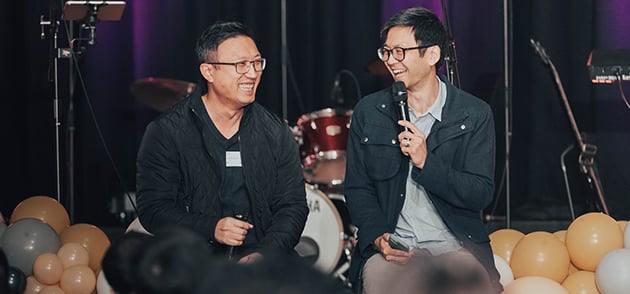
Chinese church planter Eugene Hor leads a panel discussion involving key multicultural ministry workers on the future of ethnic ministry in Australia.


Transcript

This transcript has been generated, and can contain errors. Please refer to the original recording for the definitive language used.

Read transcript

[0:00]
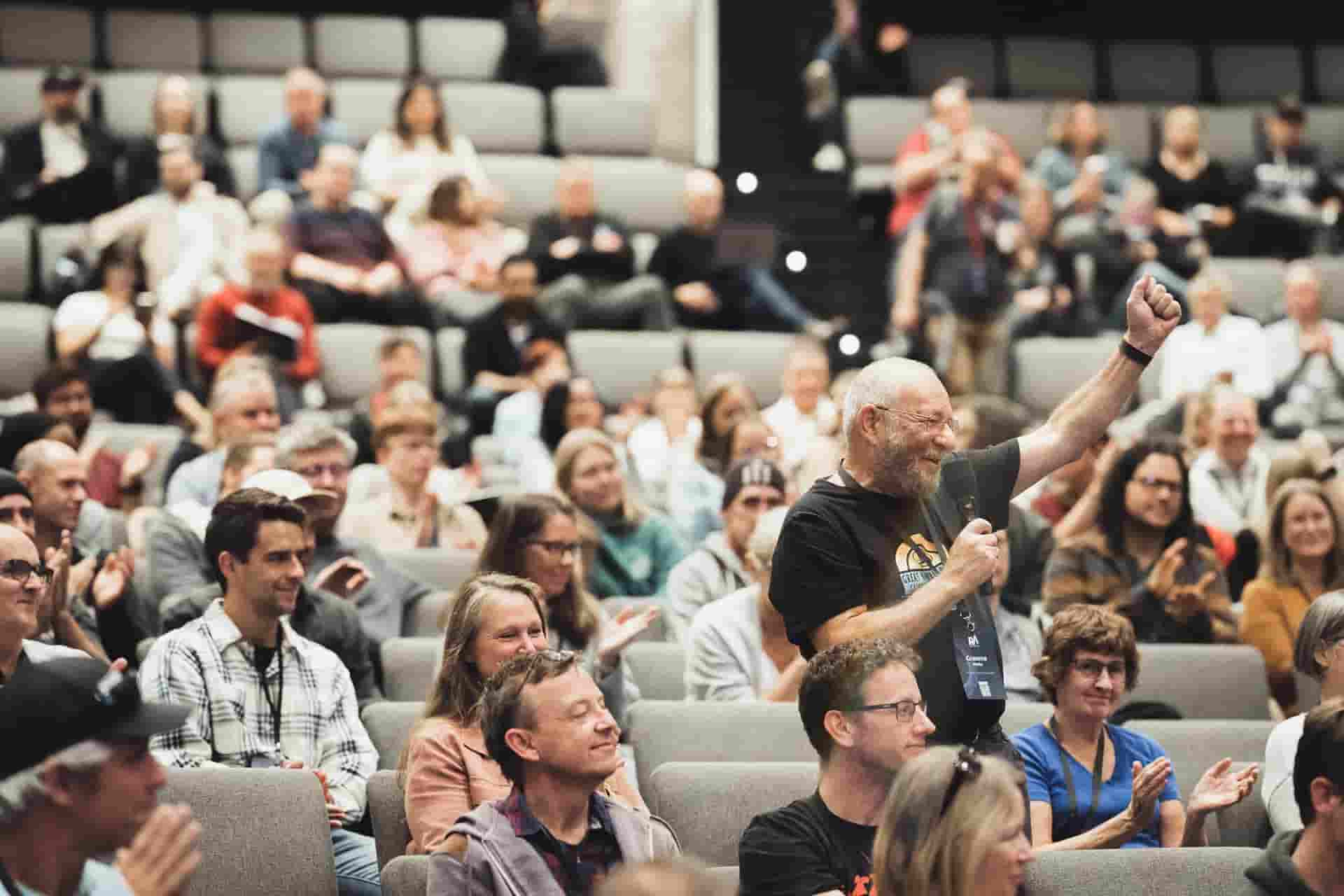
Yep, if I could actually have Archie up, Pete Coe, as well, and Bruce, we're going to have a quick question time. This is about 10 minutes worth of question time. So while we get the seats up here, if someone can actually grab the mic, I think Scott's somewhere around. Can I indulge you for a sec? There's something I didn't say in my talk because time got out and I want to say it that in my research, there is so little evidence in a

[0:30]
and not much around the world actually about cross-cultural churches going into the next generation. There's a very bad track record so far. And so one of the things that we need to try and do is establish our church plants so they can spawn multigenerational churches. Questions?

[1:00]
It's a complicated question that ties in with Bruce's emotional image at the end. Granted, cultures are different and diverse. And then an Australian hears that one feature that we encounter constantly is Islamic radicalism. Is there any sense in which that is a part of Islamic cultural differentness? So is there some degree to which that fear?

[1:30]
is a justified one. How do you wrestle with people who are coping with that dimension of that emotional reaction? Does that make sense as a quite a question? I'm trying to capture there in terms of the the Aussie fear reaction? You're saying how do you manage, is, first of all, is it a legitimate reaction? Yes. And then how you manage that with people? Is that the question? That's right. Certainly a legitimate reaction. And the people who do the sorts of things that ISIS does, did, need to be brought to Brook for that.

[2:11]
And that needs to be said, clearly. It's the sort of thing that we need to stand against, as we need to stand against it in every culture area of life where people do that sort of thing. However, it is also, I mean, they killed the Lord Jesus, stood against him.

[2:41]
The aspect of the gospel that teaches us to love even those people that do those sorts of things. And to recognize that that sort of Islam, is not the only sort of Islam. And so it's a couple of things there, I suppose, the love aspect and the recognition that it isn't the only sort of Islam around and that people get converted from those sort of backgrounds.

[3:15]
So it is a matter of working with people regularly, I suppose, to help them see these people are just as long. even the people who do those sorts of things as the people next door that they might find as very, you know, friendly but not Christian. Can I actually use this directed towards Archie, though? I'd be interested to see what other people had to say.

[3:50]
Just in your last comment there about the sort of multi-generational kind of thing of cross-cultural ministry, is one of the issues behind that is that culture actually changes so that, you know, what was, I guess, Australian Greek culture 20 years ago may not be quite the same as it is today. And how much does that influence things as well that culture shifts along the way? Do you want to… Yeah, yeah, thank you, Pete. I should have paid you for that question. You can pay me later, that's okay.

[4:21]
No, I said they should have, not that I will. I think in the five models, that I, so Pete's suggesting that when you establish cross-cultural ministry, culture does change over, say, 20-year periods, so why should you expect that group to have multi-generational life? I think it's a right question to ask. By the way, it is not just heart language, it's heart as well, I want to say, agree fully it's heart language, that what we have seen in Greek

[4:54]
ministry is that people have lost the language of Greek. but you go to a Greek wedding and the music starts and they're back at home. And so it stays for many generations. Yeah, I think the five models I gave before, I think the boundary rider model is the one that I'm now advocating, which Bruce and Ian C, so do talk to Bruce about it at doing with community chaplaincy. And that is, it's always looking for where the next gospel opportunity might be.

[5:26]
That actually enabled. if you like, morphing of DNA to occur. So you experienced the opportunity and the difficulty of hearing the gospel coming from another culture, and yet you don't look out then for the next generation. And so that's what we need to do. Now, I don't want it just to be the pastor. I want the pastor to be working with the congregation so that we all become boundary riders to kick my own culture in the faith.

[5:57]
I've noticed the ones who are most racist against the new generation. And 15 years ago was the Vietnamese migration with the Greeks because they finally found somebody who was more recent than they were. And rather than siding with them, they used it to put them down. And what we need to do is be boundary writers and say, look, God has brought us here and given us the opportunity to hear this gospel. And here are people that are in exactly the same sort of situation. Who can we pray, who can we look out for that might be able to reach this generation?

[6:27]
We'll go and talk about the difference in experiences with each other. Who knows the Greek may see the Vietnamese converted? A friend of mine commented. A friend of mine commented that some church planting movements like elephants, they reproduce.

[6:57]
slowly, maybe once or twice in their lifetime, like a single church. Whereas in other places in the world, churches get planted like rabbits where they're multiple churches. They're quick. They're all over the place. In Australia, it seems to me, just that we've got the kind of elephant model commonly. But how do you see that playing out in trying to reach people from other cultures and doing it to think about other ways of planting churches, training leaders, looking at more rapid expansion and things like that?

[7:27]
I agree. I mean, in North Africa, in lots of other places in the world, the disciple-making movement does reproduce home churches in India. There are millions of people in home churches. And it does reproduce very rapidly. Here, for a variety of reasons, we are much slower. Sometimes that's a good.

[7:57]
slowness, but I think that we do need to explore more rapid ways, which we haven't done yet. Every, the elephant model, if you want to use that idea, that's really helpful. And it's served us well, but it won't serve. So the idea of developing community chaplains, finding people who will work in the community, perhaps a little outside the structures.

[8:31]
That might be the way forward that we are seeking at the moment where we'll find someone who will be a serial evangelist. And just keep on, because she's a very good evangelist, they keep on meeting people, gathering people, someone else will come in and disciple them. That may be the way forward. And we may find that new migrant groups, which are so much more family-orientated, and that's how it's working in North Africa, for instance, that that's the model that we start,

[9:02]
instead of drawing them to us, we stay with them and work through their networks rather than them come to us. So we're yet to explore, I think, some of these things. We just need to experiment more with the new things. I think it's quite an exciting time that we're faced with. Sorry, Josh, if I can add something. to the elephant in the room about the elephant. That is our systems shape the way that we think and how adventurous we're going to be. And the systems that we have are you need to have somebody who is

[9:37]
theologically accredited or somebody who you can pay full time, which is absolute folly, of course. And what we actually need to be willing to, like Bruce said, to experiment. I think what I want to do is have the next conversation. with somebody who is from a different setting because that opens doorways to a whole lot of other conversations. And I think the more difficult the setting is, the better it is, because some groups are hard to reach because they are tightly packed and it's hard to get into them.

[10:09]
And we shy away from that. Well, I think we've got to work really hard at being able to penetrate into that group because when they're tightly packed, they can't get away from you either. So if you're in there, you get great gospel opportunities. So I used to work in a church that had a very strong Muslim area down the bottom of the hill. And it was impossible to penetrate. The whole school was Muslim and no one could come down. What we needed to do was have somebody who was willing to spend the next 20 years of their life buying down there, living down there.

[10:43]
You don't get the capital appreciation on your house because no Ingo wants to buy in the area. But the whole community down there, lived on the street, talking with each other, the kids played together. If you got in there, you'll get gospel opportunities. And so I think we need to say, let's modify our models of how you do ministry. Just kind of add one thing. I mean, one of the attractive ways to multiply churches quickly is sometimes a house church model, and that's kind of going gangbusters in places even like China.

[11:15]
But what's really interesting is if you're part of a denomination with empty church buildings, there are some ethnic groups who don't consider its church unless they're in a church building. And so if the only model we're going is multiply house churches, we're never thinking of using existing buildings. We're actually missing out a whole bunch of walk-ins. Because there's some ethnic groups who won't go to a school and think it's church. But it's in a building and they're suddenly very interested. I think it has to do with Dan's the foot in the front door. Hey, come to church with me. And then you'd bring them to the school and look, this is church or into a home. So I think I also want to kind of temper that with, you know, I think if we've got,

[11:49]
if you've got denominations with church buildings, maybe one of the things you'd do is to put people in those buildings, have ethnic ministries, and they don't need to necessarily have a full-time pastor. You just use them, and you might actually see that some of the growth will happen very quickly amongst multicultural Australia. Got time for probably one more. That's there. Do you want a serial questioner?

[12:19]
Hey, it's me again. I've faced huge difficulty. This is probably more for you, Daniel. Huge difficulty in evangelising to Japanese people who seem to have grasped the gospel, but go back home to a culture that's extremely conformist and very hierarchical. And I was just wondering if you could give some flesh out or comment on some more.

[12:49]
practical tips on how to, what, how do you actually prepare people for the, the enormous shock that hits when they, when they go back to a culture like that? I wish I had great silver bullet answers for that. Japan, I think, is really hard and I can't say I'm an expert on reaching Japanese. The people to speak to maybe the missions are over there and doing that work. I think Japan is very hard, as you've pointed out, the, the, the,

[13:19]
The unspoken pressure to conform to the wider group is just extreme. I remember one missionary giving the illustration of, you know, you're walking along decking with your bare feet, and there's that one little nail that's sticking up, and you catch your foot on it, and you go and get your hammer and bang that back down into place because you just want that uniformity. And she said that's what Japanese culture is light, so I think it's very hard. So they're the experts. In terms of preparing people to go back, whether it's Japan or anywhere else,

[13:49]
I work with students. So if a student's here for three years, then it's great if they're popping back each summer or whatever it is to Japan and then coming back here for second year, back to Japan and so on. For a number of reasons. Reverse culture shock. The shock of returning home is lessons because they're kind of touching base each time. You can tell them if they've come to Christ, say, here, God willing, in their first year, to go back and try and find a good church. Or, you know, you've got connections. You recommend.

[14:19]
a good church. So they go back and they experience that over the summer and then they return and they go, that was weird. It was different to Australia and you can begin to process that and work it through with them. One of the things we are not good enough at yet and we need to get better at. I say we meaning the university ministries in Australia and we need to team up more with the UK and the US is when we've got graduates going back to, you know, say we've got a grader and they're going back to Osaka. Who do I know in Osaka? No one. But maybe someone from Newcastle

[14:53]
uni sending someone back to Osaka, or you guys have got someone who's in a church but has now moved with business to Osaka. And, you know, the states have got two people that they sent. And we can, that's not the whole answer, but at least then they can have some fellowship with other people who can say, I too came to Christ in the West. And yes, reverse culture shock was hard and I struggled, but we're here for you and we know what you're talking about. there's some of the things that occur to me. You guys?

[15:24]
Our time is actually up. If you want to have a chat with these guys, I'm sure they're available. The band are going to come up. They're going to close us off in a song. I want us just to remind us that we don't want to end the night on a note of pessimism. I think the scriptures reminders, Jesus reminds us, that he will build his church and that we are part of his mission. The mission is a success because Jesus has guaranteed it. and he's going about the work of gathering others for the harvest through his people.

[15:54]
And so as we close this evening, we want to be mindful that it's Jesus' mission, and he invites us to share the mission. And so tonight we've heard of many opportunities. Let me remind you, please be here tomorrow. We start at 9 o'clock sharp. So if you could be here on time, that'd be great. That's Strand, the third stream of the workshops. Is that going to pop up? So we know where we're supposed to be tomorrow? Yep, cool. So that's up there. Let's close off the evening with the time of praise. Let's give thanks for the good work that God is doing. Let me pray for us. Father, we just want to celebrate your mission. We thank you that you will build your church and that you invite us to participate in your mission. We thank you that, as we anticipate the promises of Revelation, continue to grant as a vision for the nations, gather around your throne, despite the difficulties and the challenges.

[16:49]
help us remember your great purposes and our part in that purpose in seeing others come to know the Lord Jesus. We just want to praise you. We want to give you thanks because you haven't just called us, but you are with us as well as we go about the work of seeing others come to know you. And we give you thanks for the time we've been able to share today in Jesus' name. Amen.