
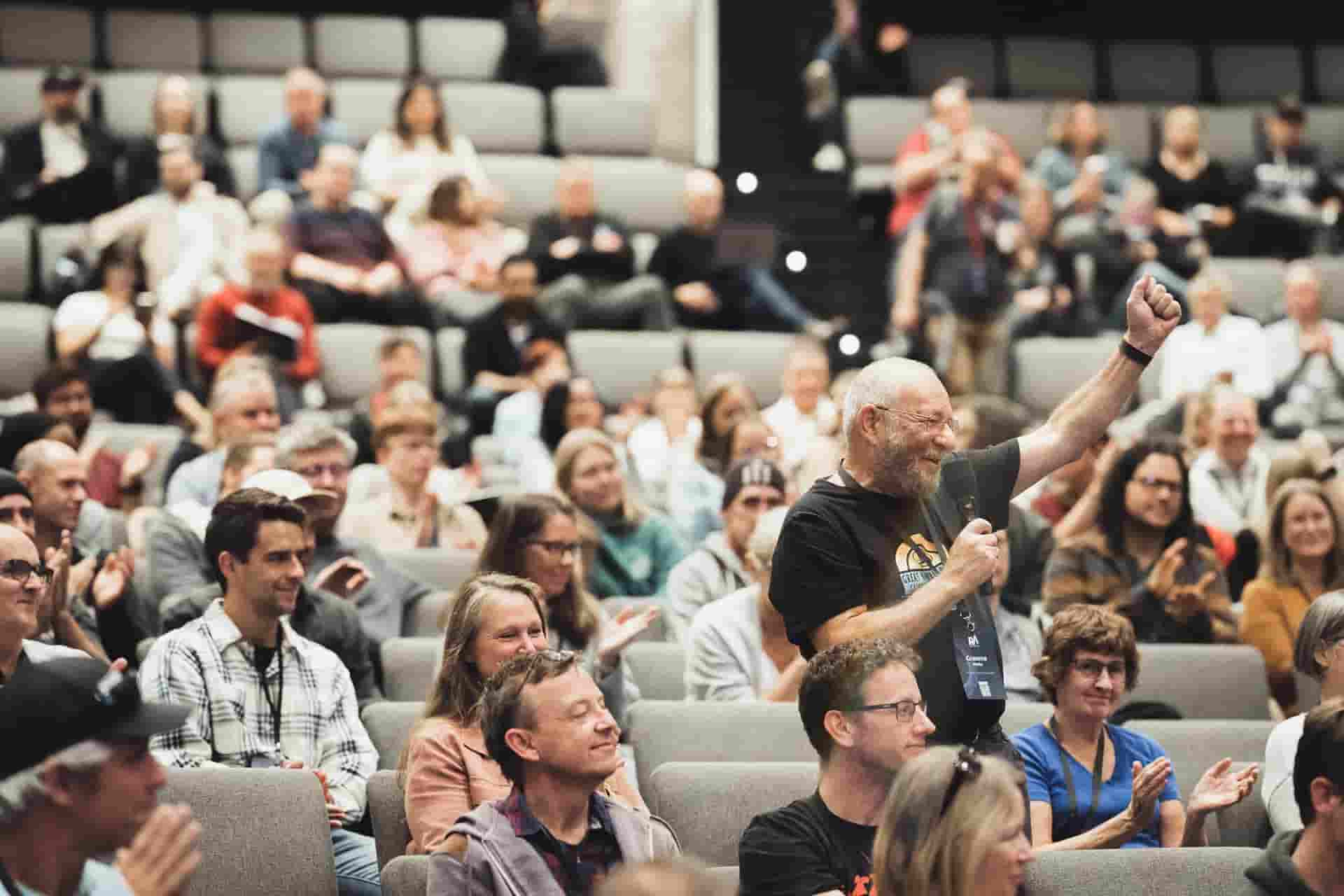
Is it OK to fail? It certainly needs to be, because failure is a common experience for anyone in a faulted world. So how do you go about creating a culture for your ministry that accepts failure so that your team is empowered to keep trying for the sake of the Kingdom?


Transcript

This transcript has been generated, and can contain errors. Please refer to the original recording for the definitive language used.

Read transcript

[0:02]
LifeWay Leadership Podcast Network. G'day, I'm Scott Sanders. I'm Derek Hanna. Welcome to the one thing. Mark, why are you putting those sound effects on the background? A podcast designer give you one solid practical tip for gospel centre ministry every week. I just felt we needed something today just to sort of jazz it up.

[0:33]
Oh, you brought it. Make it jazzier. You brought it, baby. Now, we're talking about failure today. I just want to hear, what was the biggest cricket failure that you had on the field? Because I always hear about the hundreds. I always hear about the big scores. But tell us about the time you've achieved the golden duck. No, I never got a golden duck. Mark, I once let a teammate run onto the field with a meat pie and field a ball. He knows who he is. He's a church planer in Trinity in Adelaide. It was embarrassing for everyone. It was embarrassing for everybody. I'm sure he would have done it well.

[1:05]
It's quite a skilled, skilled church planer. He didn't drop the meat pie. That was a skill. Mike Sams, we know who you are. Yep. We're also proudly part of the Lifeway Leadership Podcast Network. For those listening overseas, cricket, it's a game a little bit like baseball, only a lot better and a lot longer. Check out cricket.com for more information on that one. But for now, you've pressed play on episode number 45 of The One Thing, Creating Space for Failure.

[1:35]
I've got to say, I do like thinking about this topic because for me, it's an intersection of a number of areas. I'll name two. First, it's the theological truth that I'm finite, imperfect, and I'm not in charge of everything, which means failure is going to be with me until glory. So I need to learn now how to understand that in light of the gospel and in light of who I am as a person, as a finite human being. But secondly, it's also a developmental truth. The reality that we grow in failure, you might have heard sort of fail fast.

[2:06]
That's very much an entrepreneurial sort of saying. But we actually do improve in failure. We rarely start brilliant at something. We're not all as great at cricket as Derek thinks he is and was. So if we're going to be better at something, we have to have space to fail. And here's the point again. If we're going to develop those around us, we actually need to be great at creating safe spaces to fail. Not with the intent to fail, but with the knowledge that it's okay to do so. So Derek, I don't want to ask the obvious question, have you ever failed? Because yes, you have.

[2:39]
But are you a perfectionist? I am actually. Yeah, I am a perfectionist. Yeah, yeah. Yeah, it drives me nuts. Are you? I think I was. I think with four kids, I'm letting it go. Yeah, yeah. Mark's shaking his head here. And with time, I'm just like, no, 80%. I think I say regularly, 80% is good enough. You do. You do say that. You're lower. Mark's saying lower. But that means you get a lot more done. Absolutely. Yeah, yeah. You do. So Derek, what does it look like when you don't create safe spaces to fail? Yeah, I think we probably all know these when we see them.

[3:11]
But it looks like hell. It really does. When you create communities where there is no space to fail, it looks awful for you personally and for others as well. So individually, if there's no room in your life for failure, it's just an awful place to be. In your church, if there's no room for failure, it's an awful place to be. It can look like there's a lot of activity going on, but there's very little execution because you never pull the trigger and do something. It looks like anxiety, that nagging feeling that even though you might be doing stuff, you're consciously anxious about it because you never feel like it's good enough.

[3:44]
Now, part of that might be okay. That drives you forward, but that anxiety can often rise to unhelpful levels. And when there's no space to fail, whether it's in your own life or within the life of the church that you're leading, it's that constant attempt to control as many variables out there as you can, but the reality is still looming that you're never going to be able to do that. And then you have all the consequences that flow from that. So let me just give a little example of that. The PowerPoint, the church PowerPoint.

[4:15]
I mean, that's a beautiful one for you, isn't it? There's fonts, there's pictures, there's scale, there's just the technology. There are loads of opportunities to fail. But you want to get that right every week, don't you, as a church planner? Yeah, you do. And the bulletins as well. That's probably where I noticed it more. Actually, the bulletins when I look at churches. Because there should never be more than two fonts on there. And if there is, there needs to be a very good reason for that. So where does this heart spring from? Where does that, you know, that anxiety, where does that desire?

[4:47]
About fonts in general. No, not about fonts. But about not being able to create this safe space for folks. Where do you think that comes from? Yeah, look, I think they, as with nearly everything, it comes back to a heart issue, this stuff. So my perfectionism is because I am, it can spring from a number of places. So for me, if, you know, just between me and you, Scott, and the three people who listen to the podcast, that is for me my perfectionism about not wanting to do things that other people will think are not very good.

[5:18]
So it's actually about how other people perceive me. So it's a perception problem in that. So it springs from the heart. It springs, it can spring as well for a lot of people into, when it's in a community context, into wanting to be able to control things because they think they are better than others at doing things. That sounds like, I mean, pride's at the core of it. Absolutely. That's where it comes from. So pride is there. So, you know, Keller always goes to two options, fear and pride. And maybe it just comes back to that.

[5:49]
They are heart issues unless you diagnose up the top where your issues are coming from. Because sometimes they're real issues. The reason you take back control, there might be a good reason for that. But unless you've diagnosed the heart issues and how you tick and where you might be inclined to do, you'll make the wrong decision around this. And create spaces that denies people ever the opportunity to do something or critiques them so severely when they do fail. How have you ministered to yourself in this? Yeah, yeah.

[6:20]
Look, actually, it's been interesting. So working with you more close the last few years has been interesting because you do that 80% thing. And I find that really confronting because it's not my inclination to do that. But I recognise that sometimes I just need to let stuff go. So I think having people around me that push me to say, no, sometimes it's not about you or how you perceive it. Actually, it's just we need to let it go and you need to get it out there. So I think understanding where that stuff comes from in my heart and then being able to understand, get it to a point where I am.

[6:55]
I can ask people, actually, am I being realistic in what I think this is like? Am I being unrealistic in asking this person to do this in this way? And am I being fair and godly in what I'm calling on people to do? Asking those questions of people I trust rather than just trusting my own instincts in that is really important. Having some objective measures rather than just pandering to my perfectionism I think has been really helpful. Well, I'm going to pause you there. Yeah, we want to open up the toolbox into some resources that are going to actually help you think about this.

[7:27]
Just a couple of quick tools that I think are helping in just growing self-awareness in this area. The first one is Emotional Intelligence 2.0, a book by Bradbury and Greaves. It's a helpful book. It's a secular book. What's helpful is it's got a really good tool. So you've got to buy the book to get access to the tool. But that's just another tool that can actually help you think into more how you operate as a person. The second tool like that is the Gallup's Strengths Finder. So again, another multiple choice test that will give you five sort of self-awareness tools to understand who it is that you are and how you've been made up.

[8:03]
And Derek, have you got one other resource for us that you would recommend? Yeah, yeah. There's a great book for you, this guy, by Jerry Bridges called Respectable Sins that spoke about sins that we just kind of gloss over, particularly for people in pastoral ministry. I think that's really helpful for pushing into those areas where we think we're being godly and it's gospel driven. But actually, it's just sin in the different guise. I think that's really helpful. Well, Derek, I want to build this back into the church that you're trying to grow, that you're trying to start.

[8:39]
How do you actually build a culture and structures where people can develop, but also where we actually still get things done? Yeah, yeah, that's good. Because like that last part of the question is really good because you do need to get stuff done. Things need to happen at some point. So let me just give a few, a bit of a framework. So actually, a guy named Pete Mayrick, who is at Centre for Ministry of Development in Sydney, he's got a whole bit on delegation and on a pipe model. It's excellent. I've got a lot of time for it. He's great with this stuff. Anyway, some of the things that come out of that and some extra things.

[9:09]
First of all, you actually need to define goals of what you want. So in a community context where you're asking someone to do something, you need to define what it is you want them to do. So goals broadly or narrowly, however it is, for that task and for that person. So you might not articulate the goal for the person. You might just articulate the goal for the task to that person. But in your head, you're thinking, I actually want this person to grow in their ability to do X, Y, and Z. So I'm discipling, I'm maturing them. But you're articulating them. What I'd really love you to do is prepare a talk for this event that we're doing in order to share the gospel with young adults.

[9:45]
So you need to define it. So helping to define it in the broad, here's where we're going as a whole church, but then here's what it looks like for you and here's the piece you play. That's really helpful when someone's just a small part of a massive process or a massive system. Yep, yep, yep, absolutely. You need to provide a framework for that as well. So what are the lines within which they work? So often I think of RAR in my head when I'm handing a task over resources and authority and responsibility.

[10:15]
How do I hand those things? How do I define those things at people? What are the boundaries within which they can work? You need to be available for check-in. So as the process moves along, you need to make sure that they can come to you at any time and ask any question about how the process is going. So there needs to be check-in points so they can ask any question, no matter what it is, and not feel stupid. And regular check-ins where you can ask them questions just to check that they're going all right. So that's really helpful to have those regular points in time where you can actually see how they're going and you can hear their progress.

[10:47]
So you can jump in and actually help ensure that it's not a failure or it's less of a failure. How though are you dealing with the things where it can't not fail? Like I'm thinking of the launch of a church plant. It's not like you're putting your MTS trainer in there and saying you've got the first talk in the first week. Yes. How do you create those opportunities where it is actually okay to fail? Everything's not on the line. This is not going to impact a whole bunch of people.

[11:17]
It's going to be a great learning experience for them and it's also not going to completely steer the ship completely off course. Yes. Well, sometimes you know that in advance or you should, like a church plant is the example. You don't hand out the talk to a student or MTS guy in the first week. You just don't do that. And you should know that in advance. That is common sense. But sometimes you don't know those things until you do them, until it's too late. But my comment would be on that first one, whereas things, you need to work out what the things are that you can't hand over.

[11:50]
Now, sometimes we think that's a bigger list than they actually are. But you don't hand over something which you shouldn't hand over. And if you do and it fails, it's not that person's fault. It's yours. So you need to work out the things you can hand over and the things you can't hand over. Yes. And you need to be willing to provide feedback. They need to know it needs to be small course corrections along the way. They can't get to the end. And you say, hey, look, I gave you this task. I asked you how you were going. You said it was going well. But actually, this is a complete disaster.

[12:22]
I didn't tell you along the way because I didn't want to make you feel dispirited. But that was a complete disaster. No, it's got to be feedback along the way. And if they fail, if it turns out that it's not 100%, whatever failure looks like, if it doesn't quite hit the mark, if you've done those things along the way, you need to own that outcome as much as them. You can't make them walk the plank because you're with them on that. And part of owning that is sitting down and actually evaluating and learning from that together as a team, learning from it personally as well.

[12:56]
So having that evaluation process. Now, you've talked a lot about there's a lot in there just about the skills you need to have as a leader. I'm hearing you need to have good, strong delegation skills. There's understanding how to sort of manage a project and a plan. So mapping that out with other people and communicating that as well. And then there's that important regular ongoing work of just feedback. So there are a whole bunch of resources out there to be thinking into those three areas in particular. Can I encourage you leaders who are listening out there to be growing yourself in this as well?

[13:29]
And we're not perfect. We are working towards this, but it's a really key critical area to work on. Well, that brings us to the end of the show. So, Derek, what's the one thing people should be taking away when it comes to creating a space for failure? We don't only want to get stuff done. We want to grow people. We are growing people towards maturity, towards Christlikeness. And part of that is creating safe spaces where people can try things, perhaps fail, but in that process be developed.

[14:05]
Now, that brings us to the end of the show. If you like what you heard, then we'd appreciate if you'd take a moment to rate the show on iTunes, even leave a comment. You might even want to shoot a quick link to a friend and say, Hey, I really think this is important for you. Maybe don't pick this one as a podcast that you share. Look into our back catalogue. Because people might not take it the right way. We're doing one on passive aggressiveness coming up. Well, thanks for joining us for another episode of The One Thing.

[14:35]
Coming up in our next episode is starting a second service with Tim Clemens. I'm Scott Sanders. And can I encourage you to listen to one of our other podcasts from our network, The Established Podcast with Sam Rayner, Micah Fries and Josh King. They regularly talk about ministry issues for The Established Church. Jump in and check out Established. I'm Scott Sanders. I'm Derek Henner. Chat soon. All right. See you next time. Bye. Bye.

[15:05]
Bye. Bye. Bye. Bye. Bye. Bye. Bye. Rock. Thank you.