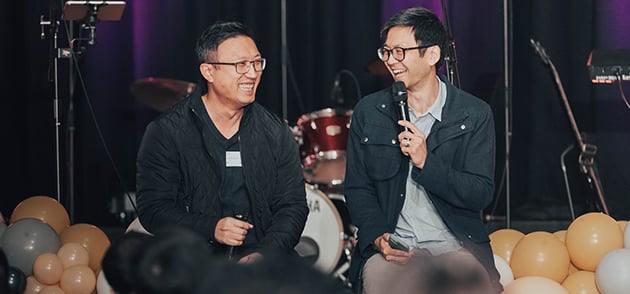
Rory Shiner and Murray Campbell explain how they’re slowly beginning to transition their churches back to physical gatherings, but the highlight of this episode is Derek Hanna’s relaunch buzz-words bingo board.

Transcript
This transcript has been generated, and can contain errors. Please refer to the original recording for the definitive language used.
Read transcript
[0:02]
LifeWay Leadership Podcast Network. G'day, I'm Derek Hanna. And I'm Scott Sanders. Welcome to The One Thing, a podcast designed to give you one solid practical tip for gospel-centered ministry every week. And Scott, we're a new week, but last week a big week. We kicked off relaunch conference. It was a massive scramble trying to get everything together for that.
[0:33]
And to get a whole bunch of passes together online to be thinking about restarting, to be thinking about this season that we're in at the moment. Yeah, hugely encouraging. Good to hear from the guys out front. Also good to hear feedback from people across the country who tuned in as well, who were saying, you know, they do want to be connected. They are thinking through this stuff. Yeah, it was great. I mean, it was great just to hear from Adam Lowell up in Toowoomba. You know, that was really nice to have his piece on change and transitioning amongst a whole variety of passes from around the place. Yep, absolutely.
[1:04]
Well, The One Thing is brought to you thanks to Geneva Push, the Australian Church Planning Network. And we're also proudly part of the LifeWay Leadership Podcast Network. And we'd encourage you to check out the network page on iTunes and see a few of those other podcasts. Scott, what are you listening to for the LifeWay Leadership Podcast Network at the moment? I've been getting my head into the 5LQ podcast at the moment. So, to be honest, I am missing Todd Atkins. And I was hoping to get across to Nashville. But obviously, international travel has been shut down. And so it has been great to sort of hear him talking with leaders, hearing his insights on 5LQ.
[1:40]
So check that one out. But for now, you have pressed play on another episode of The One Thing. Two Churches Approaches to Relaunching. We're going to feature two leaders today that you spoke to over the last couple of weeks. The first one is Rory. He's the lead pastor at Providence Church in Perth in Western Australia. Let's just listen to Rory's clip about what he's doing around Relaunch now. My sense is that leading out of the crisis is going to be more challenging than leading into the crisis.
[2:18]
One of the features of coming into a crisis is that you had no one saying, Oh, well, last time we were in a pandemic, this is what we did. Because there was no last time that our generation was in a pandemic. And so for all of us, it was the first time we've had to scramble to work out how to do church under these circumstances. It happened very quickly. And there was a lot of generosity. There has been a lot of generosity in our churches, I think, as we've done the best we can under the circumstances. And we've led into a situation where there were no expectations.
[2:48]
No one had a template for what happened last time because there was no last time. Whereas as we head back to normal, everyone's got a template. Everyone knows what normal look like. Everyone has ideas about which things we stopped that we probably shouldn't start again, which things we started that we probably shouldn't stop again, and which things we should change on the way back in. So we're dealing with many more expectations. And we need to be good at communicating with congregations, communicating with our leadership communities,
[3:21]
doing all the good pastoral change management stuff on the way back in. That's my observation for the leadership challenge that is ahead of us. In terms of the particulars, I think we really want to think from principle out. Because if you keep thinking from structure to structure to structure, you create this kind of exhaustion for people as church keeps reconfiguring. Whereas if we can speak into the purposes that God has for his church,
[3:56]
what is it we're trying to do? The more we can teach into that, the more the various configurations will be tethered to the purposes that God has for us as his people. That's the way we're trying to think about it. So I think we're probably going to head back into a situation where, is it stage three, where you can meet in groups of 100 with social distancing. In our current properties, that means none of our current services will be able to meet in the way they did meet. And so we're looking at whether we can set up hubs or social situations
[4:31]
where groups of 30 or 40 or 50 could get together in appropriate levels of social isolation and start that gentle re-entry into eventually being able to gather in those larger numbers. And we want to seize that opportunity to take what's positive about those smaller groups, to take what's positive about paying attention to our local suburbs and so on. We came from a missional community background. We don't operate like that at the moment.
[5:01]
And I think missional community is really, it's a structure and you've got to work out how that structure serves the circumstances. And it could be for the next little while that smaller group, especially that dynamic discovery, that group between 30 to 70, could be a really powerful way of configuring our lives together on the way back in. That's what we're thinking. Lovely to be able to share with you. Let's just pull out some things that he said.
[5:32]
One of the things he pushed into was leading out of this crisis, he's feeling like it's going to be much harder than going in. Yeah, so he talked about the reality that everything just happens so fast. And so the need to make decisions meant that you were the expert, you were the Johnny on the spot really quickly and had to make those calls. But now coming out of it with so much uncertainty, yeah, so many decisions to make, it's actually going to be a tougher process to lead out of that. Also, you've got the reality that there's a lot of conflict.
[6:04]
As a church leader, you'll have a whole group of people be saying, let's get back. A whole group of people also saying, actually, let's not. They've both got their proof texts from God's word to say that you're wrong. How do you manage that conflict and bring unity in the midst of very diverse opinions? And one of the things he very healthily points out is he's saying, you know, there is a tendency to rush back and just patch stuff up or put in what you had in place or just put solutions where you see a problem. But they are pausing for a moment.
[6:35]
They're pulling back and they're reflecting. And they're thinking from principles, biblical principles. Yeah, so it's going to be very hard to put something in place and then retract from it. So you've got to be very careful about what you're starting at the moment. Now, this time gives the opportunity for innovation, for reinvention, for trying through new things. But be principled as you put those things in place. Because it's very hard to unwind what you do in this time. So I think it is a good opportunity to reflect, to stop and think through what is it that you want to continue on
[7:13]
and how can you do these things. Or if you are going to start some things that you know won't last, actually let people know and understand, you know, here's why we're doing this. Here's why it's only for a season. And here's why, you know, when we do get a chance to go back, we're going to stop these things. So change management is going to be a huge part, as it is in any part of church life. We're going to have Michael Lynn on in a little while, at some point in the future. And the one thing, to talk through change management. But Rory spoke about stopping and starting. I'd want to add a third one in there as well, which I know he does as they're thinking about it.
[7:43]
Thinking through your ministries, what are you going to stop? What are you going to start? And what are you going to pivot to as well? What are you going to adjust? Yeah, I think what I want to add to what Rory said in all this is, it's important to have, you know, have that overarching bigger vision. You know, so as you're thinking through all these plans, you know, think into the next three to five years where you want your church to be and have that driving your decisions now. So give people that bigger vision. And then as you're carving that out, you know, again,
[8:15]
using one of Cotter's key principles from his sort of eight steps of change, pull in, you know, pull in a number of people who can actually influence that. And you need an army, not an audience. So how can you actually be getting this filtered down into your teams and in your teams of teams and them all working towards that overarching larger goal? All right. We're going to talk to our second person now. This is Murray Campbell, who you spoke to. He's at Mentone Baptist in Victoria, in Melbourne.
[8:46]
Let's have a listen to what Murray said about how they're thinking through relaunch. I guess we've got three things that we're keeping in mind as we consider what we're going to be doing. We want to be informed by government laws and guidelines. We want to be directed by our theological convictions. And we also want to be aware of pastoral sensitivities in terms of, you know, how comfortable are people to meet in person again, people's tiredness and those sorts of things. So we want to keep those three aspects together as we make decisions.
[9:20]
We're grateful for what the government has announced, the federal government, with their three-stage plan. Of course, it's up to each state to determine how and when that's going to all work out, flesh out. So in Victoria, I suspect we're going to be behind most of the country when it comes to returning to meeting up again. So what we're planning at this stage is already we're encouraging small groups to meet again in person as they feel comfortable and,
[9:51]
you know, practicing social distancing. But we can do that on our church premises, but not in people's homes as yet. So we're encouraging that because we are social beings. We're physical beings. We need to be together. So we don't want to starve people of that, those kinds of relationships any longer than we need to. So we're reintroducing that. People are opening their homes again and doing some hospitality, having friends over, which is fantastic. In terms of Sunday meetings, we're continuing with Zoom at the moment.
[10:23]
So we pre-record a sermon and some prayers. We throw that up on YouTube. But then we also have a Zoom session on a Sunday morning. We're about 60, 65% of the congregation listening. And we're listening together. We have breakout groups. We'll continue with that for the time being, probably until stage three kicks in in Victoria. At that point, we'll probably move to multiple congregations. We'll probably only fit maybe 50, 60 people in the auditorium because of social distancing rules.
[10:56]
Now, we want a whole church to be together again. So we think that the best way to do church is for everyone to be meeting at the same time in the same place. But that's not going to happen until 2021, I suspect. So as a temporary measure, we'll move to a few congregations, small in size on Sundays. That won't happen until July of the earliest. So you're keen to move to some sort of physical gathering. And the way to deal with social distancing is to split your one congregation into two congregations.
[11:32]
Two or three congregations. Yeah, that's right. So what are you doing in terms of engaging the newcomer or the not yet Christian? Sure. At the moment, I've been putting out a podcast every week, which is on iTunes and on YouTube. And we've just sort of encouraged people to share that with friends. So that's aimed at the unbeliever. And that's encouraging unbelievers to just be thinking about some of the big questions, issues of life. At the moment, we're doing that. We've been pretty clear with the community as to what's happening in terms of we've got a billboard outside our church property, just keeping people updated.
[12:12]
I've written a couple of little videos on our church website as well. So we're doing that. And as we move through to stage three, we'll make some announcements on social media, also on our property that we're meeting again. Our visitors are welcome. And we're also working on an evangelistic course that we're going to do probably via Zoom, which hopefully will start up in a few weeks' time. When this whole thing started, my thought was, you know, September this year, we'd all be rushing back together.
[12:42]
Tears, hugs, you know, big group, all in the jumping castle together. That's not going to happen. And so we have to think about how it is we do get back physically, how we help people transition. He spoke about small groups starting on church grounds as a kind of foray into that face-to-face at least. Yeah. So I think they are going to be the litmus test for how people are responding. Already we're starting to see, you know, articles and Gallup polls sort of testing people's feelings towards, you know, coming back into whatever this new normal is.
[13:13]
In some ways as well, the pubs and the clubs and the sporting associations are also going to lead, you know, lead this for our sort of church place as well as schools. But the reality is we're not, you know, there's not going to be a time to turn to the person next to you, you know, give them a holy kiss, shake hands, social distancing, physical isolation. It's going to continue for some time. And so church is going to be very different. I think the other reality is a lot of people are thinking about starting, you know, starting small and starting a number of extra additional services.
[13:47]
So Murray talked about potentially three, you know, three services, you know, currently only got the one service, but because of physical isolation, they might have to start three services. I think we need to be really careful into thinking to that. So, you know, great to listen to Paul Harrington's talk where he says, you know, in some ways that's a question we're all asking, but it's not the question that we ought to be asking. We ought to be thinking in this time, how can we make the most of this opportunity to grow our people spiritually, but also to reach the loss.
[14:18]
And so in some ways, let's wait as long as possible so that we can actually have as, you know, most like the experience we had of church beforehand. Yep. All right. That's great. Okay. Well, listen, we're going to go to the toolbox. Now we've got a whole number of things that we have got out there at the moment. One of the problems at the moment is there is an overload of information out there that does. So relaunch Australia, can I plug that one? And then I'll throw to you, Scott, relaunch Australia.com. We are pulling together the resource site.
[14:49]
We're trying to pull together different resources from around the place, around the network, around the country, around the world, actually, as well, in order for you to have a more curated list of resources to start with because you realise there can be an overload with that. So that's one thing we're doing. Yeah. Yeah. Let me point you to one of our key resources on that website, the what are you thinking and why videos. We've captured a number of conversations with pastors. I reckon it's worthwhile just having a listen, seeing what sticks out for you, note it, and move on from there.
[15:19]
Also, we'd love you to be part of the process of us producing resources as well. So send in your roadmaps, send in things that you think are helpful for other churches to be thinking about. I'll talk quickly about Cotter's change management framework, so we'll provide a link to that in the show notes, and also a link to Paul Harrington's talk as well from relaunch last week. All right. Well, that's all we've got for you today from this episode of The One Thing. Scott, what's the one thing we need to be thinking through as we think about relaunching? Sink opportunities to engage your team in this process of thinking into relaunch.
[15:53]
You're going to be so much better if you're doing this with others. So can I encourage all pastors out there to be working with their teams to be thinking into relaunch? That's great. Well, if you liked what you heard today on The One Thing, we'd appreciate it. Just take a moment to rate the show on iTunes, even leave a comment. Thanks for joining us for another episode of The One Thing. I'm Derek Hanna. I'm Scott Sanders. Chat soon.
[16:27]
I'm Scott Sanders.