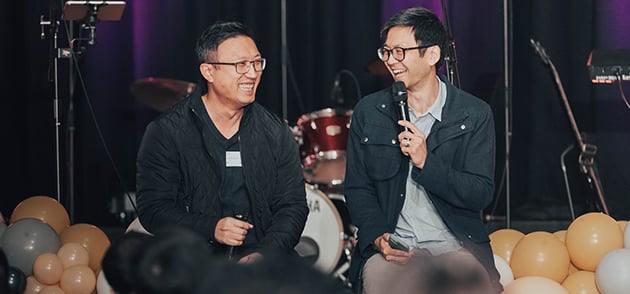
The Starrs, the church planters who established New Life Anglican Church at Oran Park, talk about the structures that support a successful Gospel ministry.

Transcript
This transcript has been generated, and can contain errors. Please refer to the original recording for the definitive language used.
Read transcript
[0:00]
Stuart and Carolyn have been founding members of New Life Anglican Church in Orren Park. They started with themselves two pastors, their wives in a living room and it's grown from there. Stuart met Caro in year seven at school I think it was and ever the optimist he pursued her for ten years before she gave in and now Stuart's advice to young guys at church is sometimes you need to know when a girl is not into you and you need to stop. It's really good that he didn't because they're
[0:34]
here today to talk to us together about how events fit together with prayer and intentional of connections. Fantastic. Thank you so much. Yeah that'll be helpful. I think I could mirror Sam's story. I probably need the little trolley but I'm not going to risk it and I lived in Darwin for two years mate so we're almost brothers how does that sound? Okay oh great. Is that right there? Great. Okay fantastic. So what what Karen I want to do tonight?
[1:04]
Um, Cara's very brave for being up here so she's awesome. Um what we want to do is we want to tell a little bit of our story and in doing so you guys know who builds the church don't you? Jesus builds his church and so it's not about us but we want to tell you what Jesus has done as he has chosen to use us. So Cara's going to tell a little bit of the background and that explains part of what we do because I'm a bit weird. Cara's lovely for loving me. We do some unusual things. We want to tell you about that but part of their weirdness is our context and so Cara will
[1:35]
tell you a little bit of our background and then I'll dive into some of the details and we'll double-team it. Great. So we want to talk to you about being intentional from the very start. So we started six years ago with just one other family and their kids in our living room and sort of six months in we had maybe a couple families but we met there for six months we started meeting in some schools in halls like lots of you probably do. Then we started to grow by the grace of God. We were blessed by the Anglican diocese with a building which is just out of this
[2:06]
world and so we very thankfully moved into a actual solid place where we weren't packing up chairs every week and we had a congregation after three years in of about 140 people. Yeah that's kids in adults no one ever clarifies this okay and at our church it's almost 50-50 kids in adults okay so just get that okay as you think about what's happening in your world we're probably about 70 adults about 70 kids something like that. And then one year ago we decided to start an evening
[2:37]
service so we were starting to grow we wanted to reach some of our younger generation a bit as well and so that was a year ago we really only started with 30 people that was all the ringings for the night and so it looks a lot bigger than it really was. So this is full disclosure okay it's probably about 30 people who started our evening service and then last Sunday. And last Sunday we started a third service we were not fitting in the room anymore and we decided to split the morning to two morning services so we now have the three and by the grace of God people still keep coming and we are continuing to grow yeah. So who are we as New Life Anglican? We now have other people on
[3:13]
staff which is lovely so obviously it's true and I Jeff works one day a week in pastoral care and life groups Michael came a year ago and he's now doing kids youth and families and he's done that full time full time and Lauren's now doing women's ministry for one day a week. Who are our partners so we're in a really unique area we're in a greenfields area which is not the same for everyone else we're in a suburb that's growing that's started as cow paddocks and there's now houses so we partnered up really early on with our local college the Anglican College
[3:45]
and we're connecting the school there with the kids we connected with Chessaland which is a retirement village so we started ministering to the elderly older generation there. We call them the Chessalonians and we started connecting up with other ministers in the area so that we could be reaching out to the whole wider area together in mission and also really early on we connected with the town centre and the developers and they were very gracious and connected with us as well and we wanted to serve the community with them. So we were in the south west of Sydney
[4:17]
new suburb that wasn't there six years ago basically they're putting a lot of houses in cow paddocks so that big red dot is Leppington which is going to be the biggest hub we're down the bottom here and we have 32,000 people in our own park and in this whole south west region they're putting 300,000 which is the size of Canberra or something in the next 20 to 30 years. So what's the personal picture for us? Basically it's cow paddocks turning into homes and they're putting in 700 homes a year basically we went there it was cow paddocks and cows and Stru said
[4:52]
we're going to go and play a church here and I said no we're not my starter crying and by the grace of God we are still there and God is doing amazing things. Yeah so one of the awesome things we think there's a pretty unique opportunity in this Greenfields area and so what we believe is we believe that lives in transition are open and what that means in practice is when you have a new house you're working out where do my kids go to school where do I cut my hair where do I get my groceries and in that openness as you start to work out who's who's over the back fence as you have to negotiate to put up a back front fence you're more open to new friendships and we believe you're
[5:26]
open to consider God in a unique way for a very short window. We reckon you got about two years where you'll actually think differently at least be open to the concept of God in your life in a fresh way and so we want to take advantage of that opportunity and so at new life we have a foundational scripture which is in two Corinthians chapter five my absolutely favorite bit of the Bible in two Corinthians 517 Paul says therefore if anyone is in Christ he's a new creation the old is gone the new is come all this is from God who reconciled us to himself through Christ and gave us
[5:59]
the ministry of reconciliation number number one God offers us a new life number two everyone who comes to Iron Park is there because they believe they want to start a new life that's for real and so what we do is we thought we could put these two things together and say if our church is called new life we're going to tell you what we're on about and we're going to echo why you came here just a really nice synthesis of things and just to pick up Greg's point of where's the command in the Bible it's pretty good that God says that he gave us the ministry of reconciliation isn't it yeah not bad what what's our vision so our vision then as a church is we so we long to see new
[6:33]
life in Jesus come to every home in Iron Park and the growing southwest for their salvation for the good of the community and for the glory of God and we are absolutely passionate about that and I think I said a little while ago in Sydney we had a 10% vision for a while and I think it was Dave Mac is Dave Mac here there he gave a brilliant illustration a while ago he said if there's a bushfire coming through your town and the fire is said they could only save 10% would you think that was okay and so our theology compels us to be about every home doesn't it they're absolutely
[7:10]
compels us so I've said to our church we are committed to be perpetually dissatisfied that's our vision so whenever whatever growth God brings we're going to be still about the people who aren't there yet because we want to see new life in Jesus come to every home so how are we going to do it that's our vision and Kerry people actually know this don't they yeah so really early on we started teaching our people this and so when they come to our church we actually get them to learn it which sounds a bit crazy but they most people in the church could actually say this to you and they understand it and they know it and they actually are living and breathing it from
[7:41]
a very early stage of the church plant so it's now become a culture that people know this and they know what we're on about really clearly so the short the potted version is what's the name of the church you guys can tell me fantastic what do we long to see new life in every home okay you're done right congratulations you just graduated then we say well that's the vision what's the mission the mission is how do we do the vision two things okay we talk about two things we talk about giving the message of new life and living new life for Jesus okay how are we going to get new
[8:13]
life in every home we're going to give it and we're going to live it you got that so far we're going to give the message of new life in Jesus and we're going to live new life for Jesus we have to be living ambassadors and we must be speaking ambassadors otherwise we're rubbish being ambassadors did you know that so we're going to give it and we're going to leave it if you got that clear okay that's what we're doing so you guys are ready which is fantastic now But when we say that you're ready, what do we do? We actually have a plan for it. And our plan for giving the message of new life is really simple. I was responsible for evangelism at a place
[8:45]
called Fig Tree Anglican for six years. That was my job. And there I thought that it was all about, I had to just get more people with a gospel outline. And what I realized that we had two big problems. We lacked process and we lacked prayer. We lacked process and we lacked prayer. And so what I said was, let's break it down from a sweaty conversation into reasonable steps that actual Australians can do. So, Karad, do you want to tell us what the four steps are? We're looking at them on this side here. So we look up the left side and the four key points are connect, care, communicate and commit.
[9:17]
So people in our church actually know these four points. They're all eight of them. And this side is giving the message of new life. And so we teach people that first step is to connecting. It's just meeting people in the community. It's making friends. It's joining the soccer club with your friends, your kids friends and actually just having those conversations are being a normal person. We then teach them to start caring for them. So go the next step of not just chatting at the football field but maybe ask them over a meal or just ask them how their works been. Is there anything we could do to help out? Just going a bit deeper.
[9:48]
We encourage people if they get the opportunity to be able to communicate. And that's I think that everyone is scared of. But because we've been relationally getting to know people and it's quite natural, people are much more happy to get into conversation about, well, actually I go to church and this is what I do on Sunday and it just starts from there. And we hope that at some point people will get their friends to that next step of committing and actually accepting Jesus. So under each of these points, we actually have some questions to turn it into something practical.
[10:18]
And so we ask people, are you praying and looking for the people God's prepared? That's where prayer comes in. And I'm with you, mate. The questions that we ask are, first of all, I want our people to consider who can I see who I don't know here? So what's our safety now? Our safety now is, here's a crowd. Who do I know? We want to flip that on ahead and say, when you're going to pick up the kids from school, who do I not know? Because they probably don't know anyone. Let me go and say hi to them. Who do I not know here? And the second thing is, what did you get up to on the weekend? Which is, I just love this question. So I love it because if I want to tell someone I'm a Christian,
[10:51]
I ask them what they got up to on the weekend. So they tell me and I listen. And then they're socially obligated, aren't they, mate? They're socially obligated to ask me back. And so long as I don't engage any creative editing, I will tell them I went to church. Do you guys know what I'm in about creative editing? What did you do on the weekend? Well, Saturday was really full. And then Sunday afternoon, I did this. Are you with me? If you don't edit, but you just answer honestly, and honest answers to an honest question, you will disclose the fact that you're a Christian.
[11:22]
And you've just done it there. And anyone I want to tell them a Christian, I asked them how their weekend was, and we're done. See how practical that is? Connect. Easy, done, solid. So that's that. I reckon, by the way, everyone here is doing this at some level. You're all trying to be intentional, but we want to talk a little bit about how we do it. And yeah, we're not doing anything necessarily new, but we want to talk about being intentional. So intentionality is the key, okay? And it's not the same as activity. Intentionality is not just activity, okay?
[11:52]
And he's, I just made this up, right? So who knows? I'm saying intentionality is a plan plus a concrete expression plus a habit, okay? And I'll explain what I mean by these. You need to have some plan. There has to be, you have to have thought about it before, you can't just stumble into it. So I said to plan, it should have a concrete expression. If it's going to live beyond the sermon, where you get fired up and make your congregation feel guilty about evangelism, if it's going to live beyond that, you need to give them some resource.
[12:23]
They need to be able to hold something, they need to be able to touch something. There needs to be something concrete that they can do with what you've done in what you've said. So a plan, a concrete expression, and then we want to embed it in a habit that they can live out. Does this make sense? Okay. Let's look at some key areas under these headings. So evangelism, so I think I had a rant at this, at Geneva Push a while ago, multiply, and I said don't use the word evangelism. So anyone would remember saying that?
[12:53]
We never say the word evangelism in our church. The reason being, as I was heading up evangelism at Fig Tree, I did a little motion test. I asked people to wrote down the words they associated when they heard the word evangelism. And if I can sum it up for you, your people feel guilty, they feel scared, and they feel ill-equipped. When you say evangelism, we need to evangelize the world, and they feel sick to the pit of their stomach, knowing that they should do it, feeling unable to do it, and feeling scared about it. And so at New Life, what we do is, we talk about giving the message of New Life,
[13:26]
because I can do that, because that's real and human, and it doesn't make me think I need to be Billy Graham standing on a little trolley. Okay, so plan. Here's our plan. Our plan is to connect, care, communicate, and lead people to commit. There's four C's, we have a plan for people. The concrete expression is this little brochure here, which has got that plan inside it, and something else carried you want to tell us about this one here? Let's just create a little card. I think maybe Greg talked about praying for Father
[13:57]
over the people in your life. So we have a little card, and on the back we pray for a family member, a friend, a next door neighbour, and someone I'm yet to meet. And that's someone that you don't know yet, but you might run into maybe at work or something, and they ask your question about God. And so we encourage everyone in our church to have one of these cards on them, to write the names down to the people they're praying for, and we actually pray for them, hopefully, each week, and we're intentional about naming them, and praying for the future that they will meet Jesus. And we show you how we do that in a second.
[14:27]
So the habit then is, we want to be asking one another, if you've got a person in your life who's a non-Christian friend, we say, how many C's along are they? Are you with me? So, do we just connect? Hey Sam, nice to meet you. I'm Stuart from Australia. Good to meet you. Okay, so that's one C. Okay, I have no chance to tell Sam that our wheel is trolling around for him next time. He's got to stand up, that'll be caring, okay? All right, and then I might find an opportunity to ask Sam how the weekend was going. I get to tell him I'm a Christian, we have a little bit of an awkward moment.
[14:58]
I like that that's slow, but then I'm looking for an opportunity to communicate, to speak clearly about Jesus. And once we've done that, I am praying, and looking for opportunities where I can lead him to commit to Jesus as my king. But the thing is, I'm asking, hey, how many C's along is this relationship? And once I've worked out where we're up to, what I pray and look for is how to take that relationship to the next C. Does this make sense? Vagnauting, all right, you better talk, Karen. Life groups, tell us about life groups. So we do life groups the same model.
[15:28]
We want to do life around God's word. So our plan is that we do life together. It's not just a Bible study, but we want to build relationships and we want to have pastoral care together and we want to just be doing life together. So what is the concrete expression of that? We do a meal together, we get people from babies right through to older generation, and we have a meal together to start with. And our habit every week is that we do food, we do a meal. Everyone has their little card, and we pray for someone on their card.
[15:59]
So we're really intentional about that each week. Then we have pastoral prayer where we're caring for other people in the group, and then we engage with God's word. So prayer's not left to the end. It's really intentional, and we're being missional and angelistic when we're praying. We're thinking about people every week that God's preparing. So what it looks like in practice is, I say, hey, anyone this week able to share something that's happening with the person on their 316-441 card. John 316, pray John 316 for four people for one year. That's what the 316-441 is. His brain is very complicated, it's hard to keep up.
[16:29]
Don't worry. It just gives me a nice hook to say that card thingy that's got four people's names on it. Okay, 316-441. So I say, hey, what's happening with your 316-441 people? And someone says, what? I don't know. And we say, all right, that's okay, Sam. Tell me one person in your life that's on your card. John. Okay, John, how many sees along is John? 316-441. 316-441. Let's pray. Now, mate, have you had an opportunity to lead him to commit to Jesus yet? No. Right.
[16:59]
We're going to pray that over the next coming weeks, that Sam looks out for an opportunity to lead John in making a commitment to Jesus. Just see how we then hone it in. It's not just, we pray, God, that maybe perhaps, possibly in your time, you could maybe, if I get enough courage, perhaps, talk to mate. Do you know that kind of prayer? But he said, now we're really focused in, and we're saying, I want Sam to talk to John to see if he's ready to make a commitment to Jesus. Just see how that works. Really, really helpful. And now, this next bit, Carras is going to say, just say,
[17:30]
just jump through it. Right. Okay. You need to organize, I think you need to organize intentionally, the big plan for our church. It looks like this, okay? Carras is going to say, we're weird, we're weird, that's okay. You're weird. I'm weird. So basically, what we're trying to do is go, what comes next and what went before, and I'll explain that in a second. We'll just forget about that, that's fine. This plan informs our staff meetings and helps us think about what we need to do now for what's coming up. Okay, that's what that's for.
[18:01]
But let's pull it all together, because we've got three minutes to go. So, the four Cs, can anyone remember what they are? Thank you. You guys, we've got a great church in Sydney, which you're all welcome at, so that's fantastic. You're doing really well, so connect, communicate, communicate. What we want to show you is how to put them together intentionally. So, if we talk about the ministries that happen in the life of our church, let's put a couple up here, Carras, do you want to tell us about them? Sure. So, one of our early ministries was playgroups.
[18:32]
So, when there was any 20 of us, we decided to run a playgroup, which is normal. Most people do it. There's probably only one other lady. We had a few women come. That was one of our connecting ministries. And so, it was just meeting people, a safe place that women could come and get to know other people. But it was also caring as well. So, we'd have conversations about their week and sort of to give it deeper as the relationships grew there. But it wasn't about communicating and committing at that point. This ministry was just for those first two Cs. So, they're really important. You need to know what does this activity do in the life of our church?
[19:04]
Not just what activities do we do? What does this activity do? And so, the revolution is to say, actually, do you know what? Playtime can be a perfectly legitimate part of our ministry. Even if we don't intentionally preach Jesus at it, so long as we know what it's doing in the life of our church. So, playtime is a big net where we say we do two Cs. Has anyone become a Christian at playtime? Well, that's actually not what it's there for. It's to scoop up a bunch of people, which enables us to then pass them on to.
[19:35]
On to Mop. So, hopefully, they start coming to playtime and then we have a group called Mothers of Pre-Schools. And they come along and they have more time together, but they have more intentional time of life skills and also talking about God and Jesus. And that's a really safe place. They have good relationships there. And so, it's that next step of starting to care for them more, but also communicate Jesus to them. So, what does playtime do, scoops up, what does Mop's do, gives us an opportunity to care further
[20:05]
and communicate clearly about Jesus. But we're not going to call for commitment in the middle of looking after your preschoolers. That's just not a natural fit. So, we have a thing, you guys call it, if people call it life, they do all sorts of stuff, I call out Jesus for the curious. And so, if you're curious about Jesus, right, come and find, spend four weeks with us, instantly, this is a side point. I invite people to four weeks, because I don't know how you guys get people to 7, 8, 9, 12 weeks. I don't know what you guys are doing. You're amazing. I said that people come for four weeks
[20:35]
and we'll do four weeks, but I haven't started any group that goes for four weeks. Because by the end of the fourth week, I was like, hey, no, I've got another week. You come back again next week and they go, yeah, we'd love to. We're really enjoying this. So, I give them a fifth week and then a sixth week and then a seventh week and I had one go for half a year. But the idea we do is we bait it up so that if the hook is, if you come for four weeks, that's it. And if someone's about four weeks, that's fine, they've heard the gospel. But almost inevitably, we get more of an opportunity and I get more people coming
[21:05]
because they can be curious for four weeks. Does that make sense? Okay, what else do we do? We do a thing called R&PARC Community Carrels. That lets me connect with a whole bunch of people, care for them in some way by running a large free, safe event, communicate the gospel. I read half of, in fact, all of Luke 2 from the front. It's brilliant. Because there's no Santa and so there's plenty of space for Jesus because I started it and so it's fantastic. We talk clearly about Jesus. Our big epic kids' fund days coming up, we're going to do all four for a whole bunch of kids and our Sunday services, of course,
[21:35]
enables to do that. So what are we doing? Well, from mobs, we can invite people to Jesus for the curious. From our first Friday feast, where we open up our building, we can invite parents to bring their kids along to the big epic kids' fund day. From our first Friday feast, we can invite people to church, where they will hear the good news and be invited to commit to Jesus. And from our carols, we say to people, come to church on Sunday and we're going to tell them, today is a great day to get saved. You need to repent and put Jesus as your Lord and Savior. So we're really intentional about those connections. And from every Sunday service,
[22:06]
once a term, we invite people to come to Jesus for the curious. Generally, people come. So what are we doing? We're moving our people intentionally through the course of the year, through the seas to the point where they're ready to commit to Jesus. So what's intentionality? Intentionality is asking what's next. What's next in evangelism? What's next in the life of your church? And I'll leave you with my favorite person who asks what's next. Anybody? JED Bartlett would ask you what's next. And that's what intentionality looks like,
[22:38]
we think, in new life. Thank you.