
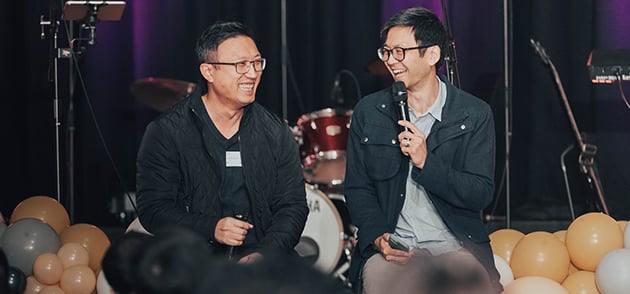
Al Stewart is the newly appointed director of the Fellowship of Independent Evangelical Churches (FIEC) in Australia. He chats with Scott Sanders about the leadership lessons he’s learned.
Key quote: “love everybody, reject nobody and go with the goers. You’ve got to go with those who will go with you. If people don’t want to, well…love them, care for them but maybe you can’t drag them along. Go with those who’ve got the vision.”
More from Al Stewart: https://reachaustralia.com.au/preaching-that-grows/

Transcript
This transcript has been generated, and can contain errors. Please refer to the original recording for the definitive language used.
Read transcript
[0:09]
G'day, I'm Scott Sanders from Reach Australia. Welcome to On Leadership. In these episodes of the Reach Australia podcast, I talk with Australian Christian leaders about what's shaping their leadership, what issues they're currently working through with their teams and what are the regular practices that help them as a leader. In this episode, I talk with Now, I've known Al Stewart for a very long time. I first met him through a mutual friend, and we started reading the Bible together every couple of weeks in a cafe,
[0:40]
just down from where he was working then as the head of YouthWorks. He's been a mentor, a coach, and now I call him a friend. And so it was a wonderful time having a chat with him about leadership and all that he's learned. Now, you may be interested to know he's also married to Kathy. and he's also a grandfather as well and he's packed all that in and so I really had a great time chatting with him about leadership. You've pressed play on leadership with Al Stewart.
[1:18]
Well Al welcome to on leadership it's great to talk with you today. My pleasure Scott nice to be here. Now I'm interested you grew up in Grafton New South Wales what were family dinners like growing up for you oh yeah we have um we ate dinner together regularly uh although it depends dad uh dad works shift work so sometimes dad wasn't there or dad was at the pub so mum would heat up dad's dinner and sometimes he'd eat late
[1:51]
or not at all um mum dad was dad was often at work at the at the jail and mum was really the the family together. But I had a happy childhood. I can't ever remember being hungry. And I, you know, was always well fed and home was a safe place. And yeah, that was good. And the North Coast, man, what a beautiful place to grow up. Now, I've done a lot of family dinners with you. One of the things that always happens
[2:22]
at family dinner with Al and Cathy is you open up the Word of God. What are family dinners Or, you know, what were family days like for you when you had the four kids running around? Yeah, that was the routine that we had at the end of a meal. Actually, usually if we're going to have dessert, I'd always have it between main course and dessert. We'd read the Bible because you won't get any dessert. It's always some pretty good leverage. And we would read a little part of the Bible and talk about it.
[2:55]
When the kids were small, sometimes we'd get them to draw pictures of what we'd read. we still do it if the kids come up it doesn't matter who's there we open the Bible read a part of it if our kids are there sometimes sometimes it's a 30 minute robust discussion about it sometimes it's just grunting and then we ask who wants to pray or things to pray about usually I get the job because I'm the dad and then we pray and then maybe we'll finish our meal
[3:27]
so they know it's a routine it's good So you're a big reader. You read the newspaper regularly. You're always reading a book. You're always learning from someone. Who are you currently learning from? I haven't read a lot on actual leadership lately. I mean, I can tell you the best books I've read about leadership, but the last year I've read a mountain of stuff about the men's issue, men, masculinity, fatherhood, raising boys, raising girls. because I'm trying to write a book about what it means to be a Christian man.
[4:00]
So I look over here. I think I've read 30 books. Now, I've had a long service leave last year. I'm a slow reader, but I plod through. I take notes. Yeah, so that's what I've been reading. Let me think what's best. Steve Bidolph's books on the new manhood, he is a very good writer. I don't know where he is in terms of the Christian faith But he's a communicator, he's very good And yeah, so that's what I've been reading
[4:32]
And so what prompted you to write the book or start writing a book? There was a young guy at a Presbyterian men's event in Chatswood About two years ago Asked me at a question time in this little men's convention and what does it mean, what does it look like to be a man? And I didn't take the young bloke seriously. I kind of fobbed it off with a cliche or two. And I thought later, this kid doesn't actually know.
[5:03]
He hasn't got role models. He hasn't had anyone sit down and work it out with him. So I begin this little book with an apology to him, whoever he was, and it's working through what does it look like to live as a Christian man. And then the Bible talks about us as in different relational roles, as husbands, fathers, sons, brothers, workmates, et cetera. So that's how I've written the book. It's being edited at the moment.
[5:35]
Someone might even want to publish it one day. Who knows? Now, that was where I first came across you. media you and we started reading the bible together over over many breakfasts uh i i've learned loads from you but you also strike me as someone who learns from people um so who who have been the role models and the influences that have shaped you and your leadership yeah um quite enough i've had the privilege of working with some very fine men over the years um
[6:11]
uh philip and peter jensen uh let me i'll tell you the guys and some of the key things i've learned from uh from philip jensen i think i've learned over 40 years the value of relationships uh long-term trust and a common mind and uh i mean the other night i went and saw him and talked over two hard problems i've got with him at the moment and that's his 40 years of friendship there that and he's built a long long line of men who've invested in their lives and
[6:42]
that it's been great to see I think from Peter Jensen I learned the value of the the calm non-anxious presence and don't rush Peter will take his time making decisions that's and that takes courage and also humility like I saw him as the Archbishop of Sydney It's absolutely lived out. It's not about me. Very impressive. Andrew Hurd's another guy. I think I've worked for Andrew at the moment.
[7:14]
And what I see in Andrew is a discipline of thinking things through carefully. I'm Mr. Ready, Fire, Aim. Andrew has this kind of iron discipline in the way that he thinks. And also about where will this decision lead in a year, two years, ten years. whereas I just want to fix it up for this afternoon. So trying to learn that from him. Peter Kaldor, the CEO or managing director of City Bible Forum,
[7:47]
I just learned persistence from Peter. Peter's the ultra-marathon runner. He doesn't get tired. He doesn't get discouraged, man. He works like it's a 100-kilometre race. Amazing what he gets done. And the other man I had got to work with for 20 years was Tony Willis. and from Tony Willis I just learned calm under pressure or trying to learn calm under pressure he is he is the man like he's the ultimate swan if you like um a swan is serene and care you know
[8:18]
calm on the surface and paddling madly underneath but Tony's always Tony's when Tony's in a room things are calm but just yeah now so as you reflect on those are they you value their leadership for obviously their long-term presence in your life and their friendship but it sounds as well as i that they're different to you they're complementary to you and how you lead uh yes yes they are and so um i maybe that's why i've been able to work with them for so long that
[8:51]
they bring strengths that i when i look at that list and if i have any strengths but they They bring all the strengths that I need. Yeah. You just follow and ask questions every now and again. That's right. Yeah, what's going on here? Yeah, that's right. Exactly. Now, you've just taken on the role of executive director or director of the Fellowship of Independent Evangelical Churches. Yes. You've been director. I started the day after lockdown. So, yeah, massive timing.
[9:22]
Yep. But over the last sort of 45 years, you've worked with a large church planning network or a large church that had a network of churches. You worked for YouthWorks and been the CEO of, you know, they had camps, they had resources, they did scripture in schools. Then you pivoted to be a bishop in a large region with loads of churches. and then you came out of that working again for the diocese in Sydney trying to get church planning happening.
[9:54]
And then for many, many years and probably through all those years, you've been preaching in the city telling people about Jesus and now you find yourself heading up an independent evangelical church, network of churches. Yeah, yeah. Might be why I feel tired occasionally, I guess. so so what are you what are you currently focusing on with your new team well the the team uh FIEC is around 40 churches uh around the country um and a great bunch of uh
[10:29]
pastors that are leading churches that are you know hungry for mission and growing and most of them it's it's great a great bunch of blokes uh I am working particularly for a reporting to the which is about eight of those passes. Andrew Hurd's the chairman. In terms of, I guess, that's reporting. In terms of my team, Dean Ingham is the operations manager. Dean lives in Canberra. So Dean and I kind of inherited one another.
[11:02]
I took over this job from Dave McDonald, my good friend. I've known Macca for about 35 years. unfortunately Macca's health deteriorated and he wasn't he's not able to do the job so actually Mac was happy for me to step into the role which is which is great I'm very sorry that he's not not well but Dean was Macca's close friend for a long time and then they're working together so Dean has kind of inherited me now so I think the bigger one of the big agendas I've had
[11:37]
for Dean and myself to get to know each other, strengths, weaknesses, are we going to drive each other mad in particular areas, that sort of thing. So I've literally told him, Dean, you need to be able to say to me, stop, no, I can't do that, put the brakes on, because I get a bit excited and push ahead on things and he needs to be able to just pull the handbrake on and say, wait, stop. He hasn't done it yet.
[12:08]
but I've given him permission to do that. But as far as I can tell, we're working well together, but it's still trying to work out what are Dean's patterns of work, what's the best way to help him do his job, what are his strengths compared to mine, et cetera. And do you relish sort of doing new things, starting new things, being involved in new things? Yeah. I don't know whether that's a strength or a weakness, but it's almost like once I've done something about three times
[12:39]
So, yeah, I love new things and I've got about six things at the moment on the run that I have no idea how to do them. But that's what I love. I will work that out or find someone who can or, yeah. So that's a strength and a weakness. There's the follow through, just the kind of plotting, making something work and settling it down. I'm not good at that. So thinking about your leadership and you as a leader,
[13:11]
what are the things that you do regularly that benefit your leadership? Do you mean me personally or in a team? Yeah, personally. Me personally? Yeah. I think the way to get things done is actually the right routines to work out the patterns that make you efficient or most efficient in terms of work and then to build those into routines. So for years I would go to bed early, get up very early,
[13:46]
go and exercise for an hour, come back, shower, breakfast, bang, hit the desk and have a pattern during the week. Now that's gone out the window since it's lockdown because I can't go and exercise, I've closed my gym, et cetera. But I've now worked out another routine where I get up very early, work pretty much all day and then exercise from kind of 5pm that that sort of thing and I can explain why but but it's the routine and then also dividing up your day uh to be it for me this
[14:22]
if I'm going to read and think and write it needs to be pretty much before lunchtime uh in the afternoon my brain's okay with dealing with people if I'm trying to do serious book work in the afternoon forget it so you work out your pattern in the time of day that sort of thing and then you also uh there'll be a few key people in the organizations and networks that i'm part of that i'll be deliberate about keeping close to and keeping in touch with so that's there there's some
[14:54]
of the some of the disciplines now you you've always got an aphorism a leadership aphorism so I think when I started working at Geneva Push, I think you must have quoted this to me every sort of second day. Go with the goers, love everyone. Yeah, aphorism is a very nice word for cliche, I guess. Yeah, what I've… There's two for you. What I've said to you a million times is this. You have a great ability to want to work with people
[15:27]
and incorporate people, people are small-minded and parochial um that's one of the things i love about you but what what jim ramsey taught me 30 years ago was this love everybody reject nobody and go with the goers you got to go with those who go with you and if people don't want to well okay love them care for them but maybe you can't drag them along just go with the ones okay love everybody reject no one and go with the goers, go with those who got the vision, et cetera.
[16:01]
That's one. But the other one is, and I got this from The Contrarian's Guide to Leadership by Stephen B. Sample, S-A-M-P-L-E. Very interesting book. He says, in leadership, you spend 5% of your time recruiting the right people and then 95% of your time working for them. so i mean in the kindness of god i yeah i we were able to invite you to head up geneva push
[16:31]
and that was about 10 years ago uh you've done a great job for that but i with that really have now i don't know if you notice that i now work for you all the time right so i spent five five percent of the time inviting you into that role and now well, like, you know, I do what you tell me. I'm a director, but hey, now, what does that mean? Well, when people start working with you or working for you, it's your job to then open a door for them or follow something up
[17:01]
or make a hard phone call or how do I help the people who work for me do their jobs and kind of put an umbrella, if you want a cliche, put an umbrella over them or push a door open or tell someone to pull their head in how do I help you do your job? I think that's one of the key things in leadership. Which takes a lot of humility to hand over responsibility, hand over jobs. But I guess if you're the sort of person who likes doing new things
[17:33]
all the time, you can hand over stuff and get on to the next new thing. Yeah, yeah, yeah. So maybe it's not humility. Maybe it's just… No, Scott, I like to think of myself as a humble man with a lot to be humble about. and that is true and that is if you as you can hand things to people and let them grow into jobs often they'll do it better than you will but it also means okay well then you're you're free to go and work on the next thing yeah so in terms of in terms of thinking about all those
[18:09]
those various roles that you that you've had have there been has there been a time where you haven't been able to keep that regular routine or have you always stuck to this routine and this process? Look, I think when I started one of the jobs there, I was putting in like 12 hour days or more, leaving home at 7am, getting home at 7pm, exhausted, etc.
[18:43]
there's a time where Kathy said you better get your hours under control or I want a separation which really got my attention so that was where I had time had got out of control and part of the in in Christian ministry work there's no obvious line between your life and your ministry work. And so the people that you're mates with and you're working with
[19:15]
and you love your church and you're part of the community and where is the line? And so sometimes you've got to be able to put up the firewall between kind of quality family time and what you're doing versus your ministry. Somewhere you've got to be able to draw those. There needs to be a line. and that was one time where I the lines had disappeared that the job had just taken over my entire life so you've got to be able to put like a firewall if you like and there'll be things that you're worried about and and people and there but you need the firewall so that on the other
[19:50]
side of that you're actually physically and mentally and emotionally present with your family because Kathy said to me sometimes you're not here I said yes I am look and touch me said no So it's that firewall thing that you need, which I'm learning. Learning. It's helpful to hear that you're still learning that at 60 years of age. Only 61.
[20:21]
It's very early 60s. Now, you speak about Cathy in many ways. You two are a team and a partnership. and again, you know, her strengths are your weaknesses and vice versa. There's great complementarity in how you minister together. Yeah, absolutely, yeah. What does leadership look like in your home? Yeah, good. I'm married to a, in the kindness of God, I'm married to a very, very capable lady.
[20:53]
She's a brilliant cook, manager, administrator, et cetera. At the moment, Cathy's mum is living with us, and that's a lot of work for Cathy. So what am I trying to do? Well, in the short term, it's trying to be more useful around the house, you know, do the washing, empty the dishwasher, kind of just lift a bit of the house workload. But try and keep an eye on how she's coping with the whole thing.
[21:26]
You know, we want her mum here, she wants her mum here, just how do we manage that? But I think one of the things that I do that Cathy doesn't is I look six months, a year, two years ahead in terms of family life. So I'll think about, okay, what are we going to do to pull our, we've got four grown kids, they've all left home, three of them are married. What are we going to do to pull our family together at regular intervals so we keep the family corporately thinking of each other together?
[22:01]
at Mollymook each January and the kids are now used to, they turn up for some part of that week. It's free, it's at the beach and mum's a great cook. Well, you know, that's the right bait. Who does it when I come? Yeah, exactly. So I'll think of that and we'll do that 12 months in advance. You know, our kids need somewhere to live and so I'll think a year or two, how do we help them with their finances mortgage or can we buy property with them or that sort of thing.
[22:34]
So I'll probably think longer term than Kathy will, but Kathy's a brilliant budget and manager. She keeps track of a thousand details that I can't. Yeah. So thinking back 40 years ago, what would you tell your 20-year-old self about preparing to lead? Well, the first thing I'd say is you'd better marry Kathy Wong. I'd say that would be a very good move.
[23:05]
I got that one right. I think patience. I've got, as I look back, I have got frustrated and left certain positions too early and when I shouldn't have. There's a strength in having the testicular fortitude to walk away from something when it's not working or not the right thing. but I, if I had my time over again, I should have stayed longer in certain places and been more patient.
[23:39]
And so, you know, young men are often in a rush. And I know now as I talk to a lot of guys, younger blokes in ministry, often I'm saying, just be patient, all right? It'll be all right. You've got to give it a year or two or whatever. Just it'll be okay. You've got 40 years left. Just be patient. It'll change or et cetera. And so I think that's what I would say to 20 year old self, just, you know, just be patient, buddy. It'll, it'll happen. Great. Well, Al, it's been great talking with you.
[24:11]
Appreciate your honesty and looking forward to reading this book when it comes out. Yeah, well, we'll, it's with the editors. We'll see. Thanks Al. Good on you, Scotty. If you've enjoyed what you've been listening to today, leave a review, share or subscribe to this podcast in an ongoing way. If you want more information about Reach Australia, head to reachaustralia.com.au.