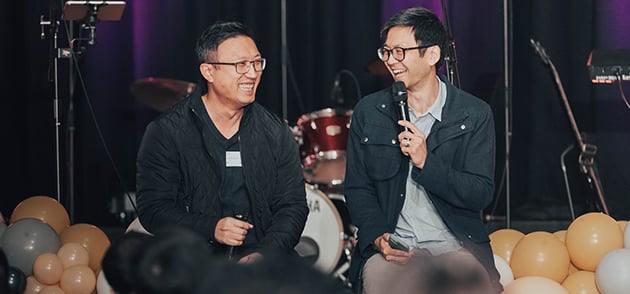
Lots has changed but many things are still the same. How does Covid-19 affect the church ecosystem? Andrew Heard (Lead Pastor at EV Church on the NSW’s Central Coast) discusses the church ecosystem with Scott Sanders. Part of a series in which Andrew Heard discusses the five key purposes of a healthy church ecosystem: Mission, Godward attentiveness, Us Together, Serve and Deep in the word. For more from Andrew Heard on the church ecosystem, watch The Practicality of Church and Mission from the 2019 Reach Australia conference.


Transcript

This transcript has been generated, and can contain errors. Please refer to the original recording for the definitive language used.

Read transcript

[0:08]
G'day, I'm Scott Sanders from Reach Australia. Lots has changed, but many things are still the same. How does the COVID-19 crisis affect the church ecosystem? Well, over the next six episodes, Andrew Heard, lead pastor from EV Church on New South Wales' central coast, discusses the impact on the key purposes of a healthy church ecosystem. going to look at the impact on mission, Godward attentiveness, us together, our community life, our serving structures, so how do we develop leaders in this context, and finally the structures

[0:41]
that get people deep in the Word. Now this first episode addresses the opportunities and challenges present in moving much of church into the remote or online space. Andrew I wonder if you could help us reflect on ministry in this time I've got to say I'm not enjoying it as an extrovert I'm hating not being able to see more than my my family whilst I love

[1:12]
my family 10 days in isolation it's it's definitely grating on me can you help us reflect Whereas all the introverts are having a ball. They're loving it. Can you help us reflect on ministry in this time? Yeah, yeah, good to do that. Lots has changed, but many things are still the same. Lots of things have changed in that we obviously can't physically meet in big buildings. As you can see behind me, there's a big empty space and it's sitting here being used on the weekends for streaming,

[1:43]
but not much else. but it has also impacted our small group life you can't meet in small groups you can't meet in threes you it's even hard to meet in twos so it's impacted all of our levels of people work but in the midst of all of that so much is still the same and it's important to keep clear on that that the great task that we're about is no different we're still about making making disciples that's the big outcome to see disciples made and breaking that down helps you just make

[2:17]
sense of our ministry purposes our ministry goals where to see disciples made keep pursuing that outcome that great cause and and that can be broken down we want to get more people one to Christ we want to mature those who are in Christ there it is now that's not any different we're context to try and work that out. And being as leaders of ministries and churches to be clear on that helps us bring to our churches, our ministry teams, clarity and confidence so that we can be

[2:55]
the non-anxious presence who that big thing's not changed. Let's find ways to achieve those outcomes in a different setting and context. And it's worth just being aware too that as we've often said Break that big purpose down, not just into two bits, but further down into what we often talk about, the five pieces. We're still about getting people to be Godward attentive. We still want people to be deep in the word, prayerful. We want people to care for one another,

[3:28]
be committed to one another ministries. We want people to be serving sacrificially, and we want people to be on mission. These things haven't changed at all, comfort as leaders to know that our task now is to I guess how do we now in a new environment pursue those big outcomes for us here it's a case of gathering together the leaders and brainstorming how we can now achieve those outcomes in a different environment and I think that's just a simple ministry

[4:01]
philosophy that you bring to whatever church you're in whatever size it is gather those who are together with you in this work and think about in this new environment how can we best achieve those goals those outcomes but the mission hasn't changed utilizing your team your lay ministry leaders the whole church to pursue that goal of seeing disciples made in ever-increasing numbers is is is what you're pushing forward with it with the clarity and with that same focus that you had three months ago it's just now there's a different context you spoke really briefly about the impact on one-to-one ministries and on small group

[4:35]
ministries on just gathering together what's that you know what's that meaning for ministry just generally what are you seeing yeah look it's i think it's early days actually for for all of us to see the the full impact in the way this will flow through for instance um very early on there was the thought that this will be the great time for the one-to-one ministry work to really flourish. And, you know, I guess I would offer there's always,

[5:08]
we always ought to be seeking to pursue the flourishing of one another ministries. I'm not sure this is any easier to do that than it ever was. In fact, it may well turn out to be the case that it's easier to deliver content and word to many from one through the streaming processes than it is actually to do the one-to-one. So time will tell which has become the harder.

[5:40]
There's an initial enthusiasm where Zoom has been, you know, taken up with great sort of enthusiasm by many people. And that will fade. I think, Scott, you've reflected on the difficulty of being in the hours of Zoom meetings. And it's very tiresome. So, look, I think the one-to-one work will be difficult as well in this environment. You can't easily go and visit someone in their home. You can't sit down with someone easily either.

[6:10]
And so I think the whole range of ministries that we're involved in has its challenges now. But there's great opportunities in it all as well. So I think you spoke, well, we were chatting about this last week, but the real opportunity there is for families. And for, I mean, in terms of the one another, that's the one another that we're having at the moment. and our nuclear families and then a few other people that are part of our bubble or part of our sort of social isolation grouping.

[6:41]
What do you see as the opportunities for families ministries and for ministering to our actual families in church life? Yeah, huge. Yeah, I think there is one of the great opportunities for us is to equip, help encourage particularly men as fathers, husbands in the home to to realize there's none of the easy supports around them now and it's become difficult it's a difficult context and it's time for them to step up and make the

[7:14]
most of this particular time and in many ways it's a bit like a family being sent to another country where all their family support structures all their other easy support structures have disappeared it's a little bit like that and sink and swim and we want to we're working hard here to help our men particularly but but men and women to swim to to actually take hold of this particular context and learn how to build patterns into family life that should have been there and in many cases have been there for a long time but things like you know dinner at the table where the father opens

[7:50]
the bible and prays with the family and talks about their life and their christian walk and so building structures in their week, in their day, where they have time for personal Bible reading and prayer, building time where even a mum with the kids can develop weekly patterns of not just learning, because they now suddenly become part-time school teachers, but also spiritual input and discipleship, opportunities to minister.

[8:20]
Kathy and I heard of one couple who have built into their family life the expectation that at one time during the day, the kids would all look for ways to help those around them by phone call, by text, by contact, visiting as they're able to see if any elderlies and shut-ins need help. These are great opportunities for families to step up and make the most of this time. Now, one of the things I've always valued about your vision, your leadership is having this bigger vision,

[8:51]
a vision that's bigger than your local church, a regional vision. what are the opportunities that online church you know presents what are the dangers it also presents for thinking about actually reaching out to our local community like thinking out thinking into reaching into our local region yeah yeah look it's never been easier to get church into people's homes or people into church uh though there is some question around what church actually is in this context we need to reflect on that but it's never been easier to to

[9:24]
get my friends and family to sit and listen to the experience of church and so this is an extraordinarily wonderful opportunity mission-wise of the the one speaking to the many and you know we've always thought that was a powerful contextual environment to bring your non-christian friends to the experience of god's people gathered well now we can take god's people kind of gathered into the home and that is hugely powerful. We are hearing stories regularly now of unconverted family

[9:57]
who are sitting in the house, able to listen to church, sit through church, talk with their Christian husband, Christian wife about things or send links to friends, family. I mean, we've done it with all my family is unconverted. So, you know, Cathy has been sending links to family. This is a fantastic opportunity to bring the gospel into people's homes. But there are some significant challenges with that. And probably more for the Christian than the non-Christian.

[10:30]
The challenge for the Christian is now the massive amount of resource available. And it's now possible to stream into whichever church you actually start to enjoy the most. And so, ironically, in a more difficult time with the lack of ability to meet, there is a greater capacity for consumerism amongst Christians, which we need to take care and heed of. For instance, we do want to encourage congregations to preference the however frail and faulting the ministry of their local churches streaming is to preference that.

[11:13]
because they're the community that they belong to. They're the ones, that's the church where the pastors there have heart and concern for their spiritual wellbeing. And so to encourage our people not to become consumers, but actually make the most of their particular church ministries, this is an important time to do that as well. How do you do that though? As a leader of a church that has a good presence, you've been able to pull together a team to get an online church done quite well.

[11:43]
How are you doing that just as you lead from the front, encouraging people to be going to their own churches? Yeah. At the moment, we're doing it through all our network of leadership back through church. Yep. So our small group leadership, our ministry teams, we're using these avenues as communication pathways to nurture the leaders who nurture people in their group to work that whole process

[12:13]
whatever communication means they can, you know, whether it's Zoom weekly in their group or whether it's text messages, phone calls and so on, but to work all those normal processes. We've got other things operating as well. We call them care callers to connect with people who aren't in small groups, who are part of our church community more broadly, all kinds of communication paths we use. So what about for the non-Christian? I can conceivably say after this that you might be connecting with someone in, let's just say, Victoria.

[12:43]
they pull up on the feed and they, they enjoy coming along to EV church on the central coast after, after restrictions have been, you know, closed back down. EV goes back to not streaming online. What happens to the non-Christian is connected in with church in the central coast. Who's living in Melbourne, for example. Look, yeah, it's a helpful question. It's, it's something I think we need to pay attention to as we begin to see the possible end of the restrictions.

[13:13]
we'll have to then transition back into a context where we're localised, where we're embodied, where we're caught back up again in the local community event. And I think we'll need to do a lot of work to help people move out of the online virtual experience into the real experience. Part of what we need to make sure we do at present is to not so talk up the online experience

[13:44]
that people are left thinking it's equivalent to church and just as good as church. One of the things we're working at doing, which probably goes back to an earlier question you raised, one of the things we are doing in the larger context is reflecting on the grief that we ought to feel about not being able to be in each other's presence physically. We have lost something very massive in losing the ability to meet as a church to gather.

[14:15]
And online is only an approximation of church. It's much, much less than the proper experience. So one of the things that's kind of beneath all our ministries is a desire to help people in all kinds of small ways see that when we have the opportunity to gather locally, physically, we need to grasp it with both hands. for how precious and wonderful and important it is. And if we do that, particularly as we're coming closer to the time when the restrictions might end,

[14:46]
I think we will go a long way to help the newly converted person through the online experience transition into a localised church experience. Can you call online church, church? Is that the right name for it? Look, I wouldn't run a crusade against people doing that, but I think there's great dangers with doing it. The danger of using a biblical label, the ecclesia, the church, for an online experience is that all the attributes of the ecclesia in the New Testament can then inappropriately be connected to the online thing.

[15:29]
and there are many dimensions of the physically gathered body of christ the church that simply don't apply to an online experience of gathering they're just just one i'll give you a few actually i'll give you a couple one is the experience of the spirit so where two or three are gathered in my name there I am among them says Jesus now is that true of the virtually gathered community 1 Corinthians 3 the the gathered community is the temple of

[16:04]
God 1 Corinthians 5 you get this similar idea of being gathered to discipline the immoral brother the these things kind of reflect on the importance of the Holy spirit being dwelling in the gathered community of god's people now if we call the online experience church our danger is we'll take that truth which is true of the embodied physically localized gathered community and apply it to a diverse separated scattered community in a way that's

[16:39]
unhelpful the other one that comes to mind particularly the Easter coming up is the lord's supper. 1 Corinthians 11 makes it plain that the Lord's Supper is an experience of the gathered community, not something you do in the private home. So Paul does distinguish there in chapter 11 between when you gather and haven't you got homes to eat and drinking? And so just a little danger of calling the online experience church is that you can end up transferring various features

[17:11]
and aspects that are particular to the embodied experience, to the diverse experience. So, for instance, we won't be doing the Lord's Supper through this period until we're embodied, gathered, localised again, because I think it's appropriate to that experience. So that's what's behind your sort of online approximation of church, that you'd want to only say it's an approximation, it's not the gathered church experience that we see in the New Testament. Yeah, but because it's an approximation,

[17:43]
I don't think we ought to condemn those that might talk about it as church. You know, I don't think it's something that we ought to be pharisaical about at that point. But we just need to be aware of the danger of using that language is it can carry biblical themes, truths of the gathered physical experience and apply it more broadly. Now, there are, you know, various people have been thinking about this and talking about this. I think helpfully you've got Lionel Windsor and Chase Kuhn I think they would be happy to call the online experience church.

[18:15]
And I don't disagree with that. Mikey Lynch has done some helpful thinking in this area too and delivered some material on that. And I think he would be happy to do the same call at church. I don't have a great beef about that. I think there's much to commend it, but just watch what then gets pulled in its train is the issue. Just to finish, one final question as we close. guess what are you most looking forward to for your church at the end of

[18:46]
these three, four, five months of isolation? Oh, most looking forward to growth. The Lord Jesus is building his church. The gates of hell can't prevail against it and no virus is going to prevail against it. And God is working all things together for our good, even this experience. And so I'm, I'm looking forward very much to the possibility and I'm confident that we'll we will actually come back together as a stronger community of faith that we'll have a group of people who have been helped to take heed to themselves and

[19:24]
perhaps take some steps in their own personal growth and maturity worked hard at being proactive at connecting with each other in a difficult context so that when we finally when when the bonds are the kind of chains of not being out again and find that almost easier experience of being now localised and together, I'm hoping that will be a richer experience as we move forward. And we'll have many more people, I think, come to church because they've had an experience and taste of the gospel in their home in a way

[19:59]
that they just might not otherwise have had. So I think we'll see lots of new people in church, lots of matured and deepened people in church. we're just going to take a quick break to hear about something new that reach australia is doing hey i'm mike one of the church consultants for reach australia to help your church during this time we've started offering free 30-minute online church consultations we can help particularly think through a 90-day plan making disciples improving online gatherings and even your care

[20:33]
support plans. To book yours, go to reachaustralia.com.au. You've been listening to the Reach Australia podcast. If you've enjoyed what you've been listening to today, we'd love it if you'd leave a review, share or subscribe to this podcast in an ongoing way. If you want more information about Reach Australia, head to reachaustralia.com.au.