

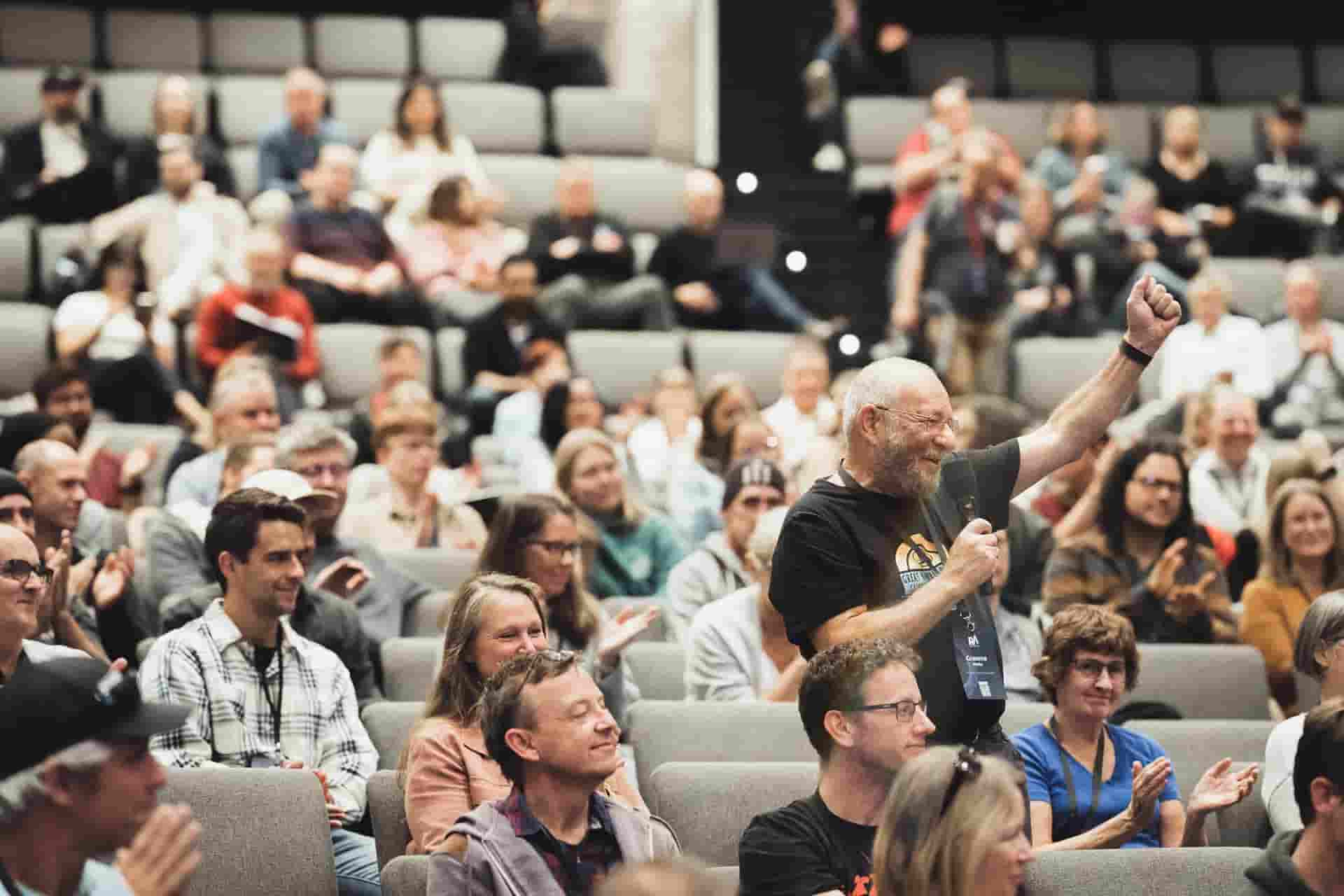

Ed Stetzer applies his international research to the challenge of raising up leaders ‘from the harvest’ of Gospel work, so that churches naturally perpetuate themselves.
This talk was part of The Geneva Push’ 2012 Multiply conference in Sydney, which addressed the process of producing church plants that naturally plant churches.

Transcript
This transcript has been generated, and can contain errors. Please refer to the original recording for the definitive language used.
Read transcript
[0:00]
I want to come back just briefly to where we were kind of ending the last time and just address a few things that I think will be helpful. And then it'll kind of relate to the issue of leadership as well. These are some principles to drawn from viral churches, which is based on the largest study of its kind ever done. That looked at what was leading to actual church multiplication. It was a group called a leadership network that contracted with me and our team to do this research.
[0:30]
It's a very large project, I guess six figure plus project that we hired dozens, dozen plus people to work for eight or nine months on the project and kind of look at what some of these are some principles we kind of drew out. Actually, the report is about 450 pages, but because it names names and says who's doing things well, who's doing things poorly, we didn't, that wasn't to be released. So, but we put it into a popular book. Well, I don't know if it's popular, but we put it into book and hope someone would find it a benefit. And I just want to kind of draw some principles.
[1:00]
Real quickly out of that book that may help along the way, not by repeating it because some of you have indicated to me, you've read it. I'm grateful for that. It's not available here. There's no bookstore. I like speaking at a place where there's no bookstore, because then I don't feel like I'm selling a book because I'm not. I just want to share with you some principles along the way. A couple of things. First is a matter of fact, I encourage you to read my blog today at edstetzer.com because I've written about point number one about multiply everything. And really the importance here of creating a culture of multiplication in everything we do as Christians. I so appreciate it. What Scott just
[1:30]
did a minute ago where he talked about apprentices and MTS, MTS. And I'm going to talk more about that as we talk some about this issue of leadership. But multiplication here, here's the problem. We go before the churches or church or churches. And we say we want you to start new churches. We want you to multiply. And yet they've never seen anything multiply before in their lives. And so it's just a shock to the system. A better approach is I think to teach churches to live multiplication at every level. So the churches are multiplying disciples.
[2:00]
Multiplying groups, multiplying ministries, and thus out of that multiplying churches. So there's actually the Wesleyans with the Wesley Center. I was speaking at the Wesleyan national meeting in the States. And it was they who gave me this term. I was going to talk about on church multiplication. They said, but we want to talk about multiplying everything. Disciples, groups, ministries, and churches. So think of those four things. When you have that culture in your church and the first three are multiplying, then church multiplication makes sense. When there's no disciples that are multiplying,
[2:30]
then church multiplication is simply the division of a few number of disciples. So part of that is you yourself kept to model that multiplication. Now you wouldn't be here today if you were not a pastor or an elder or a key leader in a congregation. And so really for you, you've got to model that. Who are you multiplying yourself into? I'm going to close this presentation with much more in depth conversation on this. Now another issue we find in church multiplication is the importance of letting churches lead. When you see successful churches
[3:00]
around the world, I think particularly of a group of churches in Europe that have become effective in planting churches, they've been effective in planting churches because it wasn't driven by a denomination. It wasn't driven by a network. The denomination or the network was the agitator. They would agitate again Hebrews 1024. They would provoke one another to love and good deeds, but local churches owned at the ground level, at the local level, the desire to plant churches. Another issue for movements that want to see
[3:30]
is that there is increase in church planting is the necessity of making planters feel welcome. Making planters feel welcome. I spoke to a group of the Pentecostal churches and their denomination of Pentecostal churches. One of the things they've done globally, and this is actually right now in their best year of church planting, is they've actually created a pin. It's a little silly. It's a pin and it says church planter. Now and if you mother a church, you get a pin. It says,
[4:00]
mother church. If you mother two churches, you get a little star in your pin. Mother five church, you get a little diamond in your pin or something like that. I want you to know, it seems really silly, but I want you to know that for them, they have chosen to celebrate church planters. Many of you are, let me just be blunt, many of you are in denominations where movements where people are suspicious of you when you're a church planter. What's them, why are you doing this?
[4:30]
What are you up to? What was the matter with the established churches? You've done something wrong to step out of the rightful path. When denominations and networks and families of churches are like that, they tend to lack church planters, why? Because church planters are not welcome. My denomination in the States tends to see, not always, but tends to see church planters as their competitors rather than their families.
[5:00]
They're coming into town, we've already got a church there, they're starting another church, why not help me instead of starting a new church, which is one of the reasons that we end up with a lower percentage of people planning churches. I want you to be a movement that welcomes church planting. How do you know that? You see it in the schools, you see it in the annual meetings, you see it in the celebrations. Listen, when you're a movement, what you celebrate, you become. Right? If you celebrate strong expository preaching, your people
[5:30]
will become more focused on strong expository preaching. I encourage you to do that. If you celebrate, I can give you a thousand things. If you celebrate church planting, your movement will become more about church planting. So what you have, I don't, you know, different groups have different meetings, you have an annual meeting. If your annual meeting is devoid of the celebration of church planning, if nobody has a pin or pins with stars, that might tell you something about the movement. Now for them, we might roll their eyes and say, that's silly, but I want you to tell, I think it was a wonderful idea because what you celebrate, you become.
[6:00]
And celebrating church planting is necessary to see viral churches moving forward. I would also encourage you to define Missional Well. Missionals of Buzzword, maybe use it, maybe you don't. I do. I've written books, several books with Missional described and explained. I've actually written a Missional Man of Festo with a series of pastors and scholars and others to really lean in on what we mean by the term Missional because it's become in many ways a meaningless word. Everyone's using it in different ways. But I would say this, if your definition of Missional
[6:30]
is not included the advance of the gospel for the, the planting of churches that preach the gospel, you've defined Missional poorly. If you say you want to join God on His mission and I'm good with that, Jesus said in John 2021, as the father has sent me so send you, if you say you want to join Jesus on His mission, the disciples upon hearing the commands of Jesus in Matthew 24, 46 through 48 or Acts 1, 8 or John 2021 or, or, or else. If we, if we hear the great commission, if you want to join Jesus on his mission, the disciples upon hearing the commands of Jesus in Matthew 24, 46 through 48 or Acts 1, 8 or John 2021 or, or, or, or else, if we, if we hear the great commission,
[7:00]
in Matthew chapter 28, the disciples upon hearing those commissions of Jesus. You know what they did? They planted congregations. People say to me, well, church planning is not commanded in the Bible. Well sure, neither is the definition of the trinity given in the Bible. But the obvious presence of that belief is there about the trinity and the obvious action of church planting is throughout. The New Testament is a series of church planting events and then letters written to church plants that are having problems.
[7:30]
So defining mission well means to join Jesus on his mission? Great. That will include the planning of churches. Let me encourage if you want to get serious about a movement is to plant by multiplication and not by funding. Once you hear this, you cannot buy your way into a church multiplication movement. You cannot buy your way in a church multiplication movement. Matter of fact, I would say one of the great mistakes that has taken place in church planting around the world is the oversubsidization of church planting that has created a mission dependency rather than a permission giving structure.
[8:03]
Another is to be born pregnant. I know that's a strange phrase. I debated whether or not to include it in there because I'm trying, you know, when you're in a different culture, you're in different contexts. I'm trying to be more cult contextually appropriate. I know some speakers come in and they don't wear, I do worry about that. This is actually a reference to a TV show, but considering that every person, again, the Simpsons reference, Al, Al, the Simpsons, you'll stand before a holy god to defend that
[8:34]
reference one day. Vane imagination that you have expressed before this group. But that's actually a reference to Star Trek. You've seen Star Trek? Yes. Wagon trained to the stars. Gene Roddenberry called it premiered on September 8, 1966. Wow, I just geeked up the whole room, didn't I? And to low ratings, just premiered six days after my birthday. The most famous episode of that whole series is written by a guy named David Gerald.
[9:07]
The name of that episode was, anybody know? If you know you're not going to say, this is the geek sign, the loser sign might be given. It's called the trouble with tribbles. So you may remember the tribbles episode, oh, lots of people are shaking their heads. In the tribbles episode, I won't go through the whole story. Scott asked me to make my story shorter. But in there, sorry, I was not supposed to say that to everybody. I've noticed, I'm starting people like to push back. And yeah, when I'm speaking in Melbourne, which is a very nice place, I get up and I do
[9:41]
my whole message and the first guy gets up and disagrees with me, like, right, this was all in their other views. I'm like, yeah, four people hold that view. The entire rest of Christendom holds the view I just presented. But it's like, it's a cultural thing. And it, I mean, is that a cult? You just sort of, it's contrary to, I like that. I like that. It makes me feel good about being a jerk. And so I'm embracing that. So Scott, I just publicly kind of brought you out there. But as I'm going to continue to tell my long story, contrary to your advice.
[10:11]
But in this episode, these little tribbles sort of take over the ship and they keep eating everything. And they save the world because they eat the grain that's poisoned, blah, blah, blah, blah, blah. I won't give you all the details. But I think I just did. But at the end, I've got to figure out how do we get these things to stop reproducing? Isn't that what you want people to say? How do we get these churches to stop reproducing? It seems to me that 99% of churches are on some serious birth control. And so the question is, how do we get them to start reproducing? Well, what the tribbles, the answer was, was real simple.
[10:41]
Dr. McCoy said to the captain, said, I figured it out. He said, he said, they're born pregnant. All you have to do is feed them and they multiply. Well, I want your church to be born pregnant. In other words, from the day you begin to have another church inside of you ready to be sent out and say, well, how do you do that? We're starting with 20 people. How can we do that? You can do it in vision. You can do it. So the first service of our church, the first service of our church, I get up and said, we're going to plant a church in the first year.
[11:12]
Now, maybe that's too soon, maybe it's between the second year. But part of our DNA, and that's a pithy phrase that we use around the world, part of our DNA, what's the DNA of your church? Well, disciple making or caring for the hurting, whatever it may be, part of the DNA from your church for it to be born pregnant, to say, we're going to plant churches, that plant churches, that plant churches, that plant churches. Gunsay it five times just to irritate them. We're going to do it. And so we're going to be born pregnant. Now, let me challenge you on this one. I want to encourage you to open more lanes.
[11:42]
Now I've only been in Melbourne and the city and in Sydney and the city. And so when you get out of the city where shops are smaller, do you have like large super stores with like 16 checkout registers and like that? They're saying, yeah, okay, so you know what? We have Walmart. Good, good, be thankful. Well, Walmart is kind of our big store. And what they do in Walmart is they take these lanes and they're 16 lanes. So 16 checkout counters could be going at the same time.
[12:16]
16 clerks could be checking out at the same time. But whenever I go, it's always me and nine people in one lane and all the other lanes are closed. They've got a little chains in front of them and you can't go through your non-unite. You know exactly what I'm talking about, right? So it's exceedingly frustrated. I want you to know that's what sometimes it looks like in church planting today. We've got a long line of people say, well, if I just had money, I'd go plant a church. If you could fund me, if I could raise the resources, I'd go plant a church. So they're all in the fully funded, give me money to plant checkout line.
[12:49]
When the reality is, is there are some other lanes we could open. I want to encourage you to consider them. For example, like a lane of ethnic leadership that says, you know what, I don't have to wait in this lane. I'm going to work with an ethnic fellowship of churches and we're going to plant a church or maybe giving some lay people permission to begin to start a congregation, maybe in your polity that will be led by a credentialed ordained seminary trained pastor. Maybe that lay person will become a credentialed seminary trained ordained pastor, but open
[13:19]
that lane. The bivocational lane, the urban lane, but the idea here is this, you never have a movement when everyone has to go through the same lane to get, or I guess the same shoot, if you will, to get through there. You have to have more than one shoot for that actually to happen and for true movements to take place. And that's going to be a leadership issue. I'm going to transition to in just a minute, but that requires you to give permission. You have to get to the place where you can give permission for God's people to take
[13:54]
up the leadership God has called them to. Now, most of your Anglicans, by the way, I came to Christ in an Anglican church. And I love my Anglicans, my favorite Anglican is dead. And his name is not because he's dead. I mean, it's not, you know, the only good Anglican is a dead Anglican. It's nothing like that. But my favorite Anglican is a man by the name of Roland Allen. And I think when I was asked to speak to the Anglican 1000, they're seeking to plant
[14:30]
a thousand Anglican searches. And they asked me to do a seven part series. I think I made it seven parts. They asked me to do a talk for an hour, not 45 minutes, like Scott gives me. And the question to the talk was, what would I do if I were an Anglican? And so it was kind of if I were an Anglican was the name of the talk. And so I gave, you know, so one of my points was if I were an Anglican, I would read more Roland Allen. And why? Because of the things he wrote, for example, he wrote a book called Missionary Methods, St. Paul's Or Hours.
[15:01]
Because at some point you really have to, I know it's crazy, but when it comes to the role and the training of pastors, at some point you have to actually intersect with what the Bible says about the issue in wrestle with that. See, because ultimately, if, if as evangelicals, we hold that the Bible is the authority for what we do, that should also be reflected in how we train. And if we say, no, no, no, we will not allow what happened in the Bible to happen today. We really have some explaining to do as those who take the Bible seriously.
[15:35]
I mean, that's ultimately what some say. We will not allow to happen today what happened with Paul. So again, his book was Missionary Methods, St. Paul's Or Hours. He wrote another book called The Spontaneous Expansion of the Church and causes that under it. And another book he wrote called The Case for Voluntary Chlorgy. And I love all of them because they speak to this from a Anglican confessional tradition, what might it look like if we gave permission for some others to be engaged and evolved?
[16:05]
Now when I said this to the Anglican 1000, the Anglican 1000 is part of the group of Anglicans that are coming out of the current national jurisdiction there, and forming an evangelical alternative to that national jurisdiction, there were, and some of the seminaries had come out and some of the others. But you're not unaware that the, theologically the current jurisdiction has kind of left in much of orthodoxy. And so one of the people, the head of the seminary, raised his hand and you could tell he
[16:37]
didn't like what I had to say. Now I'm very pro seminary. I have four seminary degrees. I don't say I had to impress you, but I love seminary. I'm on the faculty of three seminaries right now. I teach, I think I've taught some of you at Trinity, where I'm on faculty. A couple of the folks here, we're in one of my classes at Trinity. And so, so I love theological education. So the head of one of their schools raised his hand and said, but, but how do we not, how do we guarantee orthodoxy without theological education? It's a great question. Here's what I said.
[17:08]
I said, if there's ever a group of people who should know better that theological education would guarantee orthodoxy, it's Anglicans in North America. And they had a nervous laughter like you did as well, because they didn't know if they could approve of that as well. Now I believe in finding ways to provide theological education. I'm going to talk about some of those things. But what I want to say to you is if you want to move to move mental expansion of churches in Australia, you're going to have to find ways to give permission to people to do
[17:41]
planting in the journey of theological education. Now I'll give myself as an example. I planted my first church when I was 21 years of age in the inner city of Buffalo, New York, among the urban poor. Not the urban, you know, when Tim Keller speaks about urban, those were not my people. I'm like, really that's urban? I mean, my people had guns and drugs. And that's where I went. So Tim and I had different mindset, different world. But you know what? Someone gave me permission. And they said, you go and you'll have someone who watches over you.
[18:13]
You'll have someone kind of watching and encouraging and covering you. And you'll do theological education as you go. And in doing so, we're able to go into Plents or to take a permission to do that, though, we have to overcome some fear. Now I want to talk now, and I'm going to transition to this issue of leadership. How do we get to move mental leadership along the way? Well, General Atlas, really simple here is we're going to talk about what makes leaders, supporting leaders, and then leaders from the harvest.
[18:45]
I want to look at each of those things, what makes them, how do you support them, how do you get leaders from the harvest. And I want to draw from some research that is from several denominations that have a global reach. And some of their experiences, they have a global reach in Western settings. So in other words, the denominations I'll talk to, the drawings I want to come from. So they'll draw from Western settings. But this is not, I really do believe there's a different misiology in the two thirds world. Misiology is a discipline, but then there are misiologies.
[19:16]
So I'm talking about a Western misiology here that would be appropriate in this context. So for example, real quickly, I want to touch on this as we did a study of church planting in this case in North America. And then drew the principles from their experiences around the world. And what we did is we actually did this research. We did a multi-denominational study for church planning's fraudulent health. And then we analyzed further in the denominations requested. And we looked for statistically significant factors to form practices of church planning by the denomination.
[19:49]
And then I asked these leaders, whose denominations were leaders in these areas, to put together some resources for us. And so those include the Evangelical Free Church, the Four Square Presbyterium, Some Wies of God, and Baptist General Conference along the way. And so what we did is we looked at certain things like this. I just want to give you some introductory ideas, and then I want to get to the issues. We looked at baptisms or conversions by church plant per year along the way. And then what we did is we looked at factors for higher baptisms. So in other words, we looked at using simple statistical tools like SPSS and SAS or programs that we can use.
[20:27]
We can actually say that churches that did these things in their church plants, we asked them over 100 questions, churches that did these things in their church plants had a correlation with a statistically significant higher number of baptisms or conversions in the church plant. Now I don't spend a lot of time in that because this is a, you need to do research on Australian churches. And so I'm spending a lot of time here because these are specific things to a North American cultural setting that when they did these things, these were found to be the case.
[21:02]
Now, and we looked at things like survivability. What makes the church more likely to survive? And there are four factors that were statistically significant at the inferential level. For example, the church plant or expectations, if a church plant or had realistic expectations going in, they were 400% more likely to have their church actually survive. That was the number one factor, by the way, that led to survivability is realistic expectations. That's one of the dangers of those conferences. They go to conferences and they hear, well, I planted this church.
[21:34]
I don't even know. I just started preaching to the Leviticus and the thousand people came. Well, there's more to this story than that. And so, so, so again, expectations. Leadership development was key. Increased survivability by 250%. Being in a church plant or peer group increased survivability by 135%. Having a stewardship plan. So we went through these things. And then we actually, and you're not supposed to see this. You're not, I'm just putting it on the board to get a general feel. We then began to look and say, what were the denominations that were strongest in each area so we could learn from?
[22:07]
If you did something like this in Australia and you find out that the four square, we're doing the best job right down in this area here. You see the four square are doing the best job by supervising, overseeing, and being in community with their church planners. So then we want to say, what's the four square doing? We want to learn from the four square. Or if we find out that on assessment, on assessment, the only one that was statistically significant in their assessment process was the Presbyterian Church in America. I think that's on the next slide. And so then we say, okay, well, the PCA is statistically significant in their area of their assessment.
[22:41]
So we put these things together along the way and we get a picture of what's going on in these church plants. Now, it is from that that I'm going to draw some of these conclusions along the way. And I want to give you some systemic ideas to support. And then I'm going to talk about raising up indigenous at the end, leaders. And so I'm drawing this, for example, this is from the Evangelical Free Church, where they have a combined North American and global focus. And they talked about the necessity of supporting.
[23:13]
Here's what they said. George Clippenis, by the way, is the name of the person who helped develop this part of the presentation. And he said, our plan of vision was, was no planter left alone. But the reality is, is our planters were stranded, disconnected, and unrelated to one another. So some planter would go off to the equivalent of Brisbane, and the reality is there be no connection along the way. So they've made a commitment to create a system that would give an ongoing relationship to support leaders.
[23:43]
I'm starting with supporting, then we're going to talk about raising up new. So for them, they included assessment, which I'm going to address in a minute. Coaching, training, and supporting. That these things became key parts of the success of a church planting approach. Now, I wrote my PhD dissertation topic on the efficacy of church planter support systems. So this is the stuff that I get particularly passionate about. And here's why. Because when I planted my first church in the inner city of Buffalo, New York, there were eight church planners who were sent with us to that city of 2.1 million at the same time.
[24:18]
Of the eight churches we tried to plant, only one is left of the people who went there, five are now out of the ministry, and three of them are out of the marriage and out of the faith. And so it was, there's this remarkable scene in the movie, Saving Private Ryan. It's a rated R movie, so you, I'm sure you haven't seen it, neither of I, as a Christian. But I've heard, I've heard about this movie. And from what I've heard about this movie, the opening scene, there's this character, Captain Miller, I believe his name, Tom Hanks plays him.
[24:49]
And they kind of landed the beach, by the way, 3000 Australians landed on the beach that day in on D day. So they land on the beach, you know, you guys were busy in the Pacific. We appreciate your help in the Atlantic as well. And so it's landed on the beach and started going up. And just if you saw it, these boats would come in. They call these boats the ducks. They were amphibious vehicles. And that's by the way, where we get the expression sitting ducks. Because they would come in, the boats would open, and the machine guns from the shore would kill everybody in the boat.
[25:20]
They were sitting ducks. But a few got down, got down to the first level, and then you could see, I mean, it's just brutal, if I had seen it, which I hadn't. But just brutal battle. And so machine gun fire, and so they get down to this first, it's not even a trench, but this indentation, the sand. And they got to get up there because there's this pill box with this German soldier with the machine gun killing everybody. And the Tom Hanks character says to his sergeant, we got to take that guy out. And he says to, he says to, that means two men. And so the sergeant points to two men, they stand up and they're just shot to pieces. And Hanks says the point sergeant says to, and two more get up and just instantly kill.
[25:54]
I mean, just brutally, I mean, just it's hard to watch if you had seen it. And then he said, and sergeant's like, what are you doing? And he says, we got to take it. And he says to, and then just then, some guy, one guy, one guy, he becomes one of the key players of the whole movie. He stands up, he takes his rifle, he points, and he's a sharp shooter. Boom! And he takes out the German, the pill box, and they make it through, and they live, and they survive. That one lucky shot. That's what a lot of church planning looked like 20 or 30 years ago. A lot of people mowed down on the way, a few people get through, and get a lucky, lucky shot.
[26:26]
So what's happened is, is over the last 20, 30 years, and it's really, and to be fair, you know, this is one of the, if I could say, one of the good contributions that have come out of the states for good. Global Missiology is church planting support systems. Bob Logan and others in the late 80s and the early 90s began to talk about these things. And most of the systems, and by the way, one of the things I did is, I read every book in the English language published since 1950 on church planting in the West. And I can tell you that since that time, as part of the project for Leadership Network, there was a shift that before that time nobody wrote about supporting church planners.
[27:02]
They wrote about churches planning churches. And now we're talking about, and that's these kinds of systems that matter. So we're talking about leaders. We have to have systems that support leaders and ask the right questions. And that includes things like assessment. These are the questions that they ask in the free church. Is he a planter? Does he have a good plan? How can we train in that area? Coaching. Does he have someone to help him stay on target on time in an imbalance? And funding. Does he have adequate funding to be successful? And so they're asking these questions. Now, these questions are going to be shaped by where you're going.
[27:36]
You know, when I planted my first church, I, I, I, I don't know, I blew insulation. I installed insulation in homes. I had another job. And so my job was installing insulation. I had adequate funding. But now, I made, I was part time. I think I made $18,000 is what I made half time that year, $18,000. And that was not like in 1922. Some of you might be thinking right now. I was in the early 1990s. And so, but that was adequate funding because I had a job. I was blowing insulation. And so I had adequate funding. I could do that. But sending somebody out without these four questions in place means that we're being a bad steward of the leaders that we are calling forth and creating.
[28:15]
I'm going to talk about those leaders in just a bit. But the majority of our presentation, I want to, I want to give some learning from the Presbyterians. Steve Childers shared this part. I'm going to share some of this. Steve and I have been friends. We've had the privilege of, I teach with him down at Reform Seminary in Orlando. I guess it was he marked ever and I taught, of course, last time I was there. And, and also we've trained these, these materials in Japan. I mean, they've been used in Africa, Europe, other different places. And I want to share some of this because I want to help define some of what we're talking about with these kinds of systems that will ultimately create what we call a helpful church, church planting network.
[28:56]
An intentional multi-year process that equips leaders developed the essential components necessary for a church playing network. Leaders are going to be connected, are going to be networked if they're going to be successful leaders. Very few of you, and I would not be one of them, are wired in such a way that we can or should do this alone. There are people like that. Those are people who become missionaries and sometimes and they, and they go and they, they serve among the Polcott and they, they do that for 10 years just learning the basic language and without contact from the outside.
[29:30]
But for most of us, we need network components that help us to see the big picture of what's going on in church planning. So if we're going to have a church planning network, there's going to be a series of activities that are going to be necessary for leaders to emerge and to be served. Let me say again, leaders to emerge and to be served. Now, part of that, and we're going to spend a lot of time here and here in this session. But it's more than just that. Of course, there's leadership at the movement. There's a vision for the movement. There's ongoing renewal of churches in the movement, coaching and training, resourcing. But here is why Scott specifically asked me to drill in on. And that's recruiting assessing, developing new leaders and farming and parenting.
[30:15]
We'll talk about both of those things because in doing so, we can get a picture of where they fit. Now, Presbyterians, the PCA Presbyterians and their global arm tend to have a kind of a higher polity than some. And so when they talk about a church planting ecosystem, he uses the term church planning movement in a way I would not. And so I would say this is a church multiplication ecosystem. I think actually they do now. But if you take a look where we're going to spend a lot of our time is kind of right here in this leadership area. Just take a look and look across that area.
[30:48]
We're talking about what are the critical competencies. How do we find those? How do we do apprentice people along the way? And these are steps along the way that they do the digital assessment, develop competencies, evaluate. Then there's basic training, what you'd call being in the shoot. There's church planner in the trench training. Okay. And then there's these essential components along the way. You can also see across the top. It's recruitment readiness, cinema apprenticeship assessment. Before I finished PhD and ended up doing research, I do research full time now. I actually head up headed up my denominations program in recruiting seminary students and creating church planting programs and seminaries.
[31:31]
So I had seven professors who work for me full time and they were placed at seven seminaries around the United States. And we actually work with 20 plus seminaries. And so we provided classes and resources. Why we wanted every seminary that was passionate about evangelism also be passionate about church planting passion about missions to be platyng about planning them here as well. And so that became ultimately our focus along the way. Now the way GC a does it. I'll quickly go through this and give it as a model and then we'll talk about some principles. I want to go from model to principles. They do recruitment interviews. How are you recruiting people? How are you raising up people along the way? I recently talked to a group. I'm going to be doing their global elderings summit. They call it. It's the four square churches, the name of the nomination. And they kind of, you know, global. It's a global Pentecostal denomination. And we're spending three days together.
[32:24]
Kind of talking about what it looks like globally. And part of the challenge they're asking is how do we continue to recruit across culturally and in all cultural these these places. I think I want to hear this. I think every movement that's serious about church planning needs a recruitment strategy for church planning. They have already disseminated our apprenticeship assessment. These are all part of their process. I'm going to get just touch on these because there's more that I want to do. There's basic and advanced training. There's the new church network training two years. Monthly meeting through this process with the seven seasons of church planning. And then I'll then there's church planning movement training ongoing. So that Steve talks about the seven seasons. And remember, you're going to get this PowerPoints. Don't worry. You're not supposed to be able to see it. But notice.
[33:07]
Well, I don't want you because you have to drill in and I don't want you to drill in all that yet. Is that you're talking about preparing that's preparing to plant gathering, developing gospel center ministry, mentoring gospel centered leaders. We're going to talk about that. Okay. Look, it's like finger puppets. I don't know what that is. I can make a Tasmanian devil. I want you know, I went to the zoo the other day yesterday. I was deeply disappointed in the Tasmanian devil. It's just like a little mouse laying there right there. I mean, I grew up on Bugs Bunny. The Tasmanian devil would whirl around like this.
[33:44]
I deeply disappointed Tasmanian devil. But I understand that if you wake them up, they get a little meaner. And so I decided not to. So mentoring, mentoring gospel center leaders. That's what we're going to talk about here a lot. We're going to talk about locating a presence and multiplying all those are a part of ultimately that process. So it's it's really about practical steps to church planning. Practical steps to get people engaged in a church planting process. So what are you looking for? If we're looking for church planning leaders, let's take a look at clear, planning assessment.
[34:16]
Again, it was part of what I what I'm very passionate about this. This is usually I'm very cautious because sometimes sometimes the gifts that that we give cross culture. I don't always gifts. I do think that the development of church planting assessment was something helpful that came out of a Western context that now is used all around the world. And some of the early people were people like Tom Graham and Charles Ridley. And then Jay Allen Thompson, who's with Redeemer's city. I'm not sure which division he's in now, but with Redeemer with Tim Keller did his PhD on this and developing planter competencies.
[34:47]
Here's some things I think will be very helpful for you. If you want to raise up planners, you'd ask certain questions. Personal ones. What about their character? Personal ones. What about the character? Listen, this is this is the one that a lot of movements miss. Because they sometimes the the sharpest most entrepreneurial best persuader might look like a great church planter, but there are great character issues that are at work there. Other issues are professional. What about ministry skills? Can the person preach? I mean, if you're going to have a church that's that moves from a home, you call it a lounge. Is that what you call the room with the couch?
[35:27]
You know what we call a lounge? It's where it's a bar. You go to the lounge and you go there. So, so, you know, maybe maybe in your house it's a combination of both. I don't know. The, but we call it the living room, but, but, but the lounge. You call it living room as well. Oh, okay. Well, good. All right. So the bars have them in the living rooms. Very nice. Very nice. Very nice wine bippers. The interpersonal skills. Here's the amazing thing. What you you can pastor a large church. If you're a good preacher, you can pastor a large church and really not like people.
[36:08]
You can't do that and plan a church. You can't plan a church if you're a grouch. You have to be able to have the relational skills with the people and also theological knowledge. I want to know somebody, theologically, is prepared for this. And so there are certain key church planter competencies that we're looking for when we're raising up leaders like spiritual vitality, calling leadership evangelism, preaching family life. I, I used to do, I don't do anymore. I used to do some assessment. I would assess church planter. So Ben wants to be a church planner. I'm back bandage. You miss me. The not all he says. The, Ben wants to be a church planner. So I would assess Ben. And I'd spend four hours asking him a series of questions about what's he done. And if Ben said, I said, Ben, Ben was last time you shared Christ with somebody. Well, I really have an chance to.
[36:54]
Okay, then I might say Ben was last time you started something from scratch and you say, well, I never, never really started anything from scratch. And I would say to Ben, Ben. Starting a new church might not be the best place to try those two new things for the first time. Starting something from scratch and actually sharing Christ. Now, I used to do some assessments for, for a denomination, not not mine in the States. And I assessed five of their planters for them over a six month period. And I rejected all but one of them.
[37:25]
And, and I said, no, this person is not ready to plan church. And of course, what I love about assessment is that they always ignore me and people out of church planters anyway. Because, because Christians sort of have this, this really, there's a theological word for it, dumb idea that that, well, anyone can plan a church if they just love Jesus and they're willing to try. But the reality is, is no, not everyone's called, not everyone's wired in such a way to plant a church like that. And so I actually said to this, said to this group. I said, and I should add that, and not that I'm a prophet, I'm not a prophet, I'm not the son of a prophet, I actually work at a nonprofit organization.
[38:02]
And so, so, you know, not all. But of the five I turned down, all of them failed at their church plan, all of them failed at their church plan. And so I called up the leader of this nomination. I said, I don't want to be pushy or anything of that sort. But just to be one thing, listen, because those five lives had a lot of destruction in them. When you go out to plan a church and you put, you put your savings on the line, you put your reputation on the line. You move your family. It is hurtful to plan a church and have it fail in that way. And so the importance of actually finding and raising up leaders, I think is so key for us to do so.
[38:44]
And there are different ways and different tools. This is just a quick way that the PCA has worked in their global process through planning churches along the way. And so, the application, they have instruments that they use, exercises, I'm going to give all of this to you a little bit later on as well. We've actually developed a research validated church planner assessment tool that we use also along the way. But what about these from the harvest church planners? Where do we get them? Well, let's talk about it for just a second. I'm going to base this a little bit on raising leaders from the harvest by Bob Logan and Neil Cole.
[39:17]
And we need to go through quickly because my time is short. You said quarter after, is that right Scott? Okay, okay, good. Here's a thing. I'm convinced that pastoral leaders are responsible to raise up the next generation of leaders, church planners, and missionaries. I think it's your job to do this. The things you've heard from me in the presence of many witnesses and trustees to faithful men who'll be able to teach others also a second time of the two to Ephesians four talks about our job of equipping God's people for works of ministry. To the building up of the body of Christ, if you don't have enough leaders, you're probably right. You don't you need leaders from the harvest leaders from the harvest. We have to increase capacity to multiply disciples groups and churches and the lead. Here's why because the current need outpaces the present capacity. You need churches all over Australia.
[40:05]
And you don't have enough people to do it recruitment alone is not a long term solution. I talked a little bit about it. It's essential, but it's not enough formal training itself is inadequate. Simple addition is insufficient raising up leaders for the harvest and from the harvest will facilitate a movement. And this is key right to raise up leaders for the harvest from the harvest through a more effective and reproducible process of leadership development in local church resulting I believe in church multiplication movements. I think that boils down to goals of leadership farm systems. You need farm systems ultimately for more and better leaders more and better churches that lead ultimately to church planting movements, church multiplication movements that make all the difference.
[40:48]
You think about this in the school of tyrannis. We see this picture this picture in scripture and where they gathered together Paul was kind of kicked out of the synagogue and it became a regional base of church planning development with featuring and mentoring by by strategy and by life example. They used a van joltman discipleship to train leaders. Glad the Holy Spirit to lead emerging leaders into ministry. Mentored individuals on a one-on-one basis and empowered his leaders with accountability to God. We see when when Paul was faced with at least force, you've got to push out of the center instead to do the training in such a way that that the end result will be indigenous leaders will be raised up from the harvest. Why? Well, because it's real simple. You go from that's a little smaller than I hoped.
[41:31]
You go from a non-disciple to a disciple to a disciple maker to a disciple making leader to disciple making coach and mentor to a pastor church planning a missionary to a leader of a church multiplication movement for the harvest. Now this is hard. This is hard and part of the reason that it's hard is because we tend to think we want to hear this. I believe churches have abdicated their role to educational institutions. I think that educational institutions are partners but not the producers of harvest leaders. They are partners but not the producers of leaders from the harvest.
[42:15]
I'm so again, big believer in theological education. I get some people here something they misquote it and then I hear back and it kind of ticks me off. You don't want to tick me off on this. I really believe in theological education. I believe that theological education has been completely almost completely abdicated by churches to the academy and I think churches need to say God has called us to raise up leaders and to then say to theological institutions.
[42:45]
We've already looked into the character, we've looked into the passion, we've looked into the direction, we've looked into the direction, we've looked into the direction, we've looked into the direction, we've looked into the direction, we've looked into the direction, we've looked into the direction, we've looked into the direction, we've looked into the direction, we've looked into the direction, we've looked into the direction, we've looked into the direction, we've looked into the direction, we've looked into the direction, we've looked into the direction, we've looked into the direction, we've looked into the direction, we've looked into the direction, we've looked into the direction, we've looked into the direction, we've looked into the direction, we've looked into the direction, we've looked into the direction, we've looked into the direction, we've looked into the direction, we've looked into the direction, we've looked into the direction, we've looked into the direction, we've looked into the direction, we've looked
[43:15]
We've looked into the direction, we've looked into the direction, we've looked into the direction, we've looked into the direction, we've looked into the direction, we've looked into the direction, we've looked into the direction, we've looked into the direction, we've looked into the direction, we've looked into the direction, we've looked into the direction, we've looked into the direction, we've looked into the direction, we've looked into the direction, we've looked into the direction, we've looked into the direction, we've looked into the direction, we've looked into the direction, we've looked into the direction, we've looked into the direction, we've looked into the direction, we've looked into the direction, we've looked into the direction, we've looked into the direction, we've looked into the direction, we've looked into the direction, we've looked into the direction, we've looked into the direction, we've looked into the direction, we've looked into the direction, we've looked into the direction, we've looked into
[43:45]
and a facilitator of the 70 and a shepherd of the 120 and then yes a visionary teacher ultimately to the multitudes but I think the model of Jesus is important for us here. And the model of Jesus points us to the fact that he spent time with a few so that he might multiply himself and his ministry through them. Prepare your church. Help your church to see itself as a school of tyrannis, as a school of leaders that are going to be raised up. I'm right now doing a research project. And what makes churches centers of the development of pastors and leaders?
[44:19]
Because there are some churches that are just doing an amazing job at it and there are others where the people just not being raised up yet to prepare a church for that. Start at the beginning. Find yourself some leaders and say I want to invest some time in you as a leader and begin to raise up the leadership skills of you. I might eventually lead to theological education in a formal sense. Am I lead to elder roles? Am I lead to administrative roles? Deacon roles? Whatever else it may be. But start with the end in mind. Start with saying what we want is we want to be a church that is raising up leaders from
[44:51]
the harvest who are then going back into the harvest as leaders to engage it with gospel work. Invest in people wisely. I think most pastors have there are two groups of people that need to spend more time with. They're leaders in the lost. I think most pastors need to spend more time with their leaders and the lost. Keep people focused on the harvest. When they're focused on the harvest from the harvest and do the harvest, it makes a difference for the harvest. Finally, multiply those disciples, groups, and churches all over the place.
[45:23]
Now leadership is such a big issue. I just taught a whole course at Trinity, Evangelical of New School in Chicago, and where I had four Australians in the class on the issue of mission leadership. How do we raise up leaders for God's mission? I want to close this. You have to have this, why I went in this direction. You have to have systems to support them. We talk about assessment, coaching, relationship, networking. You have to have systems to support them and then means to create them.
[45:57]
Then those things come together to a multiplying movement. The systems you can create now because you can do the systems on what you have. You have systems to support them and then means openness, permission to create them so that if you will, I think I'm using the terms correctly. I'm not trying to be flipping. I think I'm using the terms correctly. But essentially you're preparing the shoot to use the term you use. But then what you have to do is you have to then say, how are we going to raise up a generation that goes through the shoot? Am I using a correct?
[46:27]
Okay. To go through the shoot here along the way. I think at the end of the day that can happen, but you have to intentionally think of both of those things. The support systems and part of the problem is church planners don't want to go through the systems. Church planners by nature are entrepreneurial people. The people you're looking for may be the person who's always giving you trouble. In fact, it's interesting because we do these assessments and we look for entrepreneurial self-starter maverick types sometimes. That's what church planners are.
[46:58]
Then we're kind of shocked and offended that they don't follow the rules and do what we say. That's what we were looking for. That's why you're probably, and now it's not all good, because you've got to temper that. But we find them and we ultimately take the systems and now the indigenous leaders from the harvests and put them through the systems. So ultimately we can have a multiplying movement of leaders.