
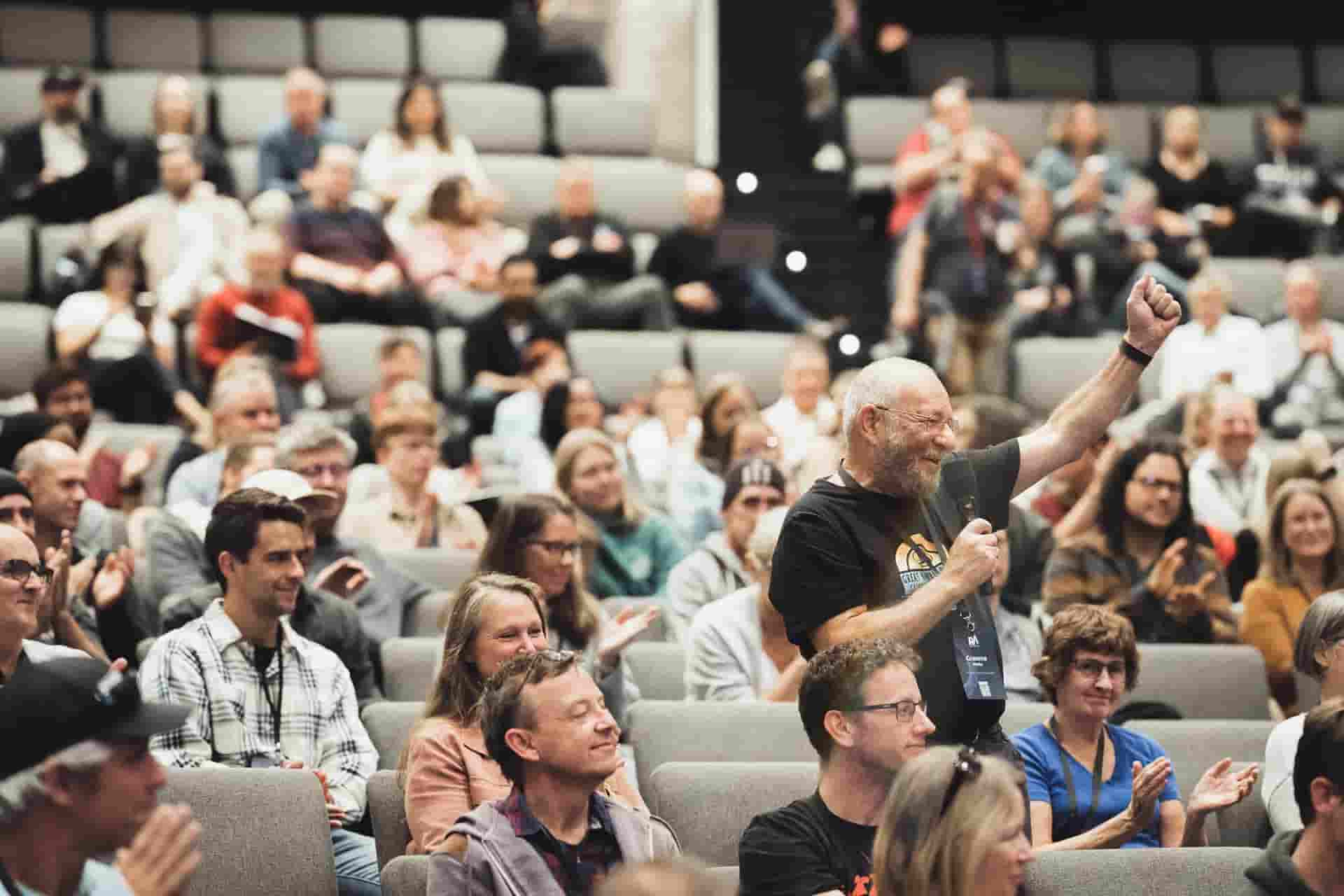
Missiologist and Trinity College lecturer Ed Stetzer discusses the theological and social barriers that have statistically prevented church plants from growing beyond two hundred members.

Transcript
This transcript has been generated, and can contain errors. Please refer to the original recording for the definitive language used.
Read transcript
[0:00]
I want to talk some about growth bearers in new churches and I don't, you know, I'm kind of, you know, we got to hear an exposition, a wonderful one. I've been preaching through the gospel of Matthew at the church that I passed her and we've been going through the slowly, maybe you're the same way. I told my church that the pace we're going will be finishing with the gospel of Matthew in, you know, 2012 and we'll just, I mean, 2022, excuse me, and we'll just end up calling a mat instead of Matthew.
[0:30]
Just because we've been so familiar with it, but just having walked through the sermon on the Mount, we took a year in 2013 and just walked through the sermon on the Mount and the disciples model prayer there. It was encouraging to see the same picture and being challenged as such in the, in the, in the Luke and reference. And so, but at the same time, we have a mix of roles here at the conference. And so my role is not going to be to exegy passages of text, but my role is going to be put on my hat. If you will, as a misiologist, my PhD is in the area of misiology. I do research on church and culture so that churches can engage their culture effectively for the cause of Christ. I'll be sharing some of our experiences and research and best practices.
[1:14]
And so, so you'll have to sort of receive the teaching of different places in different ways. And so, so, and don't assume, don't assume that a speaker who's working through a text doesn't believe in the practical nature of understanding, for example, assessments. And don't believe that a speaker who's working through kind of practical examples from around the world, but not working through a text doesn't believe in the value of working through a text. And so, as we sort of launch into our conversation, we'll, we'll talk some about, specifically, growth bears and new churches. And how can we continue, how can we move forward with churches to actually experience growth at every stage in every way?
[1:52]
We have, my PhD is primarily on studying churches in the West, the English speaking world. And, and so I've particularly focused on some of those things. And I want to try to draw some of the, some of the things we've learned from research we've done on churches we have churches involved in our research in the UK and South Africa and Australia and the estates in Canada in particular. And so, I want to begin with some quotes that may be helpful and talk about some of these bears as we grow. But I want to say even before I do any of that that I begin with a recognition that barriers and size are dependent upon context.
[2:30]
And so, so I am not unaware of that. You may have had speakers from the United States before who come and say, well, I was passionate in this church and we had, you know, 2000 people and it's just the enormity is in, is, is just doesn't make, it doesn't translate well. My experience has been, of course, starting churches from scratch on multiple occasions and I will tell you the hardest to me, the hardest experience has actually been a grow church, the 35. I found it get easier to grow churches, 75, easier, grow church, 125. But the hardest tends to be at the smallest levels. And so we're going to talk some about that and hopefully find some things that will be, that'll be helpful to you as we kind of walk through this stuff. So let me begin by talking about first and foremost, why do churches stay small? I didn't agree with a, with a good friend of mine, Darren.
[3:13]
Patrick had the privilege of preaching his church, he had been friends for a while and I asked him, why do you think most churches, particularly church plants stay small and quoting him here, largely because most pastors don't know how to build systems structures and processes that are not contingent upon them, he said. Most pastors can care for people but don't build systems of care. Most pastors can develop leaders individually, but lack the skill to implement a process of leadership development. And he goes on and say, when a pastor can't build systems, when a pastor can't build systems, see if I, there we go.
[3:45]
And structures that support ministry, the only people who are cared for and empowered to lead are those who are near the pastor or those very close to the pastor. This limits the size of the church to the size of the pastor. Now I quoted this just because it ended up the quote being got picked up by several publications and the interview got picked up by several publications. And of course, there's always some who say, well that's, you know, you haven't talked about this or that issue or maybe you didn't know how to quite this way or that way.
[4:16]
And my experience has been and I hope you probably noticed that there seem to be, if you will, spectrums of Christians respond to quotes like this. There seem to be some who are really in anything and any kind of outlook in the Christian world. It seems to you some who are fault finders who are always looking to say, no, I always said this where you should have said this or you said this one thing and it defines everything else you said. There are fault finders. And then on the other thing, on the other side, it seemed to be those who want to be truth finders and say, what in there can I find that's helpful and I can learn from? And we want to be careful not to solely be fault finders and we get to the place where we continue to say, well, they're wrong and they're wrong and they're wrong and they're wrong until the only one who's actually right is us and our close friends.
[4:58]
On the other hand, we don't want to be naive to think that well, just anything goes. We can grow church through any means possible. Let's jettison doctrine. Let's jettison theology. But I would encourage all of us, even as I talk and others talk at this seminar, for us to be aware of our own biases, our own tendencies, are we quick to find fault and disqualify the truths that we've learned from others or are we quick to define the truth and try to celebrate and see what the Lord is doing. Or do we do so naively without recognizing, if you will, that there are also things that matter beyond the practical.
[5:31]
What I want to talk about today is the practical, but I think we have to undergird at some with the theological before we even get there. And I think that has to do with the issue of ecclesiology. Ecclesiology is simply the study of or the theology of church. Ecclesiology, Ecclesia is going to be in reference to the church. And so what I'm going to talk about is breaking growth barriers. I'm going to actually have a formula that we're going to look at a little bit later on. I'm going to talk about kinds of key leaders that you have. And what I would say to you is this, is these are not universally applicable.
[6:07]
If I was one of the things that, you know, if I was teaching in Penang at a seminar, I talked recently a couple of years ago at Penang in a seminary. So if I was teaching in Kumasi and Ghana in a seminary, both places have had the provost of teach, I want you to know that I would explain and teach some of these things differently, because some of these things are shaped culturally. But then at the same time, there are universal marks that should be true, whether we're under Boma in Kenya or in a cathedral in Sydney, there should be marks of a biblical church that are present in each one.
[6:38]
As a matter of fact, let me say something as well. If your perception of church is such a way that only a church in Sydney, a church building in Sydney, I'll use as a point of reference. St. Philips, York Street, Church on a Hill, Anglican. Can I, can we just agree that I'll just call it York Street just because that's where it was? But if our frame of reference is just York Street, which is not a cathedral, but for as it is the oldest parish in Australia, so I'll think of it as such.
[7:11]
But if you think in terms of this, this can meet the marks of a biblical church, but a group of 15 who are following the New Testament teachings about church, a group of 20 in Kenya, in a Boma in Kenya can't meet those qualifications. What we have done is we have imposed upon our perception of church cultural norms, not biblical standards. And so how then do we think about these things? What we have to recognize is that there are universal marks of a church and they are Biblically described, Biblically prescribed, that they should be present in each and every church.
[7:43]
And that's what makes a church a church and it should be true. Because God's used the mega church to reach Korea. He's used the, partly, he's used the mega church in Korea. He's used the house church in China. I would encourage us to hold our, heraldor models loosely and our Jesus firmly with the application of marks of the biblical church to be the norm that we hold. So tonight in particular, as I talk about some of the marks of movements around the world, by the marks, there are two kinds of marks.
[8:17]
And the reformers would say, you know, the, the, the right preaching of the word and the right administration of the sacraments, I would say that it's, it's more than that. I'll show my cards in just a bit about what I think those might be. So there are things that should be true in every church. In my fact, it should be true in growing churches. It should be true in declining churches if they seek to have the marks of a biblical church. Now, we might differ some on those even here, or at least the application of some of those here. For example, I would say the practice of the ordinances, some of you might say sacraments, is a mark of a biblical church,
[8:50]
but I would practice baptism differently than some of you would practice baptism in your church. And so, so we'd recognize, though, that however there is a mark that if you're a new testament church, you should practice baptism. You should practice the, the Lord's supper. Those things should be there and true. And so, but that's not my assignment. So why are you talking about those things, Ed? If that's not your assignment. Because if I just go straight to my assignment, we could make the unhealthy assumption that, well, if we just have these leaders and these structures, our churches will grow. And they very well might. But what you grow might not actually be a biblical new testament church.
[9:23]
Does that, does that make sense? So the, so the challenges is again, we want to be, we want to be truth seekers, not fault finders, but at the same time, we don't want to be naive to thinking that, that just simply methodological mania gets us to biblical fidelity. I'm say again, methodological mania doesn't get us to, to biblical fidelity. But there are cultural applications of these things. There are cultural applications of these things. And I think it's important to note, even in Acts chapter 6, that we happen to find this reference to what some would say. It doesn't specifically say that, but the appointment of deacons, perhaps in Acts chapter 6, the 7 chosen to serve.
[9:59]
And it's interesting that there was a solution to a, a, both a crisis caused by growth, but also enabled more growth right here. And, and what happened was, is that it says in Acts 6, 1, in those days, the numbers of disciples was multiplying. And with that a problem, a, a complainer rose by the Hellenistic Jews against the, he break Jews about their widows were being overlooked in the daily distributions of what do they do? Well, you remember the story, I won't go into it too much detail. But verse 3 says, brother, select among you seven men of good reputation, full of the Holy Spirit and wisdom whom we can appoint to this duty.
[10:33]
So we will devote ourselves to, to, to the prayer and to the preaching ministry. And so they chose some people and you've heard this taught, so you already know this. They chose people with remarkably Greek names. And in doing so, they were able to kind of address this issue. And, and so what happened? Well, in verse 7 it says, so the preaching about God flourished the number of disciples in Jerusalem multiplied greatly. And a large group of priests became obedient to the faith. Now, what I want you to see is that they had a, they had a, a problem related to growth.
[11:04]
They came up with a solution that was well, biblically prescribed, but culturally appropriate in their setting. And ultimately the end result was, was more growth. That's what my desire is today is to kind of lay before you are based on our observation of churches in the Western world. Particularly new churches. How might they have best practices that actually lead to greater growth and multiplication? So that's what I want to try to, try to walk through today. And then, and you'll have after you ask questions. I did bring a chair up just because this would be perfect, honest. I, I don't normally have back difficulties, but, but, but, but maybe it's the, maybe it's the time zone.
[11:39]
And, and just the, the jet lag, but I've been having some back difficulties. And so I'll sit down some, if you don't mind, as we kind of walk through these, these, these topics. So, so again, so, so we begin with some universal marks and then some cultural applications of such. And so, cultural applications are going to be things that we draw from our research in the Western world. But let's, again, remember, what are some, what are some biblical marks? Now, again, when I write, I tend to use six and some people have nine. Some people might contract and say four. And it doesn't, here's the thing. Again, don't, don't, well, I want this.
[12:10]
I, I, okay, okay, I get it. Okay, we could debate what should fit into it, what should not. But what I want you to say is this, is there is a necessity of having an expression to say, this is church. It must be present without which there is not church. And we are going to have these things here. And those become the non-negotiables. And then the application of those things, sort of are birthed out in the expression of church, of church life. And that's what I want to talk some, is that what we've learned from our, from our analysis.
[12:42]
I wrote about this first, and I might, I made some modifications to it over the time, as we kind of observed churches and other cultures. First, I wrote a modified version of this in, in a book I wrote called, Planting Missional Churches. And I think I wrote that in 2006, I think, so that would be what, six, so years ago, seven years ago, by the time it was written, compared to when it was published. It was kind of birthed out of a Canadian, and US immigrants, my wife's Canadian. So everything I have to write has to include a Canadian reference. And so, but then as we began to research around the world, here's some things that, that
[13:15]
we found, and I want to talk some about, remember I talked about these universal biblical principles elements, should be present in every church. But what about churches that are breaking barriers, which is going to include some, biblical, it shouldn't have unbiblical, or nonbiblical things, but they should, they should also have some cultural applications. Just as in Acts 6, their solution was in a certain time, in a certain place. So what are those, those things? Well, I want to talk some about the key systems that we see, and I want to encourage you to consider, to have in every church that will experience some of that, some of that
[13:48]
growth. For example, in, in some of those key systems, here's what we found in churches that were moving through and growing, and rapidity is different depending upon each setting. You know, if you go in South Africa right now, Western cultural context, and you see some great things happening here, Australia happens to be in the, in the Western English speaking world with the, I'm not sure, New Zealand is actually a little less so, but, but sometimes in my apologies, sometimes demographers count Australia and New Zealand together.
[14:19]
Do we have any people from New Zealand here? Oh, okay, so we got a count damn separate. They're awesome too, I guess. So, so, so, so, so here's what we find in the, in the, in the Western world, you know, we're now, we find the percentage of self-identified Christians in Australia at 61%, it was over 90% at the beginning of the last century. If you're interested, I'll have a series of blog posts. I've asked Ruth Powell from the National Church Life Survey to do a series of three blog posts
[14:52]
this week at my blog at edstetcher.com talking about kind of the state and the future of faith, and they've done some, some really good work, I think, to help us in challenges. But here you have in, in Australia and New Zealand, even to a slightly greater degree, you have a, you have a sense that, that, that in the West, the, maybe some of the harder soil is in, is in this context. And so, so, what we found in, and, and, and some of the research projects we've actually done, I'll share some of that tomorrow and others that have found to be true here still, is here are some of the key systems that we think are necessary to move through these
[15:24]
things, and I'll sort of express how that works as we move ahead. The first is in the area of outreach. Now, now, I want you to know, first of all, that outreach is a broader topic. Outreach is not evangelism. Outreach should include evangelism. If it doesn't include evangelism, it becomes an enemy of evangelism. If simply it's reduced to inviting people to church or inviting people to activities, but there's no clear proclamation that Jesus died on the cross for our sin and in our place. And by grace and through faith, we can be changed by the power of the gospel, receive
[15:55]
him and walk in new life if that's lacking, then it becomes the enemy. But outreach requires a system, I want you to not dismiss this. Outreach requires a system of evangelism requires a person. Because evangelism is something we do as we share the gospel with somebody. Outreach tends to be a system within a church that creates a culture that includes evangelism, but has taught people to be about showing and sharing the love of Jesus to a hurting and loss world. And one of the things that we find is, is that I'll talk about this a lot, is that if
[16:25]
you're a pastor, there's probably two types of people that you need to spend more time with. And both of these will be related throughout here. Probably you need to spend more time with lost people. As a matter of fact, one of the things that I think would be really helpful for most pastors and most churches is to have some close friends who don't know Christ, who actually can reflect with them and help them understand the way people think because what happens is, and particularly often times a long group become a Christian, then we become a pastor, we become
[16:56]
isolated from, I say real people, but church people are real people too, but we become isolated from real lost people, people who don't know Jesus. We begin to talk sort of in a certain way, I think of a pastor friend of mine, you might actually know him. But you go to his church and everyone sort of has adopted this kind of weird language about everything that they say. And so, someone will say, I'll meet you tomorrow if the Lord wills. Well, I think that's awesome, but it's kind of creepy if you do that at work all the time.
[17:29]
But you say, but if you're not around non-Christians, you don't know how creepy that actually is. Well, it's a witnessing opportunity, you might say, well, I would just say the verbal ticks that we have aren't necessarily witnessing opportunities. Sometimes they're just oddities that we've picked up because we've isolated ourselves within a cultural subset called evangelical Christians. And so, what I would say is that churches that have intentionally prioritized and created systems of outreach, and I'm going to talk about how those are done, created systems of outreach are teaching their people to intentionally live on mission.
[18:02]
Now, my experience has been, is that there are some churches who, what they say is, well, we're just going to preach the Bible, and then we're going to preach the Bible, and everyone's going to get real heart for the lost, and they're going to go out and evangelize their neighbors. And what I find is, is that churches that say that and don't have systems to accompany that tend to be what I call aspirational evangelists. Man, they talk a lot about reaching the lost, but their church or people don't know any lost people. I don't actually share with any lost people. They don't have any system to engage lost people.
[18:34]
And so, what they do is, because they feel a little bit guilty that nobody's coming to Christ in their church, they talk more about it, but they don't actually do anything with it. So, don't think that your church is evangelistic because you're talking to each other about the lost. And don't think that your church is going to be evangelistic because you're preaching at people and telling them to reach the lost. What I would say is, lead your people to reach the lost. And you yourself have to reach the lost.
[19:05]
It's not just a system's issue. You know, my, I live in a, of course, in a neighborhood, probably like you do, but I live in an American-style suburbs. And American-style suburbs are probably not dissimilar to where we are here. In Rootie Hill, am I saying that correctly? Rootie Hill? Rootie Hill. I like that. It's Rootie. Amen. Amen. Amen. And so, one of the things I did when I moved into our neighborhood, I was not, I hadn't started a church yet. I was the pastor of an, of an interim pastor of a church in the community.
[19:38]
And, but I had decided that the Lord has put me in a neighborhood to share the gospel to my neighbors. I know that's seen, well, of course he did. Of course he did. But what are you doing about it? I mean, so, so what I did is I drew a map. I actually took a Google, a Google map. And when these Google, Google images, you have Google in Australia, right? Not New Zealand, but you do have in Australia, all right? I'm just checking. And so I kind of took a picture of my own neighborhood. And then I, I took the eight houses that were there in two, two houses of me.
[20:11]
And I, I decided to intentionally pray and evangelize those neighbors. And, and I've actually the privilege of being sharing the gospel. I don't know, I'm not just inviting to church, but sharing the gospel with seven of eight of them. And it's not been real receptive or responsive. It doesn't particularly like me. And that's okay. Feelings kind of mutual. It's okay. You don't have to like everybody. But, but, but what, what we did is we intentionally sought to evangelize.
[20:43]
I'm actually in two weeks, I'll baptize the fifth of those neighbors in art tradition. We baptize people after they, they've been believed. So I'll baptize the fifth of those neighbors. So, why did you laugh? That's different traditions of different ways. our tradition, we've got to test people after they believe. I still don't get what I, some of you throw water on babies. I get that. And I love you in the midst of that. But here's the thing I want you to see, is that I personally had to create a system of outreach
[21:17]
to remind myself to reach my neighbors. How would it be any different in my church? And let me just say if you're a pastor or a church leader, and you want a church as evangelistic, you can't lead what you won't live. And so you have to model that yourself. And I will tell you, I consistently, I consistently share about my neighbors, they sit in church, right? I have three, three, one, two, three, three families, four on and off, who now come to our church consistently. And so I talk about them, and I talk about how,
[21:48]
and I get the permission to do so. Why? Because your people need to hear that, and they need to see that put into a system. Here's your, my fact, let me quote, let me quote Bill Hybles, if I could do that, because I recognize that, you know, to him, you quote Bill Hybles, you're in a different category, we don't like you anymore. But I want you to say, if you ever heard Hybles speak, he always refers to a certain sport that he's involved with. Is anyone know what that is? What is it, just shout it out if you know it? Sailing, I mean, like nine people shout at the same time.
[22:20]
I got tired of hearing about Bill Hybles sailing. Because I don't sail. I mean, who sails? You know, I mean, Bill Hybles. And that's one of the reasons that we cannot like him. And so, but why does Bill Hybles, why did everyone mention Bill Hybles sailing? Because here's why. Because if you've done anything Bill Hybles going to, you've heard about a sailing team, because he has consistently sought to evangelize. And that's sort of his sailing team,
[22:51]
is his evangelistic pool. Bill Hybles has a personal evangelistic system to evangelize the members of a team sport that he is engaged with. And furthermore, he consistently shares about that with his church and in conferences, so that you can be challenged to provoke to love and good deeds hebers, to ever tend to. So what I would say is you may need a sailing team. In my case, in an American style suburb, my sailing team is my neighbors and their children. Because we have, we have a lot of kids in our neighborhood.
[23:22]
I have young children. And so what I would say is you need both a outreach, a plan personally, but an outreach system congregationally. And here's what I would say, is you don't preach your way into evangelistic passion and practice. Let me say it again, you don't preach your way into evangelistic passion and practice. You model it, and then you lead people to it. And I'll talk more about that in just a bit. And that ultimately leads to the second thing that would relate to, I'm talking about key systems in a church that's going to break barriers.
[23:53]
Remember, that's my assignment is what, how we might break barriers. So one key system is a key system of outreach. A second key system is in the area of assimilation. Now assimilation is a phrase that, you know, it's kind of grew, assimilation, resistance is futile. You'll be assimilated. It's sort of this, but assimilation is not necessarily a good thing in culture. We recognize who want to value and be thankful for the different cultures that people have. But the way we use the term in church is it means
[24:25]
that people are going to be brought in. They're going to become a part of a church family. Now, the church, now Scott Scott specifically asked me to occasionally reference the church I'm involved with. I think his desire is, and I get the desire is that we don't perceive Ed as an expert who's not involved because ex-Nobody likes experts, particularly those who are not involved in real life ministry. So for me, I am about two and a half years ago,
[24:55]
maybe three, we start talking about this. I do a lot of speaking and writing. That's sort of my job. I mean, it's my job. And so I have a team of people, people ask, how do you blog and write in all sorts of the reason is is I have a team of people who help me with this. And I was going around, you know, persecution pastors telling them to live for Jesus more and be on mission. And I just, I had served as an interim pastor of two churches since I moved to Tennessee. And I just was, we were evangelizing our neighbors and we just, some of them weren't connecting
[25:27]
with churches in the community. A lot of our neighbors were outsiders and that's kind of a long-term community. People have relationships there, long-term. And so we began to pray and we decided to plan a church. I'm not, what I'm doing is probably different than many of you in the way you're planning church. I'm not a staff member of the church that I'm the lead pastor of. In other words, I'm not paid by the church. I'm a volunteer, but I preach three or four weeks. I'm not on staff, which is awesome because if they want to fire me, go ahead
[25:58]
because I don't work there. But I'm a volunteer. So, and it's also great too, for when I lead our membership class or I lead our spiritual gifts discovery class, is I ask people to volunteer and I say, I'm a volunteer. You know, I can volunteer a certain of ours a week. And, but my full-time job is, I lead this research initiative and concern. And so, but one of the things that we have found in our church is, I just this morning in Nashville time, I got an email from our executive pastor's name is Jimmy,
[26:32]
which is, you know, he's a Jimmy Disney, no relation, but Jimmy Disney is his name. And he emailed me and we're talking about, you know, our growth and we, what we found is this is we've gone through, we've been at this for two and a half years since we launched on Easter in 11. And so, we've had it two and a half years. And what we found is, and so I guess this was, we were actually in the pre-launch stage when I was in Sydney last time. What we found is we've had three of these great cycle seasons of growth and you've seen them too. When, and again, the numbers wouldn't be proportional.
[27:05]
So, I don't know if I should share them, but we've had just this, in the last two months, we've had this disproportionate, we've grown by, by 25, 30% in the last two months, just suddenly grown by 25, 30%. But, and you know, we're, wow, you know, this is the greatest thing ever. But we've actually had this happen twice before. And here's what we know, if, in a new church, in a new church life, if we have, if within three to six months, if the people who've kind of started coming are not plugged in in some significant way, they'll be gone.
[27:37]
And sometimes they're gone to other churches, which we're actually fine with. There are other churches that love Jesus and are preaching the gospel. And we actually pray for them regularly. We pray for churches that are different than our tradition regularly. So, we can recognize that, that though we may be in different denominations or in one kingdom of God. But what we find is, is that if people don't assimilate, and so, one of the things we have decided to do is to put great effort and length, largely because we see this around the world, the necessity of such, of helping people to kind of walk through a process of assimilation.
[28:08]
How do we get people who are nominally connected to be deeply rooted in the life of our church? How do we get people who are nominally connected to be deeply rooted in life of our church? I'm gonna talk more about how we've done that as well. A third system that we've seen in the Western context is around children and children's ministry. Now, I want you to know, this is a Western thing. It's not true, for example, in Central and South America. It's not true in much of Africa. It's not true in much of Asia. But in our contexts, for example, there are, to my knowledge,
[28:40]
maybe, I think there was a little baby back there earlier, but there are no children in this room. And that's a cultural thing, because if you were in Peru, I was in Peru a few years ago, teaching and preaching, and teaching a course of seminary there, and then preaching a couple of churches, and children would be quite present. They would be seated all about you, people that have families with them. And there was kind of a low murmur in the background. Children were culturally allowed, and it was not distracting for people to talk to children,
[29:13]
to talk to one another, but they sort of were taught, to whisper quietly, and it didn't bother anybody, except the visiting American. Because I wasn't accustomed to it. And so, in my fact, last night, I was at York Street, which we have a service down on. I don't know the words, my apologies, but sort of right on the harboreds. It's at the symphony hall. And so on one side, you've got a street, and on the other side, there's the harbor. And there was some sort of, they told me
[29:43]
it was a one direction concert, but they were lying to me. But they were like, when we pulled up, the pastor, Justin Moffat says, there was literally like 8,000 people lined out right next to where we were meeting, and I was like, man, that's great. You guys really got the word out. But I didn't think, I'm not Tim Keller. He would attract all the screaming teenagers, but there was something going on in there, and there were some YouTube celebrity, I don't know what it was. But then our service came at four o'clock, and Tim, Tim, where are you?
[30:14]
I'm sorry, where were were? What's the name of that place? What's the name of that place? Okay, in Walsh Bay, Walsh Bay. So that wasn't the Sydney harbor then. Okay, it was water, and it was a harbor. So, humor the American. Walsh Bay, so we were at Walsh Bay. And so, as Tim knows, we were sitting there. And groups of, and the door was open. They have this little sign. They make a little chalk on it and says, Jesus here, and they invite people in 4 PM. It's a mission engagement into that community. And, but groups of loud giggling teenagers
[30:47]
keep coming by, one point someone yells into our room. And again, this is the first time I've preached at this church, and so I don't know what's going on here. And so, I tried to ignore it, but I noticed that they were getting distracted by it. And they were giggling sometimes. And so, finally, I asked, so this is not normal. That people would come by and like, screaming groups, screaming packs of teenagers coming by your service, giggling outside your doors. Because I would say to you, and this might be strange to you, is that in many cultures, that kind of thing
[31:17]
wouldn't be unacceptable at all. It's just part of the way you're in communities. They will have to be distracting. No, it's distracting to you, because you're a Westerner. But what I would say is because of that, one of the things that's happened is the necessity of children's ministries in new churches to break barriers becomes an important area. And I would say that one of the bigger challenges you will find is how do we minister to and how do we engage children in a way where we have an age-graded educational system
[31:47]
where children are accustomed to being separate from their parents when you often don't have the personnel to staff that. We'll talk about that in a bit. Two other things that are sort of below the line, if you will, are things about financial systems and things about facility systems, both of which I'll seek to address. But now, with that being said, let me talk some about some of the key systems. This is a church planting conference. So let me talk some about the key systems that are generally necessary to move through these challenges, these system issues
[32:17]
that we have to address. So I've actually broken down some key leaders that would go with the key systems, right? Or the key systems. So what are some of the key leaders that would go with those systems? Well, self-evident is that you need to have a pastor. But, and again, I think you can exist as a church without a pastor. That's sometimes a pastor who leaves and the church doesn't cease to exist upon the pastor's departure. But I do think that biblical leadership is one of the marks of a biblical church. But one of the things we find is that sometimes pastors who are church planter types,
[32:49]
who love to do evangelism, who love to do pastoral care, also need someone who's administratively gifted. Every church needs at least one person that's administratively gifted. If that's not you as a pastor, you need to find somebody who will actually do that. And one of the challenges is, is that many pastors, particularly church planters, tend to be younger. And many church planters are a little maybe intimidated of having somebody else do the administration. Can I just tell you something? If you are no good at administration, don't be intimidated by somebody who's good at it. Help them, find them, deploy them, work with them.
[33:22]
Because ultimately, if the pastor is not the administrator, there has to be an administrator. Second thing is obviously this self-evident, I won't spend a lot of time here, is the necessity of somebody to lead out in worship. Again, this is a cultural thing. This is an act seven, they had an issue with Hellenistic Jews, so they had a Hellenistic solution. We're in the west, what we find is, is that that worship is a normative expression. Where there was gates with Thanksgiving, and there was courts with praise, be thankful unto him, and praise his name. We know that that's a biblical command
[33:53]
that we are to engage in. And we know that there are people who are specifically assigned to task of worship leadership, but by and large, what you'll find today is that it's sort of morphed into sort of a Western cultural expression. Last night, we had a single individual at one of the place where there was a smaller group, and then we had a band and a larger group. That's kind of a normative expression today. Also too, as we talk about preschool children's leader, we know these are just systems that are necessary for us to ultimately have. What I would say is one of the things you may not have thought
[34:24]
about, these might be the obvious ones. One of the things you may not have thought of is an assimilation coordinator. One of the things we found is that in the most healthy churches that are moving through barriers, they have somebody who's a dog-id determination, is that a phrase you use, dog-id determination? Okay, whose dog-id determination is, it's not let anyone fall through the cracks. This is really key because you've got 1,000 things going on as a pastor. I can think of, I have three people now. At each campus, we have two campuses now at our church, and they have a dog-id determination,
[34:56]
and they are really not gonna let anybody go without getting connected. Now, there's a system. It's not just be my friend, but there's a system that they're connected to that I wanna talk about, but I'm gonna get to that in just a minute. I would say too that someone who's specifically helping people outreach against system will talk about that, and then finally, these are six key things that in churches that are moving through barriers, is some sort of spiritual gifts mobilizer. Now, again, people, I get the, even the word spiritual gifts can be frightening to some people,
[35:29]
apparently not the writers or scripture, but to some people, what I would say is this, there are 19 gifts listed in the Romans 12, the first Corinthians 12, the Ephesians 4 passes, depending on how you count. I'm not sure, I'm probably sure that he didn't, but I'm not sure that the writers here that Paul is attempting to give us a list of all of the spiritual gifts that God has given his people, but I certainly think that those are gifts that he has given his people to be used for ministry and for mission.
[36:00]
And I guess the question I would ask is, do you have some sort of system that helps people to find, to discover and then to deploy their spiritual gifts? So, in all likely, you won't move through barriers of new church growth. Now, let's begin to go back and kind of talk about these things one at a time. Let's first talk about outreach. And I'd encourage you first to consider having an outreach strategy. What we do at our church plant, we've done at our church plants, as we sit down, and we make a list of the outreach events,
[36:33]
activities, and focal times in the life of our church. So let me just share a little bit about our own personal experience. There are times, and it's different, depending upon the culture, but in our context, the way culture works is people tend to come to church more readily in fall, and then come to, and less so in winter, and they come to church more readily in spring, and less so in summer. And again, seasons obviously going to have different
[37:07]
applications, different parts of the world, but my guess is there are a couple of times a year when you have noticed that there is an increasing number of visitors or an increasing number of people open to visit in the life of your church. So if that's the truth, that's the case, here's what we do, I'm encouraging you to consider, because outreach has to be a church calendar, it's having part of the church calendar, church culture, the focus of not just an occasional thing. So for example, one of the things that most in the Western world
[37:38]
has been the case, we've been research in several countries, is the most receptive time of the year for people to be open to an invitation to church is actually Christmas time. And in North America, it's 40 plus percent, say they think more about spiritual things around Christmas time, so there's an opportunity there that you can seize, that you can build on, but here's what I would say, if that's the case, you might wanna think strategically about multiple points,
[38:08]
okay, so you might be doing a Christmas caroling as popular in parts in Australia. And so that might be part of the strategy, but how do we have some literature to connect with people, how do we have some services that they can connect with, are we planning some things, what is our strategy? Now let me, again, I'll give example of ours. Spring and Fall, we normally preach through books of the Bible, as I mentioned, but we don't exclusively preach through books of the Bible. And when we stop preaching through books of the Bible, it's generally a season when we're encouraging people
[38:39]
to bring unchurched and other lost people. So, for example, if I'm preaching through the Matthew, I've been last Sunday, I've preached on Matthew chapter eight, we're going through a series, Matthew chapter eight, one, the Matthew nine, 35, is a series of nine miracle stories with 10 miracles. And so it may be, it's always a good time to encourage someone to bring a friend to church, but going through nine miracle stories, which have certain specific intentions that Matthew who's writing about Jesus to the Jews
[39:12]
by a former tax collector, that might be a harder time to bring somebody, then what we do is in October, we actually do a series, a week, and then a series that is designed, this would be a great month for you to bring friends. So we saw this 25 to 30% increase in attendance in the month of October, so what we do is we see, and again, it's gonna be different every culture, our system is built on the fact that in our culture,
[39:44]
there's a church attendance is a two-humped camel, and we actually use that expression, is that in fall, goes up, winter goes down, spring it goes up, summer goes down, and so hump number one, and hump number two, our key outreach times for us with the exception of Christmas as an outlier, and so we do those two days, and we seek to build on helping our people, and let me give an example. So here's what we do, we don't just say, okay, everybody bring a friend next week, listen, 10 million people have said, everybody bring a friend next week, and they don't.
[40:17]
So here's what we do, is, well, and I know you many churches do here as well, again, I was at York Street Sunday, and they had these Christmas things inside the, the zine, the zine, I believe. Is that what everyone calls it, or is that just a weird York Street thing? It's not, you never heard it, no one ever knows, we have no idea, you people are making this up. See, I come to Australia, and this is what we say here, and some of you are lying, just trying to trick me, and there's no such thing as drop bears, don't try that on me. There's no hoop snakes, I know these things now,
[40:48]
but our vote really means after, I thought that was a joke when somebody said our vote meant after noon, anyway. So, for example, they had Christmas, they had a Christmas thing inside their zine, they call it, what you might call a worship folder, or a program, or a bulletin. And so they said, they're not for you, but for you to give out to other people. Well, here's, so a typical October, our series is, whatever it may be called, some series that's very accessible to people that don't go to church. We actually give everyone seven things, and we ask them to pass them out to their friends.
[41:19]
We ask them to take seven people that they'll pray for, and we start generally in August and September to pray for, begin to build a relationship with, and then we give them seven things. We ask them to give this to each of their seven friends and to invite them to specifically come, to me say they're gonna go out to lunch afterwards or go to dinner before, whatever it may be. We then, okay, so we've given our people tools, but then what I do as a pastor and what our staff do, we have a couple of staff members, is we actually call every one of the key leaders
[41:50]
of our church, and so, you know, I'll call up and say, hey, Tony, this is Tony's one of our small group leaders, Tony, this is Ed. Hey, you know, I know you've been praying for seven people, I wanna ask you, who are you praying for? Let me pray with you for them. Let's also, could you call all the people in your small group this week and pray with them, and ask them to reach out to others, and then I send a letter to everybody that's actually in the church as a whole, so listen, this is the first Sunday that we can begin to outreach and reach out to our friends. And what I've done is, is what we've created
[42:20]
is a system to mobilize the entire congregation, see how serious we take outreach, and to join us in outreach opportunities that we have created for them to partner in. Now, I know what somebody's saying, well, that's in America. Can I encourage you, don't automatically do that? But instead ask the question, how could we mobilize the congregation as a whole? Scott's specifically asked me to give examples from my church, but I also recognize that there's scale and differences between the two. But how can we lead, for example, to outreach events?
[42:53]
How can we lead outreach events? And are there events that we can tie into? Now, I will tell you, for example, we tie into, we tie into Easter, and we tie into Easter egg hunts at our church. I recognize that for some of you, I've crossed a conviction line, and we're worshiping, you know, Easter and taboo, the Egyptian, excuse me, the Babylonian, God of fertility, and the rabbit, it's all of the devil, and I get it. I should tell you, we also go trick or treating. I know people walking up, leaving the meeting right now.
[43:26]
I don't know. There's one night a year when all of my neighbors come to my house and give me the opportunity to talk to them, and I get to go to their house, and they give me free stuff, and that's called Halloween. And the last place I want to be on that night is at my church missing out on meeting all of my neighbors who don't know Jesus are going to come introduce themselves to me for the first time. So I sit there on the front porch, and I give out tracks and preach the gospel to them. No, I don't really.
[43:57]
But I build relationships with them. In fact, the first time I got to meet my Muslim neighbor was when we went door to door together. It was actually three of us. It was my neighbor on the left, and it was kind of this awkward moment when he brought his children out, and they were to meet Gus, who's our Muslim family and our friends, and then Jason and his family came out, and they were all the kids who were dressed as crusader knights. Um, at awkward moments, but nobody, nobody, I think,
[44:27]
really got it, and I was kind of like, no, no, they're not created. It's from the Hobbit. That's what it is. It's from the Hobbit. Um, but you know, that has opened up multiple opportunities to the time when, when, um, his family had a health emergency, and they knew they could count on us as their, the people of the book who lived down the road. And so what I would say is, is, is sometimes you'll create outreach events, sometimes you'll use cultural events for outreach. So what we do is we actually, um, we actually use, um,
[44:59]
we have this Easter egg hunt that we do. This is actually our Easter egg hunt. It's really not a hunt. Um, I think it's a really good idea that it's really not a hunt. Um, it's, but they call it that. I'm like, okay, so everyone sees the eggs. It's more of a mass stampede of chaos. Um, but what happened was, is that this is us, this is a, this is where our church meets. If you're, you can see, um, um, Barnes & Noble's a bookstore.
[45:29]
If you were to turn around, if you could physically do that, and look that way, would be the regal cinema. That's where our church meets is in the regal cinema. So we, we set up every week and we have church before they start showing, um, movies that we don't approve of. And, uh, and so, so, so, so, so this is where we are. So, so over here, you know, there were the stores over here. There's, there's, you know, five or six stores. Our visitor parking is right over here. The Victoria's Secret is where our visitor parking is. Uh, now that's not joke, there really is true.
[46:00]
It's, uh, it's not intentional, but it's necessary. Um, but it's sort of become a joke. We ask people not to sin when they park in our parking lot. Um, and, and so over here, there's different stores. And so, what we do is, um, the square, this is kind of the town square. You know, and it's a town square in the sense that it's, it's this new commercial town square. It's not town square like it's this awesome CBD that was built in, you know, 1810, uh, you know, this is all built, you know, five years ago. But we partnered with the businesses here, um, because, um,
[46:32]
we're a church, right? And so we're the church that meets in there. Um, we have a, a tent that we use here. We have a popcorn and water and, uh, and information about our church. You can actually see, um, next to the guy in the yellow shirt that's darren, by the way, you'll see Amy, their fake painting faces and, and gives us the opportunity to share with people. And, um, last year, this, this, by the way, is the number one way that people know about our church. We had 3,000 people go through last year. Uh, and 500 or so gave us their information knowing that we would send them information,
[47:03]
uh, about our church. There's a requirement to give our information. There's our, uh, you know, website and all that sort of stuff. So, so again, those outreach events become opportunities. Now again, contextualize it to your setting, but use it ultimately to have, um, to have a strategy that's part of ultimately you're of guiding outreach strategy, outreach events, and then outreach, uh, prioritizing in the life of your church, is to consistently say, we are going to make outreach a priority. Now again, can I really want to say this again?
[47:33]
I am, I am so pro preaching. I think it's a mark of a biblical church. I love to preach. Um, I, I, I, I love to open God's word, but I will say to you again, I hope you please, I'll please you'll hear this, is that you don't preach your way into an evangelistic church. You really don't. What you do is you preach your way into a church that talks about evangelism and learns to talk about it in a way that you talk about it, but ultimately won't do it unless you lead them and together you evangelize. You make priorities to actually evangelize.
[48:03]
Uh, again, other, other areas, assimilation, we talk some about it, and, uh, and I, and I, I better check and see what time am I supposed to go till? Scott, are you still around? Are we gone out for a, for a snack? What is it? A quarter past, quarter past like five? In conclusion. Uh, so assimilation and there's good stuff under assimilation that you want to have and it's life changing and, but not for you today.
[48:33]
Um, no, I'm just kidding. Um, so for example, assimilation, your strategy, having, having things like readers and usheres, these may be very basic to you, but sometimes we forget these things, follow up calls and processes. Let me give an example. Every person who visits, uh, grace church, even though you know, I'm, you know, I got a full time job. I, I handwrite a letter to every person who visits our church. Um, on Sunday after church, they get a phone call from somebody not a pastor at our church saying, man, it was so great to have you have any questions to hesitate to let us know.
[49:03]
On Monday, there's a letter goes via post to them they get on Tuesday. They get a handwritten letter from me on Thursday and they get a phone call from a small group leader on Saturday inviting the back saying, man, I'm going to give you a message to you. You know, I'm the guy who's this and let's meet so we can, you know, you're not by yourself and consistently helping move people, having a ministry and a mission focus, even in our assimilation, pushing people towards taking next steps. We have a series of processes that we use. For example, um, we, we call it a connection point that every month or so, let's say, even visiting, come, we're going to meet after church, answer your questions.
[49:35]
And then we ask people to go down to the discipleship path. Listen, if you don't have a discipleship path at your church, people won't know the next steps in their spiritual growth in life. I read a book recently on cry. I come into to you. It's called the Lego Church or Lego Principle. It's published by Joey Bonifacio. He's one of the pastors at Victory Manila and wonderful church has 60,000 people on a weekend and all these 19 different campuses. Amazing. What God has done, but very passionate about discipleship. Here's what he said to me. He was so helpful.
[50:05]
He said, Ed, your church, you think of your church as an arriving flight, arriving international flight. You've flown to, you know, you've flown to New Zealand, you've flown to Singapore. What happens is you get off a plane and it's obvious where you go next, because there's a tube that goes to it. And you go to a big room. So what's the first entry point? Is it, is it just hang around our church? No. Come, come in here and, and, and there's place we're going to explain the gospel. Explain what we believe, what our values are. And then from there you go to another room. It might be customs or passport control if in an airport.
[50:36]
And so it takes you, due to spiritual gifts, discovery. So as we go through, we have a 16 hour process. As we go through this process, people hear the gospel. I want you to know that every person who, who walks through this discipleship path for 45 minutes, I go through. And I, I seek to explain what it means to be dead in our church passage and sins and new life in Christ. The greatest concern, I think a pastor should have, is that that pastor needs to make sure that the gospel is understood by every person who considers that church their home.
[51:07]
And so we walk through that process with a ministry and missions focus central to ultimately what we do. We seek to then move people through a spiritual gift process where they discover so that they can get involved and they deploy and they use their gifts. And not only do we give them spiritual gifts tests, as we call them, inventories. And follow up, because here's the deal, you want a growing church engaging and involving people at every level becomes key for that process. I mentioned briefly financial, and I'll mention it again, is there questions that have to be asked about finances and we can talk.
[51:38]
What does it cost to fund your outreach? I really want to encourage you to consistently have, even as your church grows, 10% of your budget committed to ongoing outreach into the community. I'm not talking about missions, right? So I'm going to quickly how we structure our budget. Now again, it's probably different because I'm not paid by the church, but we have 10% that goes to, in our denomination, we have a cooperative missions fund. We have 3% that goes to local missions, 7% to direct church planting. But I'll tell you, I did that when I was full time on the staff of the church as well.
[52:08]
And then 5% to 10% of the budget of our church went consistently to outreach. So about 30% of our budget, we sought to consistently put towards things that weren't about us as a missional commitment. So again, financial outreach, what about facility rental? Let's just sound in video. These are all things that in our culture, we have to ultimately ask and ask how much do we need to make this church work and move it forward to another level of facility questions. Oh, that's a whole other issue for another day. Let me close with a paradigm that I think you might find helpful.
[52:41]
It's based on some, like Acts was, Acts 6 was based upon a Hellenistic problem with a Hellenistic solution to get the church focused and growing. What we found is if you're going to grow a church through barriers, it's actually not the attendance that matters as much as the service within the church that matters. Let me see if I can explain. You can have 200 people come to your church for a year. And if you haven't connected them, plug them in and have them serving, you'll have 35 to 40 people in your church.
[53:14]
But if you consistently move through barriers and you have 35 people and then 75 people, and most people who study this talk about barriers in terms of a 35 barrier, 75 barrier, 125 barrier, and a 200 barrier, I know you say, well, I know someone's 50 and I get it. But just suspend the specifics and listen to the trends for just a moment. Let me define some terms that I think will help us to consider this before we go to Q&A and dialogue. One is, we talk about key leaders. I've got three categories here. I work a leader and a leader of leaders.
[53:47]
A worker serves in an ongoing role. We're going to talk about how many it's going to take to actually grow through the barriers of new church. A leader owns that role. Some of you take a picture of that. That's fine. I'll give the PowerPoint to Scott. He can send this out to you if you're so inclined. Second is, a leader owns that role. Trains for it and seeks to involve others in it. Now, some of you already saying, I got workers who are helping us do stuff at church. But I don't have any leaders who are saying, I own this. I'm going to lead out with this. If I'm the worship leader, I'm going to plan it out. I'm going to recruit the people.
[54:20]
I'm a small group leader. I'm going to evangelize. I'm going to disciple. And then there's a leader of leaders, which back to Darren Patrick's, I can't quote at the beginning, maybe the most essential is do you have people in your church who lead in your church and oversee leaders in your church that are not on staff of your church? I think of Fred, you would know. But we have a system of small groups in our church. I lead one of the small groups because I want to model that.
[54:50]
I've ever sent an item my home. But Fred is in charge of our small groups at church. Fred's not on staff of our church. He's actually a salesman. Fred's in charge of small groups. Fred seeks to understand small groups. He reads books on small groups. He goes to conferences on small groups. And he's in charge of, he's a leader of leaders. Now, here's the thing I want you to see. And I'll close with this. It's for this ultimately to work. I want you to see that this is from a seminar not aching the 200 barrier. But breaking the 200 barrier. But what I want you to see is this.
[55:22]
Most churches in the Western world, most churches in the Western world are under 100 in attendance. Now, in my fact, you might find this interesting. The average church size in the United States is 79 people on a Sunday morning. I think I count. Median mean things that sort. But the average. That might surprise many of you because you see, I mean, you know, you see these monstrosities of size.
[55:52]
And there, we have a technical term for that in research. They're freakishly abnormal as the technical term. Most churches are small. And they're small here in Australia, the small in the UK. They're small in New Zealand. They're small in all these places. But what I want to encourage you to see is a paradigm for breaking the barriers that's not just about attendance, but it's about leadership. I want to encourage you that if you want to get through a 35 barrier in the life of your church, keeping in mind the systems and the leaders that I just laid out, you need one person other than you who will be a key leader, who will take the leadership, who will function as a leader,
[56:28]
who will report to you probably in a volunteer relationship, but who you are not worried about, you're not worried about, you can count on, you're not babysitting, you're not doing it for them. You now have a partner in the ministry. And probably if you don't have a partner in the ministry, your church will contract back to a smaller size where basically everybody reports to you. So to break that smaller barrier, you need typically one leader and maybe three workers. And by workers, that's not a bad thing. Those are people who can be directed and told to do this.
[56:58]
And if you give them a Bible study to teach the kids, they'll do what you say when you say it, maybe even how you say it. But ultimately, if you continue to be the kind of leader who has this worker and this worker and this worker, and soon you got seven, soon you got ten, you're going to end up like Moses when Jethro comes to him in Exodus chapter 18 and says, Moses, what you're doing is not good. You'll wear yourself out and you'll wear these people out. And ultimately, you will contract back generally to a smaller size. So once you're not to miss this, the church that I'm pastoring now, we broke the 200 barrier on a couple of occasions and then snapped back on both of those occasions because we didn't yet have the leadership structure necessary to support the attendance that we had become.
[57:39]
People didn't connect and they wandered off. And so the only reason we were able to break that end of the 230 and a barrier beyond is because we were able to do that by developing leadership structures that, well, again, my assigned topic is help us to break those barriers. So again, so 35. So what about 75? What about 75? How will we think on that? Well, again, here, I would encourage you, you're going to need, if you really want to break this barrier, not just be there. I mean, you can be there with you and seven helpers. You can be there with you and seven helpers. But if you want to break that and push through it, you get three people.
[58:11]
One person is going to say, maybe based on the systems I had, then I'm going to lead out in worship. I'm going to lead out in assimilation in small groups. That's another one. I'm going to lead out in children and students. And then you say them, well, here, read this and you can tell. You can tell if someone wants you to, if someone wants to do what you tell them to. Or instead wants to become the leader you want them to be, you can tell based on their response to the kind of leadership you give them. If you say, here's some resources on how we can create a small group minister in the life of our church. And they say, I want more. I want to know the no person who comes a leader of leaders.
[58:44]
And so now you've got 10 people. So I have 75 people. I want more. But I'm talking about workers who have a weekly responsibility. Maybe they're teaching something every single week. And again, but it gets harder when it gets larger. Now all of a sudden, I need leaders of leaders. I've got leaders who are self-motivated, but a leader of leaders is harder to find. And I will tell you, this is why most churches never pass 125 in attendance. And the reason they don't pass on to my attendance is some of its cultural. There's this downward pressure on church size, depending upon a culture and context. I get that.
[59:20]
But what I would say to you is the necessity of raising up people who are true co-labors, not directed workers. In other words, if I've got two people, and I will tell you, this was the hardest thing for us, to get two non-staff people who were in charge of non-staff people who were growing ministries for the glory of God and the work of Christ in our church. And then, if you're going to start linking even ahead, it gets harder as you go. But a healthy church of 200 that breaks through that bearer is going to have significant volunteer base.
[1:00:00]
It's going to have a good number of leaders who are self-directed. And then, a good number of leaders who can lead those who are self-directed. Now here's the thing. Watch here. See this. For a lot of pastors, they are scared to death by the idea that there be leaders and leaders of leaders. Well, I don't want to be mean to you at all. But then you'll have a church of 50 to 60 people and that's okay. That's there's no sin in that. There's nothing wrong in that.
[1:00:34]
In fact, maybe that's right within your spiritual gift mix. Maybe that's, you know, I'm gifted to love and exhort and encourage and praise God for that. Maybe I'm in a model, a parish model, a parish system where I can do that. But again, my assigned topic in task was not to talk about how to do that, but how to break through those bears. Now, it's more than that. That's why I went through the systems. But my experience has been debating whether to say or not to say. My experience has been as most pastors are better leaders in their head than they are in their church.
[1:01:13]
And I will tell you this from hard experience. First church I planted never grew beyond 75. Now, it's a real hard place. Buffalo, New York is a place where you don't want to find yourself accidentally. In the middle of the crack epidemic, it was called the very poor area, very violent area. But I didn't know. I knew I had to preach the gospel. I knew I had to love people. And I did do those faithful as I could. I was young. But what I didn't know was that I needed to raise up leaders who could raise up leaders if I was going to reach the kind of people and the multiple, multiple numbers of people that God ultimately could bless us with.
[1:01:56]
And again, this exit is 18 passage I mentioned is not. You got to be harmonically careful. You know, when Jethro and really should you take advice from a guy named Jethro anyway. But when Jethro Moses father-in-law comes to him, he says, you got to divide the people up into tens and 50s and hundreds. And he did. He does that. Though ironically, just a few years later, the same story happens again. I will tell you the hardest thing for many of us to actually multiply our ministries and grow our churches is actually to raise up leaders.
[1:02:33]
Because we want to reach people. We want to love people. Some of you just want to preach. Some people love preaching and more than I love people. This is people work. Now, let me close with this and then I'll turn it back over to my host. I think we're going to do some Q&A. And that's we'll jump right in. Probably, not certainly, but probably if you're here today. The thing you want to spend more time in is developing leaders and engaging the lost. So two else. Leaders and lost.
[1:03:09]
What I would say is if you develop leaders who then overworked with workers, who then create ministry, you'll actually find that you're reaching more and more and more lost people. So my expectation is simple. Well, it's not that simple. But my closing expectation is this is that you might spend more time with leaders and the lost. Leaders to develop systems that will help grow you through barriers and lost. So you don't just grow through barriers by taking people from the Presbyterians of the Anglicans or the Pentecostals.
[1:03:44]
But you actually reach people who don't know Christ because your ministry is not just well structured, but it's driven by a mission to show and share the love of Jesus to a hurting and lost world.