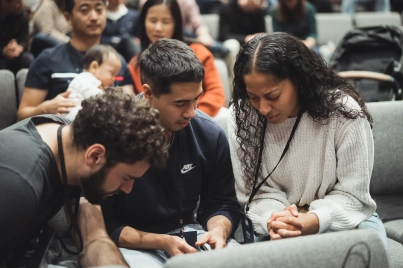
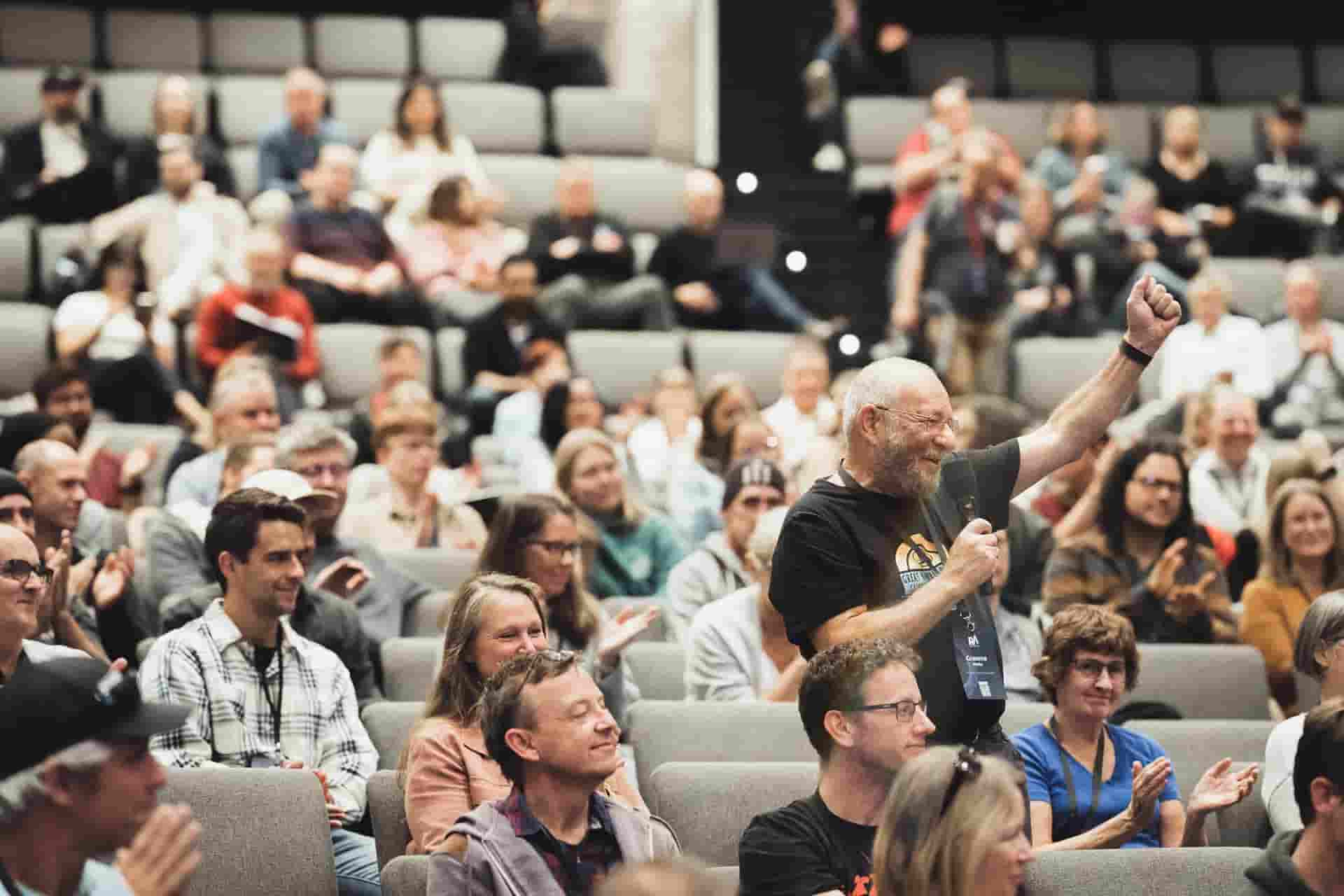
Geneva church planter David Lynch speaks at the Pursuing a Mission Lifestyle Through Gospel Communities one-day workshop at Mackinnon Reformed Presbyterian Church on October 3 2014.


Transcript

This transcript has been generated, and can contain errors. Please refer to the original recording for the definitive language used.

Read transcript

[0:00]
This audio was recorded during a one-day workshop title pursuing a mission by style through gospel communities. We're going to introduce David now. David's from Summerlee's Church, Christian Reformed Church, in Hobart, Tasmania. Not Hobart, like we say, in Indiana. There is a Hobart, Indiana. Yeah, and you pronounced that way, apparently.

[0:30]
Dave, you could probably talk a little bit about how long we've been there. It's a church plant, a bit about your ministry background, and maybe your family life as well. So I'd welcome you to come up. Yeah. Thanks. Well, good morning, everyone. Good morning. Great to be with you all here this morning. And thinking through what's an incredibly important topic of pursuing missional lifestyle through gospel communities.

[1:00]
As Brandon said, I'm from Hobart. I lived there until I was about 10, and then my family moved around a fair bit. So we lived in Adelaide for three years. Then I did high school actually here in Melbourne before going back to Hobart for university, where I became a Christian. And it's actually interesting because I got converted into a Presbyterian church. I now worked for a reformed church, so in some ways I'm a reformed Presbyterian. Who? She's just so nice, isn't it? Not long after I became a Christian, I…

[1:30]
I was challenged to think about ministry, you know, in sort of a full-time paid capacity. So wound up working for, that's when I moved to a reform church, worked there as a youth pastor for a while, went over to the United Kingdom, lived there for four years and was involved in student ministry over there. Came back, we lived in Sydney, studied theology there, and then came back to Hobart, and we've been doing some of these for about six years now. We're a church plant out of the big Christian reform church in Kingston, Tasmania.

[2:00]
And really, for me, I think the whole gospel community thing started probably while we're in the UK because the trust fund that was sort of sponsoring me to be there, I guess, was overseeing, or one of the guys on the board anyway, was a man named Steve Timas, who co-authored a book called Total Church that some of you might have read. I know Brandon sort of had that up on the Facebook page for this event. This is long before we wrote that book, but he was very interested in this whole idea of

[2:30]
gospel communities and thinking through the potential of the community of God's people when that really gets humming. And so when I was in the UK, I was exposed a lot of the stuff that they were doing in Sheffield. Came back when I studied theology in Sydney, the college where I went was very big on the Trinitarian theology, looking at the doctrine of the Holy Trinity about how our one God is at the same time three persons in relationship.

[3:00]
and how the creation and us of people have been modelled on him and in his image are built for and meant to be in relationship. And as we just heard, are going to be in relationships and community for all eternity. And so that really blew me away and made me think, wow, this is such a big thing. And yet so often the churches I've been a part of just didn't ring true as much as I thought perhaps they should in terms of the kind of communities

[3:30]
that I was a part of. Often it felt like church was very much a Sunday affair. There wasn't a lot of life sharing even through the week. While we're in Sydney, we had some massive family issues, and sadly it occurred to me that the church were a part of it, but it wasn't the first place that I thought to look for support. There are other people that I had through the theological college and other friends where we used to support, but my first instinct wasn't actually to look to church. and when I thought about that, I just thought, actually, there's a problem with that

[4:02]
because surely that should be the first place I look for support. So anyway, that's a bit of a testimony to what got me thinking about all of this. Again, I think probably the helpful thing about what Ed's just done for us is if at any point I start using terms or phraseology that makes all of this sound like a sort of a trendy new fad that might be going around in Christian circles, please don't think of it that way because I think what we've just seen is that actually what we're going to be talking about today is as old as the people of God. It's there in the Psalms. What I'm about to show you is it's

[4:40]
very much there in the New Testament. We've seen it's there in the Westminster Confession. Really, all we're thinking about today is taking stuff the Christians have been doing for 2,000 years and God's people longer and how we actually really encourage people to do that in our churches today. So if at any point it starts to sound a bit out there or whatever, I've just come back and know that really that's what we're on about and do I ever need to clarify terms or whatever, that's fine. I'm very happy to do that. Let me just take a moment to set some expectations about what we're going to do today.

[5:13]
First of all, I should say straight up, I'm just going to assume that you believe that every Christian's life should be shaped by mission in one way or another. Okay? Exactly how that looks from Christian to Christian will, of course, be very different. But where I'm starting from today is that regardless of who you are, if you're a Christian, mission should be a big deal for you. And it should be one of the shaping factors in your life.

[5:47]
Okay, that's where I'm building from. And given that I'm saying that, given that we're saying that's the starting point, the next question becomes, does the Bible actually give us any help in this whole area of helping one another to live mission-shaped lives? Does the Bible give us any enduring principles that help us as church leaders, disciple our people to live mission-shaped lives?

[6:19]
And even if you're not a church leader, doesn't give you suggestions as to how you might foster that and help others do that too. And really that's what the first big talk is about today. It's the biblical principles for pursuing a mission lifestyle, or at least some of them anyway. I mean, there's many talks we can give on this topic, but I'm going to zero in on just some of them. Later on today, what I want to do is show you how at Summerlees, in our church context, we took the principles on about to outline

[6:50]
and actually tried to structure our church life in such a way that these principles can be effectively put to work. So the second talk will be much more practical, if you like. The first one is much more kind of theological or principle, biblically driven sort of talk. So, yeah, later on we'll look at how we've tried to shape church life so that we can live out these principles. And my hope is that as you take a look at how we had a crack at it in some of these in Tasmania, it might get you guys starting to think creatively

[7:22]
about how you can structure church life in McKinnon or, or Frankston or Geelong, and sorry, if I've looked at anyone else that's come from anywhere else in northern, how you can start putting these principles into practice as well. I don't want to be too prescriptive. I believe we've got to contextualise to where we're at and what looks like in suburban Tasmania is going to be very different from Geelong or MacKinnon or wherever else. But hopefully as I share with you how we've gone about it, that would just inspire you guys to think a bit about how it might look from where you're at.

[7:53]
So let's get into it. We're going to open God's work. I want us to read from one Thessalonians together, and we're going to start at chapter one. So one, Peselonians chapter one, and I'm going to start reading from verse two. One Peselonians, chapter one, starting at verse two. It says, we always thank God for all of you, and continuely mention you.

[8:25]
you and our prayers. We remember before our God and Father, your work produced by faith, your labour prompted by love and your endurance inspired by hope in our Lord Jesus Christ. For we know, brothers and sisters, loved by God, that he has chosen you because our gospel came to you, not simply with words, but also with power, with the Holy Spirit, and deep conviction. You know how we live to mutton you for your sake.

[8:55]
You became imitators of us and of the Lord, for you welcomed the message in the midst of severe suffering with the joy given by the Holy Spirit. And so you became a model to all the believers in Macedonia and Archire. The Lord's message rang out from you. Not only your Macedonia and Akiah, your faith in God has become known everywhere. Therefore, we do not need to say anything about it, for they themselves report what kind of reception you gave us. They tell how you turn to you.

[9:25]
God from idols to serve the living and true God and to wait for his son from heaven who he raised from the dead, Jesus who rescues us from the coming life. You know, brothers and sisters, that our visit to you was not without results. We had previously suffered and been treated outrageously in Philippi, as you know, but with the help of our God, we dared to tell you his gospel in the face of strong opposition. For the appeal we make does not spring from error or impal motives, nor are we trying to treat you.

[9:57]
On the contrary, we speak as those approved by God to be entrusted with the gospel. We're not trying to please people, but God who test our hearts. You know we never use flattery, nor do we put on a mask to cover up, read, God is our witness. We're not looking for praise from people, not from you or anyone else, even though as apostles of Christ, we could have asserted our authority. Instead, we were like young children among you.

[10:29]
Just as a nursing mother cares for the children, so we cared for you because we loved you so much. We were delighted to share with you not only the gospel of God, but our lives as well. Surely you remember, brothers and sisters, our toil and hardship. We work night and day in order not to be a burden to anyone while we preach the gospel of God till. You are weak. and so is God of how holy, righteous and blames you are among you who believed.

[11:01]
For you know that we dealt with each of you as a father deals with his own children, encouraging, comforting and urging you to the lives worthy of God who calls you into his kingdom and glory. And we also thank God continually. Because when you receive the word of God, which you heard from us, you accepted it. Not as a human word, but as it actually is the word of God which is indeed at work

[11:32]
in you who believe. Let's pray. Father God, we just thank you so much for your word to us. We've just read about it there in one Thessalonians and it is just such a wonderful gift and a wonderful blessing. It is so wonderful to know. But you're not a God that just made this world and then just wound up the cogs, step back and let it all tick over without helping us, without speaking to us without relating to us. You're a God who is involved with us who wants to have a relationship and who communicates with us so beautifully and so

[12:03]
clearly through the Holy Scriptures by the power of your Holy Spirit. And Father, as we study the Scriptures now and look particularly at this whole area of how we help one another to grow and disciple one another to pursue a mission-shaped life. Lord, would you help us? We don't want this just to be an intellectual exercise where we walk out learning a few more facts. We want this to be something that really changes the way we live it should always be that when we study the scriptures. But we know we need your help for that. In and of ourselves, we haven't got it in us

[12:34]
to change our own hearts and our own minds. We are desperately needy of you to work in us by the power of your Holy Spirit to make us more like the Lord Jesus. And we ask these things in His precious name. Amen. You should know, I just love one, Thessalonians. It really has. has shaped the whole way that we think about church and how we do ministry at some of these. And it really started out as a serious taste of what I call church envy.

[13:05]
I don't know if you've ever been in a situation where you've had church envy before. It's where you look at someone else's church and you just kind of wish you went there. Or you worked there. You know, it might be that you're finding your current church situation hard or frustrating. it might seem like it's going nowhere. You're a bit depressed about that. There might be people around that's just a particularly irritating and rubbing you up the wrong way. And then you see this other church

[13:35]
and it's like Jesus has already returned there. It's like they're already in heaven and everything's going right and everything's wonderful. That's kind of what we had with the Thessalonian church. It just looks amazing, doesn't it, when you read through chapter one? Look at verse three again with me. one verse three we continually remember before our God and father listen to this your work produced by faith your labour prompted by love and your endurance inspired by hope in our Lord Jesus Christ

[14:07]
yeah they're faithful they're loving they're persevering they're enduring look at verses six and following you became imitators of us and of the Lord in spite of severe suffering you welcome the message with joy given by the whole Spirit and you became a model to all the believers in Macedonia and Akaya. The Lord's message rang out from you, not only in Macedonia and Akaya, your faith in God has become known everywhere. Therefore we don't need to say anything about it.

[14:39]
That's awesome, is it? They're the model church. In fact, they're the supermodel church. Everyone all over Greece knows about them. In fact everyone all over everywhere seems to know about them that they're just doing so and look at verse 8. The Lord's message, the word of Lord, is ringing out all over the world. It's a wonderful picture of an amazing looking church, isn't it? It's the super

[15:09]
model church. If this church was a person, it's Brad Pitt in a movie like Troy or something like that, yeah? It's really good. And it leaves you asking, doesn't it? How do you get people to be like this? How do you see Christians mature to be like this? It's the classic thing that people ask, actually, when it just comes to supermodels in general, isn't it? How do you take an ordinary human being

[15:40]
and just make them so hot, so good-looking? What is it that goes on? And so you'll get their personal trainers and they'll release articles in Men's Health magazine. and things like that. And you'll have the Brad Pitt in Troy workout. And you'll have Brad Pitt's personal trainer there and he'll take you through the big weight training regime that they took Brad through to get him in that kind of shape. And it'll make you look like Achilles too if you do it. Or you've got the Hugh Jackman Wolverine diet

[16:10]
for the X-Men movie. You eat like Hugh and be totally ripped when you're 45 or whatever. And at least, I wish we had that for churches. I wish we had the sort of a church. church PT guy saying this is what I did? Paul, what did you do when you're with these guys? What is it that you did to get them in this kind of shape? Wouldn't it be awesome if there was church health magazine where Paul gives his hot tips for disciplining people?

[16:42]
Well, the thing that I love about one, the Solonians is that that's exactly what he kind of does. In chapter 2, he pretty much just goes straight into telling us exactly what he got up to when he was amongst them. Now, of course, all of this has to be framed by the disclaimer that in one Thessalonians, it never lets us forget that ultimately any growth in Christian people

[17:13]
comes down to God working in them. We've got to keep that perspective. It's fair in chapter 5, verse 23, where it says, may God himself, the God of peace, sanctify you through and through. May your whole spirit, soul and body be kept blameless at the coming of our Lord Jesus Christ. So very clearly, this is God's work. One Giselonians never lose the sight of that. But our God is a god of means. He is a God who uses people to do his work.

[17:44]
And in chapter 2, what we've followed is a fantastic rundown as to how he used Paul. How he used Paul to go about teaching and leading and disciplining his people in Thessalonica. So, how do you go about building a model church? Well, interestingly, in chapter 2, before you worry about

[18:15]
doing anything with other people, you need to think about what's going inside of you. you. But before you start worrying about anything with anyone else, you first of all have to worry about what you're going to do with you. What's going on in your heart? What's going in your mind? And I think the first key thing that we've got to talk about today is the right motivation. And I think one Thessalonians really deals with that in a wonderful way for us. Look at verses 3 to 6 with me again. This is the first thing, the right motivation.

[18:45]
Chapter 2 3 to 6. He says, for the pure we make, it doesn't spring from error or in pure motives, nor are we trying to trick you. On the contrary, we speak as men approved by God to be entrusted with the gospel. We're not trying to please men, but God, who tests our hearts. You know, we never use flattery, nor did we put on a mask to cover up read. God is our witness. We were not looking for praise from men,

[19:17]
not from you, or anyone else. Now, it's important to note that motivation is an incredibly powerful thing. Very powerful thing. It's easy to forget about it. It's something that script writers of action movies know very well. I mean, what's going to bring a retired Navy seal who's sworn never to kill again out of retirement in order to save America? Well, all you've got to do is have the bad guy kidnap his daughter or something. And bang, he'll be out there, loaded up with heavy artillery blasting away

[19:48]
and doing all of that. Yeah, motivation is very. very important. And when it comes to ministry, motivation is especially important. And I think it's important for two very important reasons. It's important for the people you're leading, but it's also very important for you. I'll deal with each of those. First of all, it's important for the people that you're leading. You see, if people get a sniff of the wrong kind of motivation,

[20:18]
they will not want to follow you. there is nothing because they're quite so vile as a priest or a pastor or an elder or a Bible study leader that's just trying to convert people because really all they're after is their money for them. Or because they want to manipulate them in some way. Or use them to bolster their numbers to make them look important. It's horrible. And it's particularly important when it comes to mission and gospel community.

[20:50]
The reason for that is that mission is hard work. It's very hard work. And gospel communities are hard work. Both of those things force people out of their comfort zones. Yeah. Both of those things are costly and time consuming. And no one will want to go

[21:20]
on either of them with you if they think that all you're out for is just their money. No, no one will follow you on missioning gospel community by sense that all you're really trying to do is make yourself look really good so that other church leaders or the denomination will think that this is a great brain church. No one will follow you on any of these things for the sake of your ego or to boost your power.

[21:50]
And it really doesn't take long for people to spot a fake. But people just can kind of sniff that out. People know when your motivations aren't pure. It's almost as though people have got a kind of an inbuilt motivation detector or something. They can just kind of sense it. There's something inside of us that this is a text false motives. And let me tell you, as you try to build others up and strengthen them and play your role,

[22:20]
in pursuing a mission lifestyle with gospel communities. People will pick up on your motives and if they're not right, people will sense that and they simply will not want to go on the journey with you. If your motives are anything other than the pleasure of God, chapter 2, verse 4, then don't even bother. You're stuffed before you started. We'll leave people know we would.

[22:50]
So the right motivation, they're very important for the people you're leading, but they're also very important for you. And the reason they're important for you is because if your motivations aren't right, you'll do one or two things. You'll either bail out or you'll cop out. You'll either bail out or you'll cop out. Note in verses 4 to 6, Paul is very clear that he's not doing this to please people.

[23:20]
He's not building this church so that people would think he's wonderful. And again, this is absolutely foundational when it comes to gospel ministry in general, but especially when it comes to leading people in mission. If you don't get this right, you're in big trouble before you started. Because, as I said, mission's hard. Gospel communities are hard work. It means that you're going to be asking people to get out of their comfort zone. It will mean asking people.

[23:50]
to make sacrifices. It will mean asking people that are busy to give more of themselves. Really, it forces you to ask people to carry a cross when you're calling them to mission and Christian community. You're asking people to change paradigmships and ways that they've done stuff for years and years and years and years. And think about new things. Think about new expressions. And a lot of the time,

[24:20]
initially people won't thank you for it. Sometimes they'll even attack you for it. So you're really serious about leading your church in mission, I'll tell you right now you will not keep everybody happy. Some people will get really cross and some might even threaten to or actually leave.

[24:55]
! Because often leading people to have initial, shaped lives want to get you approval.

[25:27]
So what happens in? I desperately want to please people. Oh, if people don't seem that please, some people are uncomfortable, some people aren't happy, some people aren't being on board, people are angry at me, what do I do? Well, you do one or two things. If you keep persevering with the wrong motivations, that is if you want to please people, well, you'll either burn out and give up because it will just be such a horrible experience for you and you won't be able to hack it anymore or you'll cop out.

[25:58]
You'll go, that this is just too hard people aren't happy so I'm going to stop asking people and encouraging people to step up. It's upsetting everyone. My motivations aren't being rewarded so it's easier if I just just go back to the way things always were because then no one got cross. Very important that the pleasing people is not our primary motivation in any of this.

[26:29]
Because if it is, ultimately you'll bail out or you'll cop out. Now, before we do anything in terms of thinking about leading people in mission, in terms of encouraging people to live in gospel community, you've got to do that inward work yourself and go, where am I in all of this. We've got to be motivated by the pleasure and joy of God before anything else

[27:00]
or we will have failed before we've begun. Okay? First, very important thing. You want to build the model church where you've just got to have the right motivation. Let's move on a step to the stuff inside us to what we then do with others. And that's the second point, the right method. And that's really the big thing that Paul shares with us in this passage. So we've seen the right motivation, but we also get a very concrete feel for the sort of stuff that he actually did. How did he use his time? What did he do with these Thessalonian Christians? Well, that's what we're going to look at now, the right method.

[27:33]
I actually think what you see here in one Thessalonians 2 is a two-pronged approach to discipleship. I think there's two prongs to Paul's discipleship method, sorry, in one Thessalonians 2. Two major ingredients that just flood this passage. The first one is gospel speaking. That's what we'll call it, gospel speaking. If you want to help someone grow in Godliness,

[28:05]
if you want to leave someone in shaping their life around mission, then gospel speaking is absolutely vital. And what I mean by gospel speaking God's word to people. And as I said, it's all through in chapter 2. You see, verse 3, Paul appealed, yeah, the speaking language. Verse 4, it says he spoke, verse 9, he preached. Verse 13, they heard. Yeah? They're all verbal proclamation,

[28:37]
teaching Bible sorts of words. And very obviously, that just plays a foundational and central role in Paul's church building method. And I think that it's absolutely safe to say that we'll get nowhere without gospel speaking. Now, here's the good news. I think that by and large, in our Christian culture, we get this pretty well. I think. Okay? And I think we do a pretty decent

[29:08]
judgment. We often tend to have pastors who are we satisfied to put significant effort into preparing the sermons, prayer and Bible teaching. I'm guessing that your church prioritises and has structures in place for people to hear God's word. Bible study groups, sermons on Sundays. And that's just fantastic. It means that we're well on the way with one of the major ingredients of Paul's discipleship strategy, that whole area of gospel speaking.

[29:42]
But it's important to note that it's not the only ingredient in one. one is too. And I think from the churches I've been in, when it comes to this second ingredient, we tend to struggle a bit in modern Western culture. I'm also convinced that we put nowhere near enough time and energy into making sure that we get this side of things really humming. So this is where I want to spend most of my time this morning.

[30:13]
So we've seen that the discipleship strategy involves gospel speaking. absolutely foundational got to have that. But his method also includes something which I'm going to call life sharing. And you see that in two verses. Read it with me. We love you so much that we were delighted to share with him not only the gospel of God there's a speaking bit, but

[30:44]
our lives as well because you would become so dear to us. So he doesn't just preach to them. He does do that. We've seen that. Very important. He does preach to them, but he doesn't just preach to them. He also moves with them. He doesn't just teach them with the gospel

[31:14]
word. but he also teaches them with the gospel life. And it's worth noting that that word life is a very deep word. It's also translated as soul in other parts of the New Testament. And really, if you dig down to what that means, it means your very self. It's sort of all that you are. And that's what Paul shares with the Thessalonians. And it comes out very, very clearly

[31:45]
exactly what he means by this. in the illustration that he uses there in verse 7. Look at two verse 7 with me. It says, we were gentle among you like a mother caring for her little children. Very powerful illustration, isn't it, when you think about it. Because motherly love is as personal and intense as it gets. And this is universally acknowledged. Every culture

[32:15]
seems to You learn a lot about cultures by looking at their sort of their proverbs. Now if you look at their sort of wisdom literature from various cultures, you see the way a culture thinks. And what I've noticed is that if you look at the proverbs from all sorts of different cultures all over the world, you'll see that this idea of motherly love being the most intense, personal, intimate picture of love is just universally recognised and celebrated. And there's an old Chinese proverb that says this. There is only one pretty child in the world.

[32:46]
And every mother has it. That's nice. There's an old Jewish proverb that says God could not be everywhere and therefore he made mothers. A Spanish one that says an ounce of mother is worth a pound of clergy. People like meaning to listen to that, aren't we? Even the great James Joyce, the great literary giant, once put it very elegantly when he wrote that whatever else is unsure in this stinking dunghill

[33:16]
the world, a mother's love is not. The love that a mother has for a child is probably the most powerful picture of human love that you can ever lay your hands. A mother really shares her life with her children. But what Paul does here in one Thessalonians, he takes that image of motherly love and he actually turns the volume up on it a bit. Because the image Paul uses is actually

[33:46]
that of a breastfeeding mother. It's a very intimate and very personal picture there. Almost a bit uncomfortable in its intimacy. You can see why translations like the NIV try to make it a bit more decent. But you've got to look at it. You know when a woman starts breastfeeding in a public place and the polite thing to do is not to stare and gawk at her. Well, this is the one situation where you do need to stare and you do need to take it in and you do need to take it in and you do.

[34:16]
You do need to let the image wash all over you because it's meant to be a powerful, striking, intimate image that he's using here. Just imagine, and I know some of you actually don't have to imagine because I'm sure you've had kids and you've done this yourself. But the image of the love and the tenderness and the gentleness, the desire to nourish, the giving of self that you see with a mother feeding her child.

[34:46]
very powerful picture, isn't it? It's a very powerful, visible giving of self that we have here in one, Bessalonians. A very powerful picture of sharing life, almost frightening the level of intimacy that it causes to. But if we're to be imitators of the Lord,

[35:16]
of Jesus, it's not surprising, isn't it? Because his love for us is almost frightening in its commitment and passion and intimacy. You also see it in the way that he speaks to them. Look at how many times he says something like, You know. I don't know if you noticed that in the reading as we went through, but he just uses this you know language all the way through it. It's there in verse 1.

[35:46]
If they're in verse 2, if they're in verse 5, if they're in verse 9. He says that they will remember in verse 10. He says that they witnessed in verse 11. And then it's, you know again. And he can say this because he's shared life with him. And they've seen it. In verse 10, they witnessed how holy and blameless and righteousness he was. You just tell them about it. They saw that. They witnessed it. They saw enough of his life

[36:16]
in the short time that he was with them so that he can appeal to what they saw. And then they can go, actually, you know what, we really did witness that guy's life. Yeah, we really did see that. Actually, we do know the way he knew because he was with us day by day. And perhaps at this point, it's helpful just to ask the question of ourselves. I mean, can the people that you are trying to build up and minister to say that they really really,

[36:46]
know about your life and the way you live it. Do they really know about your life? Or is it all they see a little snapshot of a very tidied up version of your life on a Sunday morning. Yeah? The brave face, perhaps, that you've managed to slap on when you walk through the door on Sunday morning. You might have been in the car having an argument with your spouse, but then you kind of pull up in the car park, you shut the door,

[37:16]
on comes the nice kind of Christian picture and in your walk, brother, sit down and then off your day. Is that actually all people see? Paul taught them with words, of course, but he also taught them by sharing his life and living out the gospel truths in front of them, actually showing them what Christianity looks like in all of the different situations life throws up. And I reckon that is a massive reason why they experience such quick, profound

[37:49]
growth. Verse 12, he says, encouraged, comforted, ! Urges them to live lives worthy of God like a father. Now, how do fathers teach their kids? But it's generally not with extended 20-minute monologues. In fact, it's very rarely rarely with a formalised down lecture, study for that.

[38:19]
Now how many of you dads do that? No, no, fathers encourage and comfort and urge their children in the context of life, don't they? As they're walking to the shop, as they pick up and cuddle and comfort the child when they hurt themselves, when they have to change the light bulb or something, they show their kids how to do it, when they pick the kids up from school and find out one of them was being teased and they've got to talk through it. That's the context. Kids learn from their dads in the context of life sharing. And that's what Paul was calling to here. That's what he did.

[38:52]
And even when you kind of think this through in terms of the way people learn, it actually makes a lot of sense. In that book that I spoke about earlier at the Holy Church, a great book, I mean, if you're interested in this stuff, I'd really recommend getting a hold of it and reading it through, because it just kind of drills down into a lot of this kind of thing in more detail. But the author's there, Steve, Timis and Tim Chester, they refer to some research actually that came out of Britain. It was conducted by IBM and the UK post office.

[39:24]
And this study showed that people who learned by hearing alone retain approximately 10% of what they learned after three months. It's not very much, is it? However, people who learn by hearing being shown and experiencing retain about 65% after that same period. Isn't that staggering?

[39:55]
It's a whole, what, 55% more. Yeah? And I can't help but wonder whether the reason that many churches do not grow at the same extraordinary rate as the Thessalonian church grows is because so many churches reduce gospel teaching to simply formal. speaking. Now, again, I want to go back to what I said before. Paul speaks, Paul preaches, they listen,

[40:26]
! They heard. Yeah? Very important that we do do that. But the speaking doesn't happen in a vacuum. The speaking isn't the end of the teaching. The teaching on the Sunday gets rolled out in the life sharing. And I reckon that this is where many of our modern Western churches have got a real problem.

[40:59]
I think in our scene, we have rightly got the fact that speaking of the gospel word is central and that's so good. I think that's so important. Look, there are a lot of churches where they haven't even got that. But I think often in our reformed in Presbyterian, reformed Presbyterian circles and all many of the churches from the scene that I've been, the Anglican churches that I've been involved with. We get that the Bible teaching is important. We structure church life in such a way that Bible teaching happens. We encourage people to make it a priority to sit and listen to Bible teaching and study

[41:31]
the Bible in small groups. We've got very good systems in place to make sure that the speaking and listening bit gets done. But I reckon we really struggle when it comes to setting up effective structures and systems that enable people to see the Bible taught in the context of life sharing. And I think that it's very hard to teach people to pursue a mission-shaped life

[42:02]
unless they get to share life with someone who shows them what that actually looks like. I can stand up on Sunday, I can give out my top ten tips. on how to do evangelism, on how to live as a missionary. I can meet up one to one with someone and I can teach them a tool like two ways to live and make them do a cold contact session in the mall with me at the end. I can make the Bible study groups, do a Bible study on living like a missionary, living like a missionary. Living like a missionary.

[42:33]
And that's all great. That's such fantastic. We should do that. I want to encourage our churches to do that sort of stuff. Once this language you've got to do the speaking bit. Do the proclamation. but to be honest, when I look at the way that Paul went about his ministry, I just don't think that's enough. If you want to teach someone to live as a missionally where they are, then they need to see it, don't you? And they need to see you do it in the context of a real,

[43:05]
busy, stressed out, insecure life. Why? Because a pristine super-Christian pastor figure all they see on Sunday figure, living missionally, that's just actually not all that helpful for the average Joe. That's way too easy to write off because, well, he's a special one in a million cases that were sent off to college and preach and all that kind of stuff. I can't be like him. Yeah? I don't have a job like his. He doesn't have a marriage like mine. He hasn't got kids like mine. He doesn't have all that.

[43:36]
Now, people are busy, they're tired, they've got kids, they've got wives, they've got husbands, they've got full-time jobs. They need to see how you live as a missionary in all of that. So to teach them how to live missional lives, that's the context that we need to teach them. They need to see us do it in that context. And they have to be invited to join with us in God's great mission in that context.

[44:09]
And let's face it, it's that context where all the non-Christians are, isn't it? don't have that many of them in here on a Sunday, comparatively speaking. If you think about what percentage of the non-Christians in your suburb are actually in your church world on Sunday, I'm willing to bet it's minute. The non-Christians are in their workplaces and in their streets, they have their schools, and in their playgroups. They're all out there.

[44:39]
And so we need to teach people how to live out there. teaching people to live a mission-shaped life is messy and it's close up and it's earthy. You can't really do it from a distance. You can't stay nice and clean and uninvolved and do it by appointment. You've got to share

[45:10]
the gospel word in the context of a shared gospel life that is motivated by a love and desire for the pleasure and glory of God. And my big hope today is that we'll just be inspired to think about how we can go about structuring our church's lives and cultures and programs in such a way that we can encourage meaningful life share.

[45:40]
But I don't know if we're going to have all the answers today. I certainly haven't got them all for us. in some of these. But if we can just start that creative imagining process, I think that would be a great blessing so that we can get life sharing taking place that we might see many, many, many people pursuing mission-shaped lives so that many, many, many people get to hear the gospel of the Lord Jesus repent and be saved. Shall we pray about that? Our great God and Heavenly Father,

[46:12]
we just thank you for the way that you shared life with us and we see that nowhere clearer than in the great saviour our Lord Jesus Christ. Your willingness to take human flesh to live with us in all of our mess to suffer all that humanity has to dish out and it's very worst and yet still walk alongside us and love us and forgive us and bear with us

[46:43]
and be patient with us and sacrifice everything for us is an incredible model. And we are so grateful for the Lord Jesus. Thank you that he calls us to partner with you in your great mission in this world. Thank you that that's actually not something that we have to be overseas or anything like that. We can do that wherever we're at because there are lost pieces all over the place that desperately need to hear the gospel call. And Father, we just thank you that here among Thessalonian. You get a very clear picture as to how I go about it.

[47:15]
We pray that you would help us to get our motivations right because we know unless we've got that down first and foremost we'll get nowhere. Thank you that you've given us a heritage that is very big on preaching the gospel word and we don't take that for branches because we know that many churches have lost their way with that. So it's great that we have Bible believing churches, Bible preaching churches where your word is so central. And Father, we want to bring the compliment to that that we see here in one. of Thessalonians, which is Bible-shaped lives

[47:46]
when shared with one another that people might grow in maturity, grow in a passion for the lost and grow in their abilities to shape their lives in such a way that they are committed to your great gospel mission in this world. So we pray that you would help us today to do that thinking, to do the hard work of thinking about where we're at and how we can grow and what's required. And we pray that all of this might be the beginning of our church's becoming stronger mission to these centuries where people are trained and

[48:17]
disciples and infused with a great passion and desire to get out there and pursue mission and shape lives. And we ask all of these things and the precious moment with our Lord Jesus Christ. Amen. This audio is provided as a free ministry of the McKinnon Reform Presbyterian Church in Melbourne, Australia. Visit our website at McKinnon. dot org.a. Thank you for listening.