
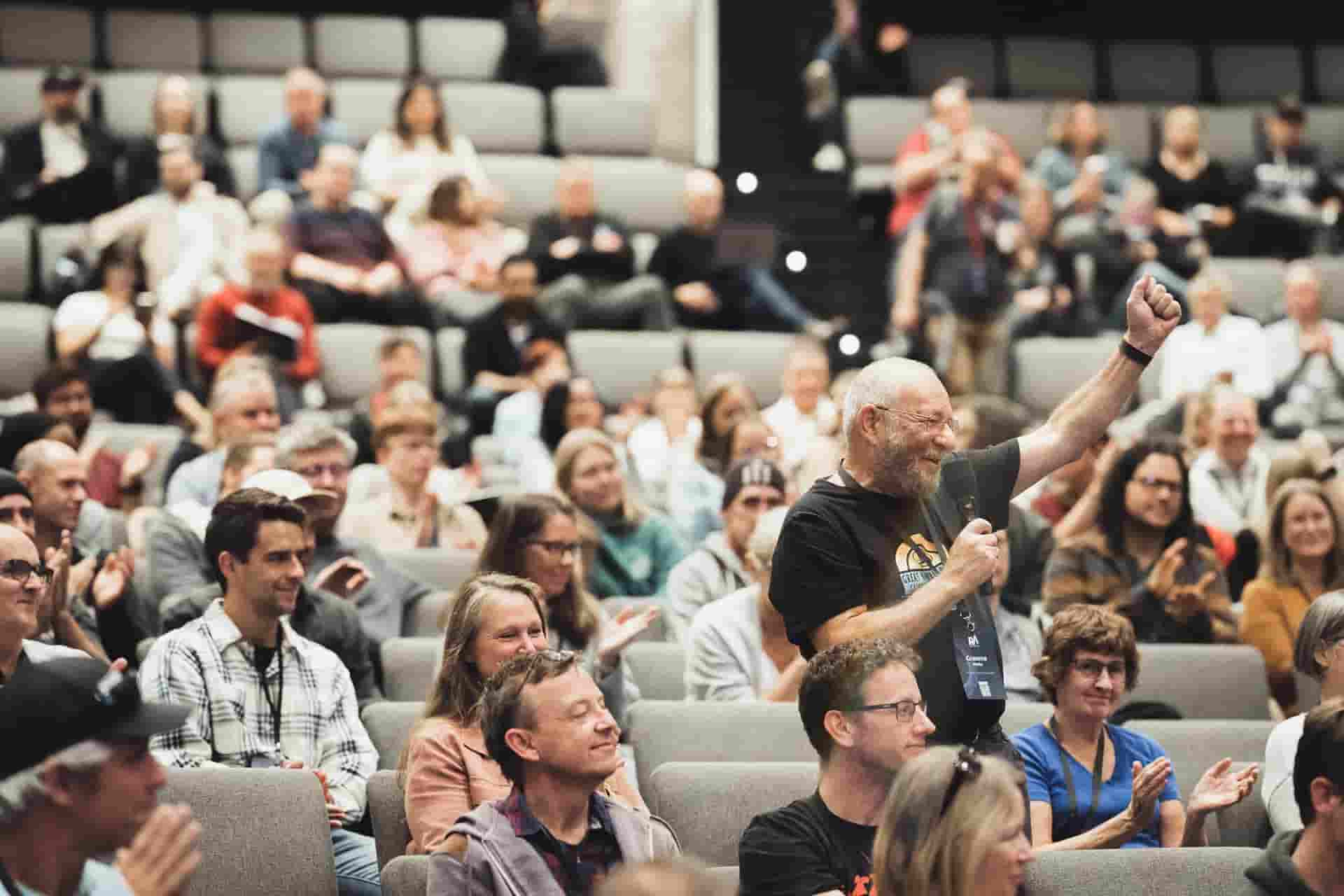
Tony Payne, the Director for the Centre of Christian Living at Moore College, reveals how the Word is the motivation and engine for making church members into disciples of God.

Transcript
This transcript has been generated, and can contain errors. Please refer to the original recording for the definitive language used.
Read transcript
[0:01]
all right we're going to hear from Tony Payne Tony you want to come on up to talk about the ecosystem again and the role of discipleship and particularly the Word of God I've known Tony for very long time he was the the founding editor of Mathias media in 1988 for who okay and now he wears two hats that one and now with the Center for Christian living Tony a couple of sentences Center for Christian living is about or you aim to
[0:32]
do it aims to take the theology of more college that reformed evangelical theology and show its practical application and implications for the Christian life and to bless the broader Christian community in Sydney and Beyond by doing that what would someone Google to find the Center for Christian living something like that certification living CC Elmore daddy dude are you okay excellent mate were all yours thank you thanks so much al well friends our task is to make disciples of all nations starting with this particular nation Australia and it's both ray and Andrew
[1:05]
said yesterday so helpfully the key to being a kind of missional out looking outward looking church is to have a vibrant strong multifaceted ecosystem of a church one that is God with the attentive and deeply word driven faithful loving repentant serving evangelistically minded and I was trying to get that picture up that had the curly you think in the middle and all the Pentagon but that that's a illustration there it is of the ecosystem is what we're trying to build
[1:35]
a richly interconnected system and to continue our pattern of thinking theological II as well as practically my job this morning is to think a little more deeply about two particular aspects that we only touched on briefly yesterday and that is how the language of disciple discipleship disciple-making fits into this ecosystem and in particular how the Word of God functions in the making of disciples in that ecosystem so disciple making and the Word of God is my topic it's interesting
[2:06]
Andrew was saying last night that this whole process of reach Australia has been about bringing together different kinds of emphases and strengths bringing the maturity people and the evangelistic people together and so on and so forth in our discussions as a committee and as a group one of the things we've been trying to mash together and think together is exactly this how do the systems how does the system's approach that looks at the whole ecosystem and how the process works how does that come together with
[2:37]
an emphasis on the role and place and care and disciple of every individual how does the programmatic systems emphasis which is important meshed together with the people emphasis of disciple how does everyone and each one fit together and that's part of what I'm trying to think about this morning I'm going to do it by firstly clarifying what a disciple is and what disciple making is now if you look up the definition of the word disciple in the standard Greek lexicon if you look up the theater's disciple in the BDA ji you
[3:09]
get this someone who engages in learning through instruction from another someone constantly associated with someone who has a pedagogical reputation or known set of views and most of you will know this that a disciple is essentially a learner a student not a follower explicitly but I'll learn up interestingly though in that definition it's not a learner in the way we would normally use that word in English today that is someone who just loves learning
[3:39]
or is a lifelong learner or is interested in education generally in the in the New Testament world and the theater as a disciple was someone who particularly wanted to learn from someone who attached themselves to someone to learn from that master a knowledge that would shape their whole experience and behavior and life and so I think a slightly better English word than learner is actually the word apprentice because that's what an apprentice is an apprentice is someone
[4:11]
who takes steps to be committed to learn from a particular master or teacher and acquires a framework of knowledge from that teacher that then results in a new practice a whole new behavior a mastery of a new set of actions and this is what an apprentice does apprentices himself to say a master carpenter and sits under that person's teaching learns from his master a framework about how to understand what wood is how wood works how nails work how hammers work how they fit together and then practically learns to actually
[4:43]
hammer nails into wood and a Christian disciple is an apprentice of disc of Christ in this kind of fashion and you see this in the great commission of Matthew 28 that is that is that is the disciple or apprentice whoops I've gone too far is somebody who turns from their old allegiances to commit themselves to a new master you make an apprentice by baptizing them by initiating them into a whole new life where they die to their
[5:14]
former life and rise to a new life that's what baptism symbolizes it's a total commitment of repentance and faith to live a new life under the authority of the risen Lord Christ and then the Christian apprentice learns from their master a knowledge that is lived out in practice he is taught not just to know the commandments of Jesus of course but to keep or observe the commandments of Jesus to do them in other words the apprentice Christian learns a theoretical knowledge it's never less than a theoretical knowledge but it's a
[5:47]
theoretical knowledge that presses down into the realities of life it's a form of knowledge that requires obedience and practice it's a knowledge that is lived and in Matthew 28 all of that happens in the context of Jesus lordship and the approaching end of the age he is with us until the end of the age and our apprentice in happens in the context of an imminent and approaching day in which the Lord Christ will return in judgment and salvation and so a disciple in the
[6:19]
New Testament is an apprentice who takes the radical life-changing step of becoming apprentice to Christ to learn from him that god-given truth about all of reality and then to grow in the practical mastery of leaving out that truth in every facet of their lives until the end the age and a church is a community or an ecosystem if you like an interconnected body to use a New Testament image in which that takes place in which apprentices are all
[6:51]
seeking to grow together as apprentices of Christ of the master now as many of you know the word apprentice the word disciple kind of receives in the New Testaments one of the little mysteries of the New Testament that after occurring hundreds of times in the Gospels after acts 21 it just mysteriously disappears from the New Testament but the concept doesn't disappear in fact the concept that we've just outlined what an apprentice is an apprentice of Christ actually is quite central to the rest of the New
[7:23]
Testaments understanding of what a Christian is Claire Smith has shown this and her doctoral work on the poor line communities and how they're deeply and profoundly communities of learning and teaching and that the concepts of learning and teaching are everywhere throughout the New Testaments description of church but it's also very striking to me how the sort of three-part picture of apprenticeship in Matthew 28 corresponds to the nature of the Christian life and the rest of the
[7:53]
New Testament that is that the Christian life is about turning to God from idols radically responding to the gospel and repentance and faith to begin a whole new existence as a servant of Jesus Christ to be buried with Christ in Baptism and rise to new life as it says in Romans 6 and Colossians 2 that's becoming a Christian then of course to grow in knowledge and love and service and obedience and holiness and in all the fruit of the Spirit to learn and
[8:24]
embrace and live out every aspect of the teaching of Christ and to do that in hope as we wait for the glorious coming of his of his appearing at the end of the age faith love hope it's the basic summary of the Christian life in the New Testament and it's the same shape as the gospel apprentice Commission in Matthew 28 in other words apprenticing people to Christ making disciples of Christ is just one
[8:55]
powerful way of speaking about the basic task before us in all its facets of seeing people repent and put their faith in Christ and grow in love in him until he returns and that's pretty straightforward I would I would hope and it has two simple implications the first one Andrew touched on last night or yesterday rather and many of you murmured very approvingly and I would murmur approvingly as well and that is that we shouldn't limit apprenticeship apprentice making or being an apprentice
[9:27]
to particular facets or aspects of actions in the life of our communities of faith apprentice in people to Christ really is just a description of what the whole body the whole ecosystem is trying to achieve and of every part within it it's what happens in the informal relational one-to-one kind of ministries that are part of our our body life it's what happens when we meet in small groups but it's also just as good a description of what happens when we meet on Sunday to have the Word of God spoken so that we can respond in repentance and
[9:58]
faith in growing love as we hope in Christ so I don't think we should think of discipleship or disciple-making as a department of church life if you're a discipleship pastor I'm sorry about that or is this particular aspect or facet of ministry if you're a senior pastor you are the discipleship pastor of that church you're leading the whole work of making apprentices of Christ nor should we limit it to one particular kind of ministry such as personal work or one-to-one work which is where we kind
[10:30]
of tend to associate disciple making and disciple in with apprentice in people to Christ is the ministry that's what we're trying to achieve we shouldn't limit it to individual work but we still do need to ask what does apprentice making look like on the individual level because as Ray pointed out yesterday making disciples this Commission is a disciple is a commission for every apprentice for every disciple for every Christian and
[11:00]
in fact the more we grow as Christ's apprentices the more we see in love to want to apprentice those around us to Christ to see them come to him and grow in him and this raises the question of course of how exactly that happens what does it look like for every individual apprentice in our ecosystem to contribute to and to seek after and to apprentice others apprentice others to Christ and this is where it's very useful to clarify and understand how the
[11:32]
Word of God functions in apprentice in the nations to Christ and that's the second part now let's move on to the Word of God a little bit on disciple-making disciple making and the Word of God now the Word of God is the fundamental ingredient in making apprentices it's the lifeblood of the community of faith I love the way in in Andrews Pentagon that the word was at the bottom fuelling and firing and founding everything that
[12:03]
happened right throughout the community in all its different parts and so let's just stipulate that as it a proposition that I won't spend any time arguing for that the Word of God is the foundation but if apprentices are fundamentally made through that word and if all apprentices and disciples have that Commission to make other apprentices through the word does that mean that all Christians all apprentices have a ministry of the word to one another our
[12:35]
logic would seem to say so but does make some of us a little uneasy or uncertain what does that actually look like for every Christian to have a Ministry of the word to be a maker of other apprentices through the word is that even possible is it achievable is it unrealistic does it participate in the kind of naivety that Andrew mentioned of thinking that we just have to train lots of individual apprentice makers and that will just do the trick and what about
[13:07]
the theology of gifting well in order to attack this tricky question I want to share with you some of what I've been learning over the past 4 years or so there's some of now I've been doing some doctoral research in exactly this area and I want to share two things that I've discovered I want to tease out two aspects of how the Word of God functions within a community of faith to grow disciples of Christ two aspects or functions of the word these are not tight descriptions of
[13:39]
particular activities necessarily as well as we'll see they exist in a field they're to zones or categories of speech the Christian apprentices engage in and I hope by clarifying them it might clarify our understanding of what it means for all of us to be involved in the word ministry together now these two zones of word ministry relate to how an apprentice learned something in fact how anyone learns anything when an apprentice learns any skill based on knowledge there are there's the
[14:10]
interplay of two related kinds of learning there's the acquisition of a framework of knowledge a framework that makes sense a framework in which the different pieces fit together that a framework which is unified and coherent and which the apprentice learns and imbibes and embraces over time and there is also the practical immediacy of learning to live our practice and embody that framework of knowledge in the particular field of practice that we're doing and all of our learning will
[14:42]
occupy a point somewhere in that field it seems to me now in the New Testament what I've discovered is that there are two categories of speech that cluster around these two poles of learning and these two categories owns of speech they're the kinds of speech they're not points and they don't describe any one particular activity they describe a kind of speech the first of them is what we might call teaching preaching speech it's practice mainly in the New
[15:13]
Testament by recognized leaders like apostles or elders overseers pastor teachers it's the kind of speech which focuses on declaring guarding and explaining the knowledge that is the scriptural revelation of the gospel of Jesus Christ with all its implications and tailmon the function of this kind of speech is to form in an apprentice a mind of Christ and a heart that embraces that knowledge of Christ it forms in the apprentices mind and heart a unified
[15:44]
multifaceted framework of truth the truth of the one true Word of God a truth that can be expressed as simply as Christ crucified but which in all its entire 'men sand implications and details can also be described as the whole counsel of God and the aim of this kind of speech is to transform the mind and the heart to understand the nature of all things through the prism of what God has revealed in Jesus Christ now you know about this form of speech because
[16:16]
many of you practice it often it's preaching that one single demon of truth that is the gospel of Jesus in all its multiple facets and brilliant reflections and this is what the teaching preaching form of the Word of God aims to do and what it's what it does do in the Christian community now this kind of speech also as you see it reaches down towards practical immediacy because it's an applied form of speech it's not just declarative it's also directive it urges and exhorts it's hearers to
[16:46]
embrace this knowledge and to live it because that's the kind of knowledge that it is so teaching preaching speech does reach down towards practical immediate immediacy and shapes everyday life it teaches me the commands of Christ and urges me to practice them but it can't reach too far down towards practical immediacy it can teach me for example as a congregation how I should live and behave at work but in the practical immediacy of the moment of
[17:17]
4:00 p.m. on a Thursday afternoon where my boss is asking me to do something that I'm uncertain whether I should do then I have doubts about that eye that pricks my conscience when I'm feeling wobbly about whether I should go ahead and do that or not when I'm facing my own weaknesses and the challenge of being godly in a difficult context in that context a different form of speech is required preaching card answer that individuals need at that nor deal with the particular doubts or weaknesses or sinful impulses that that
[17:49]
disciple is grappling with in fact if preaching or teaching speech tries to reach down too far towards practical immediacy it becomes legalistic and oppressive that's what legalistic preaching is preaching that is too fine grained too specific to over determined in the applications that it seems to impress upon its congregation too specific too many do's and don'ts about lots of specific implications and situations what's needed is a second
[18:20]
form of speech that the New Testament speaks about often that I've labeled one another edifying speech one that is not conducted so much by recognized or authorized individuals preachers and teachers but which is engaged in by every Christian every disciple now it's a form of speech that occurs very frequently more frequently than you think in 25 different passages I identified where this form of speech is either described or commanded or urged or encouraged and in fact 18 of those 25
[18:51]
passages are imperatives urging Christians to engage in this form of speech now this kind of speech has the same gospel shaped content and framework as teaching speech it's the same word it's based on the one gospel of Jesus it has the same goal to see people apprenticed to Christ and to grow in that it's empowered and enabled by the same spirit that enables teaching and preaching that spirit that fills every Christian and opens their lips to speak of God but it has a distinct function
[19:23]
and put simply its function is to apply the framework of knowledge the framework of the gospel to the practical immediacy of the apprentices life to the everyday experience of learning to keep the commandments it's the brother who stands next to me in the immediacy of that moment on a Thursday afternoon at work who talks through with me my response to the challenge of godliness I'm experiencing who listens to me and encourages me who reminds me of the truth of the gospel who exhorts me who
[19:55]
rebukes me if I start to stray who comforts and reassures me when I'm doing the right thing and it's costing me who explains and helps me understand how the truth of the gospel and the Word of God applies to me right here and now in a whole variety of ways now my time is short so I'm not going to turn to Ephesians 4 as I was going to do at this point and show you how this form of speech gets played out in Ephesians 4 how you have speaking the truth in love in Ephesians 4:15 as a kind of summary of this form of speech that happens
[20:27]
right through the body the truth being there the truth of Christ and then as you go on through Ephesians 4 and 5 you see that speech being played out in different ways in the Christian life in speaking the truth to the neighbor rather than falsehood in speaking helpful encouraging edifying words to one another rather than vulgar or corrupting words in speaking Thanksgiving rather than corruption in speaking to one another in Psalms hymns and spiritual songs by the power of the Spirit in multiple ways not just in Ephesians four and five but right across
[20:59]
the New Testament epistles we see this form of speech being practiced by every Christian as part of the normal Christian life it's as much a part of being a renewed believer in Ephesians four and five as is generosity or kindness or not getting drunk to have a whole new form of speech that edifies encourages and builds the other is just part of the renewed life that Christ brings to the apprentice it's part of the commandments of Christ that he
[21:30]
brings to every apprentice and so to summarize this kind of one another edifying speech has the same goal as preaching speech to see others grow as apprentices of Christ and it draws its content from the same scriptural gospel and framework but its function is to bring that word to bear in a whole range of ways on the granularity of everyday life to exhort encourage rebuke remind comfort explain stir up stimulate to see
[22:01]
one another grow and persevere to the end one another edifying speech doesn't pretend to preach and teach the whole framework in a fullness and unity and coherence although it is based on that framework now for many of us saying that the the Word of God is the foundation and lifeblood of the ecosystem for most of us when we hear that we think immediately of preaching and teaching you think immediately of the place that preaching and teaching has as the
[22:32]
foundation and lifeblood of our ecosystem of our community of faith but the New Testament has a richer picture than that of how the word makes a community of faith thrive and grow and become healthy a word that is taught and preached and that is the foundation but a word that is also spoken that also travels through the life part of the whole body in a manifest a manifold number of different ways the New Testament finds room for both kinds of
[23:03]
word based spirit given speech in the lifeblood of the community of Christ in fact it teaches the necessity of both kinds of speech especially given how frequently the Apostles urge Christians to engage in it in their churches now my time is nearly up and all sorts of questions are no doubt arising from what I've said I'm certainly aware of things I haven't said and that I'd like to begin – for example I haven't talked about the place of example in these two kinds of speech it seems that they're
[23:34]
involved in both one in a more general way that the teacher preacher presents an example of the godly life but example also an imitation also belongs in the one another space where we see one another's example next to one another in the closeness and exhortation of everyday life I also haven't spoken about how this model of thinking about gospel speech relates to speaking to those outside of the faith how it relates to evangelistic speech I've mainly talked about speech within the Christian community does speech outside
[24:06]
the Christian community the kind of gospel speech that reaches out and apprentices people to Christ says that have this same kind of shape I rather suspect it does as something in which all apprentices are engaged image all relate and speak to others but do so at different levels and at from context at different levels of specific immediacy to the person they're speaking to but that's another question to pursue at a certain point how about I conclude with two brief implications for
[24:36]
what I from what I've been saying firstly just very briefly a personal one digging through this material and clarifying in my own head its kind of clarified for me what I've been doing for the last thirty years at mathias media what we've really been trying to do i now realize is produce thinking and resources and teaching that advocate especially for this second kind of speech and that provides tools to help communities of faith grow and teach and train in that kind of one another speech i know we've done it imperfectly I want
[25:07]
to keep doing it better but it's kind of clarified for me what it was that we were doing when we produced all those training resources but in terms of the implications for you I'm not going to give you very much practical practical immediacy to conclude with because what I've really done in the last few minutes is give you a framework of knowledge I've given you a concept about how this speech works what it looks like in your context is up to you in the practical immediacy of where you are you'll have to ask questions about how this kind of
[25:38]
speech could grow and flourish as part of the overall Ministry of the word in your place how would it change for example what you've thought about small group ministry about its purposes and expectations about how you might change leaders you probably need to think about what forms of teaching and training need to happen in order to help your members acquire the knowledge confidence and ability to understand and grasp and then leave out this form of speech as part of
[26:10]
the normal Christian life to practice it with one another through all the different facets of our communal life let me just suggest that unless we take seriously the vital function that the one another edifying speech of the Christian community has and take positive and indeed systemic steps to see it grow and flourish and be effective then the long term quality and hell of our communities of faith about ecosystems will be compromised if we
[26:42]
construct a community a body that doesn't have this kind of one another speech pulsing through it at lots of different levels and in different ways it won't be healthy in the long run and to think that it would happen just on its own without deliberate or intentional effort and planning and teaching and training from us I think is a kind of naivety of its own the Apostles repeatedly urged that this kind of speech be practiced and it seems to me that listening to them and thinking
[27:15]
through what that looks like that's what it means for us to be theologically driven ministers of the gospel and let me encourage you to do that brothers and sisters how our theology works into practice though is what we also have to think about and that's what our is going to introduce next