Transcript

This transcript has been generated, and can contain errors. Please refer to the original recording for the definitive language used.

Read transcript

[0:01]
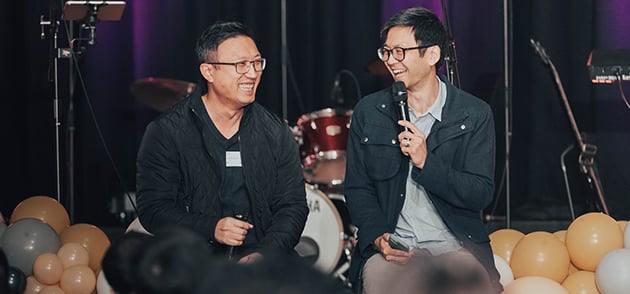
Well, friends, one of the great joys of live streaming is that right across our nation we get to join together even though we can't be together. We actually can join together and actually hear from two good friends about the Reach Australia development program. So, we're joined today by Phil Colgan who's at St. George North and Alan who's at Captivate Presbyterian. So, would you guys like to just briefly introduce yourselves and then we'll spend the next 10 minutes getting to know you guys in terms of the coaching relationship.

[0:32]
So, I'm Phil. You actually met me before, but there you go. I'm senior minister at St. George North Anglican Church which is in, funnily enough, the St. George area of Sydney. Ours is a church of six different congregations that all work together to try and reach our area for Christ. Yep, and my name's Alan. I'm the lead pastor at Captivate Presbyterian Church. We're in North Ryde in Sydney. Yeah, we're about 130, 140 kind of church and

[1:03]
I'm married to Bee. We have three kids, four, two, and zero. So, I'm yeah, in the thick of things. Yeah. That's great. Well, Phil, when you mentioned you lead a church with six congregations in it, I've got about one congregation with about 100 people and I'm stressed enough as it is. Six congregations in a church, that's a pretty big task. Um why in the world would you set aside time in addition to the church that you're leading to train or coach my good mate but someone like Alan? Like

[1:34]
why why that seems like your hands are full enough. Yeah. I ask myself that question. No. Oh, thanks thanks, Phil. I we pride ourselves at St. George North to be a training church. We we try and send people off to ministry. We try to have an MTS program. We have student ministers who come either from within or without to get trained as well as having a reasonably large staff team that I'm responsible for training but we want to share that with others.

[2:04]
And so I think it's a pretty small thing for me to do. Alan and one other person who I spend an hour or two with once a month coaching. And if I can help them think about how they can be at work in their church that's a pretty small use of my time but I actually get a great benefit out of it cuz it makes me think reflectively about what I do. So every time we talk they think I'm helping them when I'm frantically taking notes about what they're doing and um applying it to my situation but it also

[2:37]
makes me actually reflect on why do I do what I do. Why do we do things the way we do? So I find incredibly helpful for me as well as hopefully being helpful for them. That's a really helpful way to think about it because I think often when we talk about coaches and and people being coached we always think about it in a one-way sort of relationship as if the coach is just sacrificing but getting no benefit out of it but there's a real benefit that not only you get but St John's North also gets from it as well. Yeah, exactly right. Al, what about you? I I remember when

[3:07]
you started at your church I drove a hard bargain to try to bring you down to Melbourne. You said no and you broke my heart but that's okay. So do you want to tell us a bit about your church and and what's its story been? Yeah. Yeah, when I was at college I was entertaining all sorts of ideas. I want to go somewhere where I could really serve. So Captivate Presbyterian is actually my home church. It came out of a ethnic kind of Chinese church sort of deal and and actually today's material really resonated cuz I grew up in this church that didn't have a minister for

[3:38]
about 10 years but it was just guys opening up the Bible, praying, discipling people exactly what we've been talking about and it and out came this English speaking congregation of about 50. Um as I grew up there we eventually did get a minister but I ended up going back and knocking you back Adam and because the minister that was there actually had to step down because of moral failure. It was catastrophic for the church. It was a little community but it really gutted them. But what really impressed me was these

[4:09]
guys in the saddest circumstance did exactly the same thing. Whipped out God's word, prayed for each other, discipled each other and that's what got me excited to actually go back to to yeah, help this church which I thought was full of wonderful people who wanted to make a splash for Jesus. It would be incredible privilege for me to have a shot at helping them grow together. Yeah. Yeah, that's great. And then so you've been there how many years now? Uh, this is my fifth year at yeah, five years. Okay, so about five years you chose for

[4:40]
whatever reason to say I'm going to go seek out and sign up for the Reach Australia development program. What led to that for you? Yeah, so I came back to this church and you know, I said look, I whilst I was at college and looking at this 5M stuff, are we still allowed to say M's? Yeah, I don't know. Anyways, I said we're really good at this maturity stuff, you know, but we know that our evangelistic temperature is low. People walk through our front doors, we can't connect with them, they don't stay. We do we want this church to grow?

[5:12]
Do we want our service which has remained unchanged for the last 10 years to actually have a bit of life to it. And so I signed up for this program because well for the sake of my church because we actually all wanted to grow. We want to see the gospel reach people who needed to know Jesus. I signed up for the sake of myself. If I wasn't growing, there was no way this church was going to grow. I needed that sort of input and I guess for the sake of the gospel, I wanted to join something where I knew that my gospel convictions were just going to be

[5:44]
prodded and poked and just energized And so, yeah, the Rich Australia program was yeah, something that I think appealed to me because of that. Yeah, great. Maybe both of you can speak into this. Your churches in one sense, from what I gather, couldn't be more different. Your personalities are, I take it, slightly different as well. How do you marry those two things together if at all? Like, does does that help or does that hinder the coaching relationship? I don't know if Phil actually knows this, but I actually asked Scott if I could have Phil for my mentor. I

[6:15]
don't know if he ever told you. Um Yeah. And I actually don't know whether you're still allowed to do that, so don't quote me on this. Um yeah, um but I I actually deliberately wanted someone who I knew was very different. And that came out in our first coaching session. You know, we're talking about preaching, Phil was like, you know, um if a couple of people a little bit annoyed at me after my talk, I've done a good job cuz I've I've really pressed the gospel into them. Al, how do you naturally feel if a couple of people are annoyed at you after you preach? I I avoid conflict like there's no tomorrow.

[6:45]
I want everyone to be happy with me, you know, think I'm I'm think the best of me. So, I was like, yeah. But it's exactly why I wanted someone who was, you know, different, you know, in all the best ways, you know, in really in all the best ways. And it's been so enriching this whole time because of that, yeah. Phil, how have you found it being such different people and context as well? Well, my my heart's been warmed tonight, but um but I I think it's really important to understand what the coaching relationship is and why it works that way is that's not my job to tell Alan

[7:17]
how to run Captivate Church and how to reproduce St. George North at Captivate with all its strengths and all its weaknesses. It's my job to help him reflectively think about what he's doing and think theologically about it, think in terms of the church consult he's had, how to put that into practice. So, it's actually it doesn't matter that we actually have very different churches and different personalities. We're not that different now. But um the the key is that I help him think

[7:50]
theologically and critically about what he's doing. And then it's up to him to work out if that's right for what he does at Captivate. Yeah. Al, do you want to give us an example of a time that you found it really helpful? Because I know there's a lot of development programs out there. There's a lot of things you can sign up for. But what makes this development program particularly helpful for you? Yeah. Um look, we can you know, I've been coming to some of these conferences and you know, even with the consult, you get this, you know, really fat report about all kinds of things you could be

[8:21]
doing better and and um but it's one thing to to hear what we're hearing this week and to read this report about my church and what but it's just that one step and it's the most crucial step to actually making it happen. And that's where the coaching really is great. Like one one of the things, you know, going from 50 close you know, closing on 150, one of the huge things that we've been talking about is how to decentralize ministry from me. You know, I you know, I I actually had quite an emotional reaction to

[8:53]
this idea that I don't get to have a coffee with every single newcomer. Like that going forward, I need to decentralize it from me. That was one of the best bits of of being the pastor, you know, I'm welcoming every single person into Captivate. And I I've been doing that this whole time. Um so just having someone who could actually hold me accountable, hey, do we still think that's a good idea? You know, um and you know, I let's let's move through all this. I'm not a feelings person and I found myself

[9:23]
having a lot of feelings about this and and having someone to help me through that, that strange experience was um yeah, was exactly what I Phil, how Phil, how exactly did you help Al through that experience? feelings person. That's cuz I'm a feelings person. Yeah. Would you like to nominate which feeling in particular? The interesting thing is Alan know knew what he had to do and it's just helping him remind him help him see

[9:53]
that there's a gospel motivation for what he's doing on that particular one. Yeah. At other times we've talked about more structural things, you know, so uh uh one of the issues Alan's going through at the moment is there's this very young church and when families with kids join them they don't stay. So it's actually helping him think what do you have to change about your church so that you're ready to connect with those people, things like that. Yeah. Al, we've got 1 minute left on the clock uh and I've got one final question and I'm hoping that you can coach me just very briefly because

[10:24]
you said you're a conflict uh avoider, I'm a conflict denier, I just don't even believe that it exists. Uh I I am a deeply feelings person. Who can disagree with you? The idea of having someone come into my church and do a consult and write a report terrifies me. And then the idea of having a coach who feels deeply about things uh and telling me how I can improve as a pastor terrifies me. That that's hard on a heart level to put my hand up to say yes, I actually want

[10:55]
to go do that. Why should I? Yeah, that's a great question and um you know, we we had a great emphasis on being faithful and and that being a key part of it. I guess the other side of that word faithfulness is that I think God is incredibly It's God's faithfulness that ultimately grounds me in my ministry. Um whether I do a great job, whether I finally stop having these coffees, you know, cuz this is must be the thing I um God still loves me and he'll use me.

[11:27]
I've seen him do it when this church was in absolute trouble and he's carried them through. Um so, it's given me the confidence to kind of go, "Well, if we want to keep growing, we should be open to hearing where that leads us next." And it doesn't undermine my security as a as a as a child of God, uh nor does it do for my leaders. Uh we've all learned this lesson together. Uh so, we welcomed Scott and his team with open arms, and they ripped us to shreds, and we had a great time. Be All

[11:59]
for Jesus. They spoke the truth in love. Uh that's all. All right. Well, thank you so much, guys. I'm going to invite Andrew to come up now, and he's going to uh cast some vision for us, uh help us understand uh where we're headed, and then we're also going to hear from Derek uh about celebrating the mini churches that have been planted over the last 10 years as well. Why don't you give these guys a hand?