
Richard Coekin outlines what the Bible and practice have taught him are the 12 fundamental principles that should undergird any church planting exercise.

Transcript
This transcript has been generated, and can contain errors. Please refer to the original recording for the definitive language used.
Read transcript
[0:00]
Don't do it for convenience. Don't do it to show off. Don't do it because that's what everybody does. Do it for Christ. Get your head and your heart straight. That is for evangelism to grow his church for God's glory alone. Try and get your motivations right. There may be secondary motivations like it's more effective for some people or the rest of it. Make your first motivation Christ. Secondly, prayerful biblical gospel teaching ministry is essential for spiritual growth. I know the whole world is telling us all what we should be doing to plant churches.
[0:30]
I haven't read any books on church planting. I didn't even intend to be a church planter. I just intended to teach the gospel of the scriptures and church planting just seems to be a good way of reaching people. So we're doing it just because it seems a good way. There's no command in the Bible to plant churches. There is a command to make disciples. We're just finding church planting is an excellent way of doing that. To my mind, prayerful biblical gospel teaching ministry, high quality teaching ministry, is the heart of all our congregations.
[1:01]
And I want you to understand that because I know the world now is full of here's the next course, here's the next model, here's the next way you grow churches. The only way you grow churches which are spiritually alive is through prayerful biblical gospel teaching. Now there may be many ways, contexts in which you do it, but get that right. So we need high quality Bible teaching at the heart of all our plants. Thirdly, no church plant is perfect, for God likes to use our weakness. When we planted in Mayfair, I'm officially, by the way, the curate of an Anglican minister.
[1:40]
Is that rain? Yes, it is. God, it's like England. How wonderful. What was I saying? Oh, yes, when we planted in Mayfair, Jonathan showed me this letter from a very highly respected Anglican minister with three pages of criticism of our proposal to plant in Mayfair. He showed it to me, and I read it, and I thought all these criticisms were true. It's the wrong place. Nobody lives there. It's the wrong people. There's no variety of people.
[2:11]
You know, it's all wrong. We don't need more city churches. There's more churches. I read all these criticisms, and I thought they're all true. But I still like our imperfect church more than the perfect church that isn't anywhere. You know, in other words, all our churches are imperfect. None of them are ideal. I spent my ministry with our congregations being criticized. You know, in the way that snotty big churches sometimes say, oh, you don't have a children's worker. Surprise. Well, you have to do the Bible study preparation as well as preach.
[2:41]
Gosh. You know, every implication is you're not doing it the right way. And the answer is no, we're not. We couldn't. We couldn't find it. We couldn't afford it. We couldn't find a building. It's not in the right place. It's not perfect. But it's better than nothing that's perfect. Shape the plant, fourthly, for realities, not models. You know, I'm not saying models are not useful. I suppose it's useful reading books for ideas.
[3:11]
But I would urge you, in the end, you know the scene. Work it out from first principles with the Bible. You do what makes sense on the ground where you live, where you know the scene. Don't plant because some bloke in America wrote a book saying this is the best way in the world to plant churches. Do it on the ground. Whether it's internally, whether it's transfusion, pioneer, cooperative, colony, however you do it, please pray for the realities and not for some famous name's model. Fifthly, plants need leaders, members, money, venue, and a plan in any order.
[3:45]
What I mean is you need all those five things. If somebody gives you 50 grand towards a plant, you might think, oh, let's look for a leader. If a leader says, I'm ready to plant, then you might look for a venue. A great venue comes up, oh, I hadn't thought, well, let's plant. In other words, they come in different order. So it's just, you know, I am, I suppose, famously opportunistic. It's basically just the sovereignty of God. And the stories of what God has done are amazing.
[4:18]
Couldn't find a leader for the plant in Worcester Park. Interviewed somebody who wasn't right. Phone went. Steve Smith in Uganda saying, I need to come home. We're both bereaved. We need to look after our parents. Have you got a job? You're perfect. Never thought of it. We were about to plant in Walton. I was going to the vision evening. It got to the day of the vision evening where I was going. And I knew that some of the people that are involved, one or two of the Christians that have been involved in church work before where the finances had been mismanaged.
[4:50]
And I did not have the commitments to the money that I had been promised from one or two patrons. And I had been chasing this guy and chasing him and chasing him. And it finally emerged that his business had collapsed. He didn't have the money. And I was going to the vision meeting that evening with 25 people to plant in Walton. And I had no idea. And a staff member walked in. And he said, I'll do it. You can have 25 grand for three years. That morning. And, you know, what do you call that?
[5:21]
Just reminding you it's of God. This is of God. Sictfully, professional staff need high-quality, loyal elders to model church membership. We're not really just interested in the Bible teaching leader. We're interested in lay leadership. In other words, all our plants have prospered from having a quality lay family or couple or a couple. In other words, we plan plant with six, really. Leader and his wife.
[5:52]
Elder and his wife. And an apprentice with or without wife. So we like to plant with a little group like that. And the importance of our lay leaders cannot be exaggerated because they model to everybody else what this moron is talking about. When he's teaching the Bible, you know, you get this sensible, measured, mature Christian couple. I can tell you who they are in every congregation. They are fantastic.
[6:22]
We invest very heavily in our lay elders. Next. The number of members you need is mainly an issue of confidence. So if you think you need 40 and you get 35, you're worried from day one. If you think you need 30 and you get 35, you're thrilled. God is blessing this work. It's fantastic. You should come to our church. It's amazing. We've already got more people than we ever thought we needed. So so much of it has to do with confidence. Having said that, of course, 25 people for an evening congregation,
[6:53]
25 people in an Anglican church building, they rattle around in the big building, it's sad. Same 25 people in a cafe, sitting on the chairs in the back. It's cool. It's great. We're full already. It's wonderful. So the atmosphere of how you do it matters hugely. In the morning, 35 adults plus some kids. Kids fill space. So 35 adults plus kids feels like a crowd. So we would be looking for 35 in the morning, minimum 25 in the evening. To be honest, 25 in the evening is really hard work growing up. If you can get 70, great. We don't often have 70, but there you go.
[7:26]
Members of other congregations can double up or commit for a trial period. So we rent, sorry, we hire, no, we borrow people from congregations to boost numbers in a congregation for a year. We say, please, could you boost for a year, give us some music ministry, then go back. But help this 15 that we've got look like 30 for a year. Be part of it. Be involved. And we don't mind people going to two different churches in different places. Obviously, it splits their commitment. But we don't think there's any rule you can only go to one church. Obviously, there are realities to that. So anyway, rent a mob is helpful for critical mass.
[8:00]
Ninthly, plants don't happen by accident. Senior pastors need to drive them. We often call church plants, we call the planters the ministers of small congregations. But actually, they're not the planters. The planters are the leaders that drove out those groups who planned it, recruited the finance and all the rest of it. And the young man is running the small congregation. He's not a planter. He's the minister of a small congregation. It's a brilliant job to have. But sometimes you forget the people who most need to be convinced about planting are the senior men who can release the money, the people, the venues, arrange it, and get the venues.
[8:33]
So planting is not just young pioneers. Planting is often senior people who make the plants happen. Anyway, schools, sports centers, churches. Schools are good for young families. Sports centers are good for young couples. Churches are good for yuppies. Interestingly, often middle class, professional people actually quite like the establishment buildings. Giving the best people and resources is sacrificial generosity. You know that. Twelfthly Church is growing through equipping the congregations for ministry. Training is central.
[9:04]
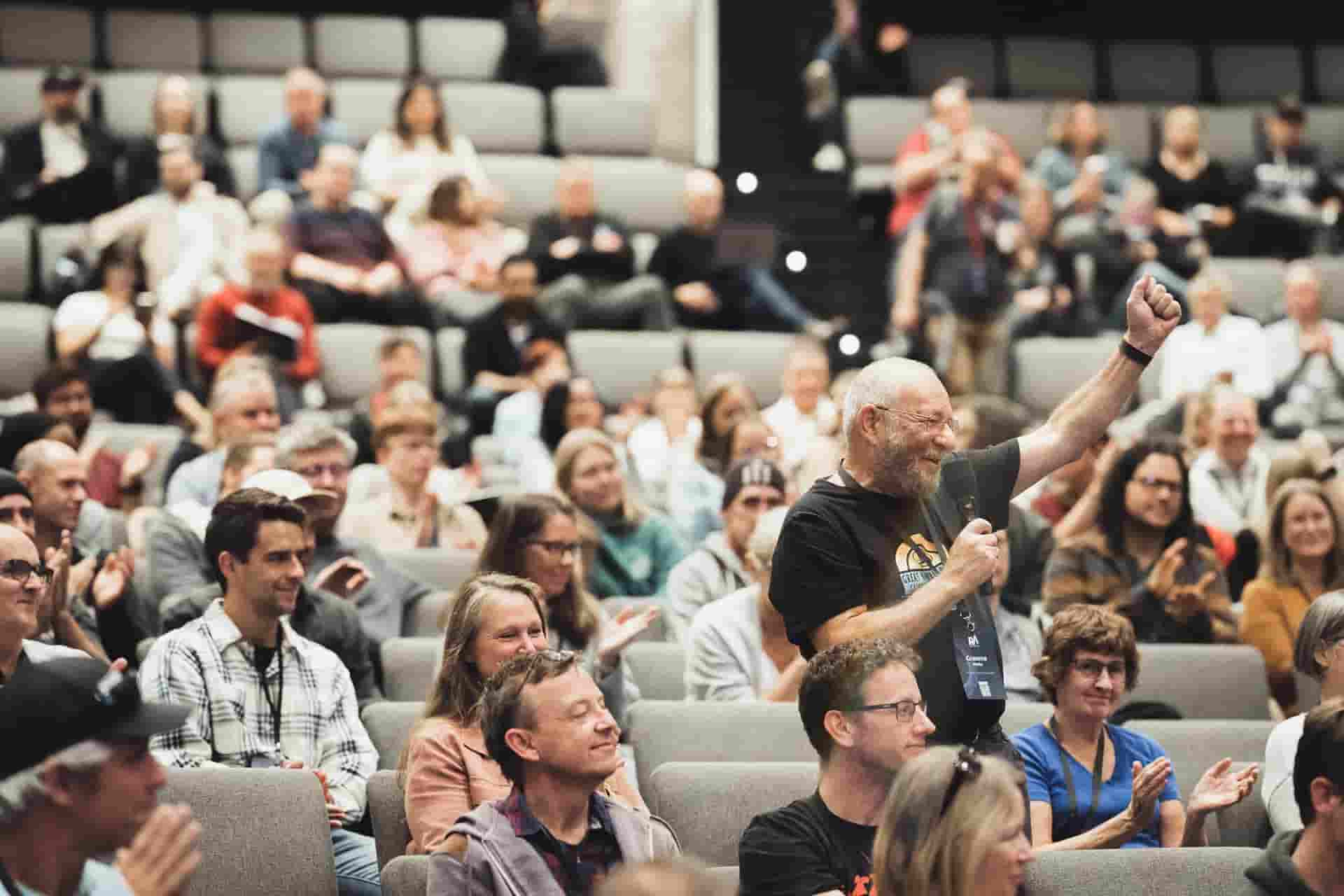
Turn over the page, the centrality of training. Training, I think… I could leave that. Do it this afternoon. Do it this afternoon. Right. It's nearly quarter past. It is. Questions. Is that right? Absolutely. We have time for questions. My able assistant, Scott, is going to handle the microphone. Thank you, mate. So if you want to ask a question, just stick up your hand.
[9:36]
I might kick off while you're thinking. Privilege of emceeing. Richard, it was really exciting to hear about all the churches that have been planted. And it's possible from where we were sitting to think this is great. They sneeze and out comes another plant. You know, it's sort of… Lots of it was happening. It's that easy? Mike, tell us a bit. Did you used to have more hair? I did used to have more hair. Actually, it's not a joke. I am permanently exhausted.
[10:08]
I'm not exaggerating. I am exhausted all the time. That's the first thing. The second thing is there have been some horrible periods. You know, I was taken to court. In the week, my daughter was sick. And I was told on the Monday… I was preaching at the men's convention on the Saturday. On the Monday, I was told she would be dead within a week if something didn't change.
[10:39]
And on the Thursday, I was being cross-examined in court for flying in a South African bishop to ordain some staff because our diocesan bishop wouldn't teach that homosexual practice is a sin. So there have been some pretty low moments through it all. So, no, it's very, very difficult. One of the most difficult things is not only do good people in the constituency suspect you and criticize you, but even your own staff can sometimes…
[11:09]
You know, managing doubts. And sometimes you've just got to say, come on, guys, we're just going to keep going. And it's worrying. And so, no, it's been difficult. But God is good. Other questions that people would like to ask? Oh, sorry, Steve's got the microphone. Sorry, I thought… I already pinched it ahead. Sorry. You can't ask a question without the microphone, all right? That's the rules. Richard, I had a question just going back to your talk, the first one,
[11:42]
when you were talking about wolves coming in amongst the flock, et cetera. And I've sort of been wrestling with this for a while at different times. And I guess the question's kind of too double-barreled. But one, when does a confused sheep end up becoming a wolf? And secondly, do they know that they're actually wolves? Yeah. I think the confused sheep becomes a wolf when the confused sheep starts teaching the other people. So obviously all the young Christians in the congregation are confused about all sorts of things. So we're teaching them all the time.
[12:13]
But if the confused sheep starts teaching serious things that are wrong to other people, I want them out of the congregation fast. Now, it doesn't happen to our congregation because we've established… You know, like many evangelical congregations, we've trained our elders, we've trained our leaders. They're not ignorant. They know their Bibles well. And they're engaged with debate with people. And nobody gets appointed who hasn't proved themselves over a period of time.
[12:44]
You know, we don't appoint elders… All our home group leaders, you see, are elders. So we… Because… Although we've got lots and lots of knowing God for the younger group, small groups, I wanted to make sure that all our home groups, all our families, had access to somebody involved in decision-making. So we've been able to appoint elders. So I've got 28 elders at Dundonald across the four congregations. We also put them all through my prepared-to-serve ministry training course in the evening.
[13:17]
So they're all expected to do that at some point. And so I'm looking hard at them. They have to prove themselves over a period of time. We don't appoint any old person to run a small group. Is that… Yep. Yeah, Richard. Richard, do you… You've talked about congregations and stuff, but we're sort of talking about church planting. Do you distinguish between congregation planting, church planting? What are the differences? Well, yes. In a church like Dundonald, for example, where we've got four congregations,
[13:48]
we talk about one church with four congregations. And there are issues about that because most churches, of course, multiply congregations and then think about giving pastors to each over time. We did it the other way around. We backed four churches into one building. So we had to be one church. And there have been difficulties with that. There have been strengths to that because they think congregationally. So the phrase that I use is one church in four congregations. In our elders meeting, I run the first half of the meeting with all the elders, and then they break into the four teams.
[14:19]
And the assistant pastors who deal with the congregations deal with the teams of elders. Again, at the prayer meeting, we all do it all together. And whenever I'm there, I run it. So at critical expressions of unity, as a senior pastor of one church, I exercise a role there. The staff are all happy with that. But sometimes there's confusion about who's responsible from members who are part of those congregations. So all I'm distinguishing is sometimes you've got multi-congregations
[14:50]
in one church, but they meet in different groups who are united. If you've got four congregations in a building that never meet, I think you've probably got four churches, haven't you? We could discuss that if you want, but… If you're starting a new congregation in a church, is that the same as starting a new church, do you consider? Well, it's interesting. I do think that the appointment of elders and the freedom given to elders to run the church is an important indicator
[15:23]
of a church that is separate from another church. So, for example, all our congregations, when we plant them, they all have a council of elders that runs the business, the internal business of the church. So I'm not called senior pastor of commission. I'm the director of commission. I'm only the senior pastor at Dundonald. So I don't try and tell the senior pastor of the other churches what to do in their churches. I expect them to consult with their teams of elders. So it's only what we do together that is commission. Within the church, we respect the integrity of the church.
[15:54]
So if they're multi-congregational, that's their business. But we want to respect the life of Christ's church. I am not in Christ's church battle. So what gives me the right comment on what the church is doing? Diocese and bishops who try and tell local congregations what needs to happen in them without listening to the people who actually run the church director Oh city Thank you.