

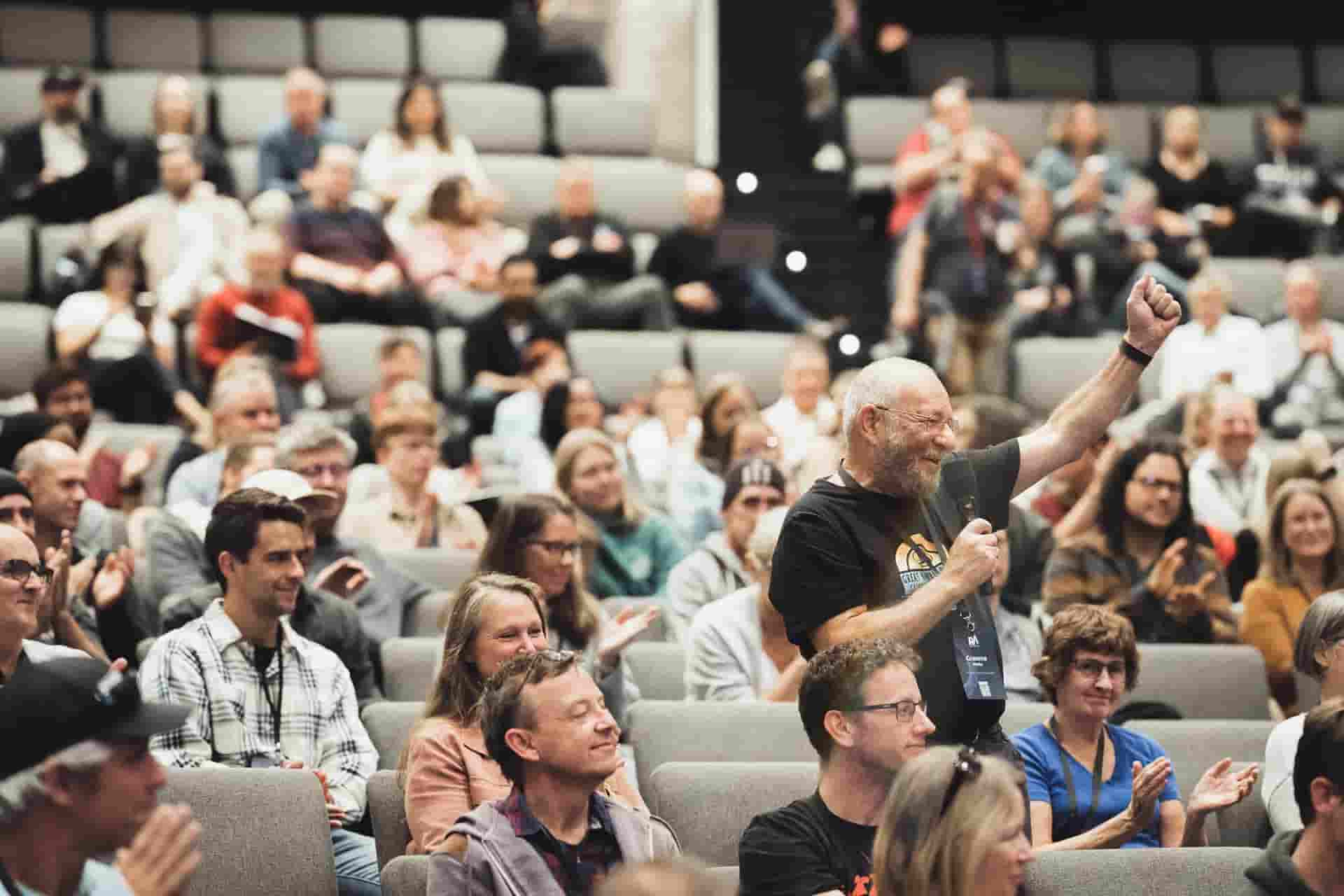

Gary Millar delivers the most unexpected talk on keeping the Gospel central – not one that warns about ego or challenges his listeners to focus on the Bible. These, he admits, are par for the course. However, as an experienced minister, he challenges the audience at Multiply15 to cultivate an attitude that loves the people we preach to, which will in turn spur us to preach the good news.

Transcript
This transcript has been generated, and can contain errors. Please refer to the original recording for the definitive language used.
Read transcript
[0:00]
So when you open up your bibles to Romans 1, and remind one another as we hear from Paul about the importance of this momentous news. Romans 1 verse 1. Paul, a servant of Christ Jesus called to be an apostle and set apart for the gospel of God. The gospel he promised beforehand through his prophets in the Holy Scriptures regarding his son. Who as to his earthly life was a descendant of David?
[0:30]
And who through the spirit of holiness was appointed the son of God in power by his resurrection from the dead? Jesus Christ, our Lord, through him we received grace and apostleship to call all the Gentiles to the obedience that comes from faith for his name's sake. And you also are among those Gentiles who are called to belong to Jesus Christ. To all in Rome who are loved by God and called to be his holy people, grace and peace to you from God our Father and from the Lord Jesus Christ.
[1:07]
First, I thank my God through Jesus Christ for all of you because your faith is being reported all over the world. God who my servant, my spirit and preaching the gospel of his son is my witness how constantly I remember you in my prayers at all times. And I pray that now at last by God's will the way may be open for me to come to you. I long to see you so that I may impart to you some spiritual gift to make you strong. That is that you and I may be mutually encouraged by each other's faith.
[1:41]
I do not want you to be unaware brothers and sisters that I plan many times to come to you but have been prevented from doing so until now in order that I might have a harvest among you just as I have had among the other Gentiles. For I'm obligated to Greeks and non-Greaks both to the wise and the foolish that is why I'm so eager to preach the gospel also to you who are in Rome for I'm not ashamed of the gospel.
[2:11]
For is the power of God that brings salvation to everyone who believes first to the Jew then to the Gentile. For in the gospel the righteousness of God is revealed a righteousness that is by faith from first to last just as it is written. The righteous will live by faith. I just joined us tonight. I'd like to introduce you again to our speaker who has already taught us well today. Gary Miller. Gary is a Northern Irishman married to Fiona a Scott who was born in Peru.
[2:49]
His dad to Lucy, Sophie and Rebecca. He loves teaching people about Jesus from the Bible. Gary has been the principal of Queensland Theological College in Brisbane since January 2012 before that he was the pastor of a pair of Presbyterian churches in Dublin. Gary is here as anyone who is up the front not as a performer to be applauded or a special person to be honored in. He's a brother and he's a servant. So the way that we can welcome him is by opening our Bibles, opening our ears and praying for him rather than clapping.
[3:24]
So let's do that. I'll invite you to come up and I'll pray for you. Gary as we get our Bibles and our hearts ready. We're loving Father. We come to you and we know that even as your people we are in need for your blessing again and again to hear your word truly, to understand it and see its relevance to our lives. We pray that your spirit be our teacher tonight that he convicts us of sin. Again draws us back to repent and put our faith in the gospel of Christ that he leads us to become more like Christ.
[3:59]
We pray for our brother Gary that he may speak with clarity, he may speak with love but he may first of all seek to honour you and his ministry among us. In Jesus name we pray. Amen. Thanks, Mikey. I feel slightly strange about coming here tonight. I don't know about you. I find Steve's talk so helpful. I'm not an introvert but I would rather just go and sit and reflect on some of the challenges that Steve led before us but also believe in a sovereign God.
[4:40]
He knows what he's doing. Having us here this evening, sitting under the sign of his word again. I've got a complaint to make. I don't know. I know Scott doesn't normally bother coming into the sessions but wherever it's got to, it's not fair. Steve got a part. Your brief must have run the pages. Steve, you know, it's just after any of you, it's not allowed to teach the Bible and has to be personal and has to talk about specific illustrations. My brief for this evening was a little more succinct than that. Four words. Keeping the gospel central.
[5:16]
So thanks Scott for that. My guess is that tonight, if you see that, you're fairly low expectations. You know what's coming in a talk about keeping the gospel central. If we run twin tracks, keeping the gospel central and making the gospel peripheral, well, you'd still have shown up to this one even just to keep your boss off your back if he's here. So, you know, even as I wander through this introduction, you know, you're selling back into your state, ready to endure entirely predictable exhortations to keep the Bible at the center and evangelism at the center.
[5:53]
And you're kind of bracing yourselves for, you don't want to appeal to cling to orthodoxy, come what may. And you're geared up instinctively for warnings against making too much of personality and pragmatism and yada, yada, yada, yada. But I'm not going to do any of that or at least not very much of that. I'm going to do two things. Yeah, I'm going to try to explain Romans 1, 1 to 17 to you because it's always better for me to teach the Bible than to indulge my admittedly strong desire to sign off about everything that's wrong with the church and young people today.
[6:24]
But I'm going to interspers that with just a few warnings, suggestions about ways in which we may actually, well, really signs that we're slipping from keeping the gospel central, which I think people committed to church planning or prone to slip into, and which I think do emerge fairly naturally from Romans 1. Whether you think we have words naturally from Romans 1 remains to be seen, but enough of that.
[6:57]
And famously in his preface to his commentary on Romans Martin Luther says this, this epistle is in truth the chief part of the New Testament and the purest gospel. It would be quite proper for a Christian not only to know it by heart, word for word, but also to study it daily for it is the soul's daily bread. It can never be read or meditated on too much and too well, the more thoroughly it's treated the more precious it becomes in the better it tastes.
[7:28]
We want to keep the gospel central, what better place to go than Romans, where we get to see the gospel in all its glory and more than not be moved to savor it and treasure it. But it does raise one question that we need to settle before we go any further. What is the gospel? That's a question. It's not really fair, but we ask everyone who interviews to come to QTC this question. It's always the second question. So it's what is your name? What is the gospel? And they're just kind of settling nervously into the room and trying to remember people's names.
[8:03]
The registers are sitting there with a pan to write a dime so that this is recorded. And then we say, oh, and by the way, there's only two lines for you to sum it up. But it's very telling. And I do think we need to know the answer to that question. If I'm still committed to this, what I'm going to suggest is that you turn to the person next to you, you kind of get into. And one of you is going to have 30 seconds to explain what the gospel is. Okay? Now, it's the one whose first name comes first in alphabetical order. Okay? You don't need a long conversation to work that one night. Okay? Okay?
[8:42]
So there you go. You get 30 seconds starting now. Okay? That's enough. Sorry. Best of order, please. Ladies and gentlemen, thank you. You've blown your opportunity if you weren't able to explain it that quickly. Okay? So what is the gospel? Do we actually have that clear in our minds on our lips?
[9:12]
The best I could do is the gospel is the marvelous news of all that the Father has done and is doing and will do for us in the Lord Jesus Christ through the power of the Spirit. Okay? Something like that. To keep the gospel central is to believe this and to live it and to allow this to shape and correct every idea and strategy and emotion. To keep the gospel central is to proclaim this and explain it and to hold it out to all people whether their Christians are not publicly and privately.
[9:45]
To live and breathe this gospel, the marvelous news of all that the Father has done and is doing and will do for us in the Lord Jesus Christ through the power of the Spirit. That's why Paul writes Romans. He writes this letter and state the obvious Romans is a letter. 22 page long, 7,100 word letter, but it's a letter written to ordinary people who make up a local church. It's a real letter written to real people in the middle of the real world to help to keep the gospel central.
[10:18]
Paul wants them to get three things. He wants them to be clear on the gospel. He wants them to be committed to partnership in the gospel with him and with each other. And he wants them to be passionate about mission. See, Romans isn't Paul's attempt to write a systematic theology. He wrote it so that people like us would be clear on the gospel and be committed to working with other gospel-hearted people and be wholeheartedly committed to evangelism together. So when you read Romans, you're not supposed to go, I know I have my theology stored at night.
[10:50]
We're supposed to grasp the message of Jesus more fully. We're supposed to work more effectively with the people of Jesus and to long to see more people come to know Jesus. Romans really is deeply practical and it's all about keeping the gospel at the center of everything. So when we read this book, we can't expect ever thinking challenged and straight night by God to have our wrong attitudes and our independence exposed by God and to have our hearts moved and our wills galvanized by God as by His Spirit.
[11:21]
He works this gospel deeper under our skin and into our lives. Because that's what God does. He works through His words by His Spirit. And that's very obvious in this opening chapter. In Romans 1, 1 to 17, Paul introduces himself, but even that's not quite true. Because he hardly says anything about himself. But what he does is show us what life is about for him, what drives him, what he cares about, what he lives for.
[11:54]
He demonstrates what it means for him to keep the gospel central. It's not really complicated. In verses 1 to 4, Paul starts off by making it clear that for him, life is all about Jesus. You probably know, one verse once, just got 10 words in Greek. It's kind of hard to capture it in English, but it's Paul. Christ Jesus slave, a point, a apostle, dedicated to God's gospel. Kind of emphatic. Why does Paul start like this? Because he wants to say upfront that for him, Paul, it is all about Jesus.
[12:30]
His life, his message is all about Jesus Christ. And even that before we've got out of verse 1, it's a huge challenge. Paul's message shant his life, match up. They're both radically Christ-centered. To know Paul, it seems, was to be confronted with Christ. For Paul, it really was all about Jesus. And that came out. Even when it only 10 words to describe himself. Wendriff, you'd been asked on the multiply booking form to describe yourself in 10 words. How would you have gone with that?
[13:07]
Gary, husband, father, Irishman, servant of Christ and the colonies. That's the best I could do. But for Paul, nine out of 10 words in his many autobiography are about Jesus. Now, I know Paul is a special, you know, once in history commission to head up this breakthrough for the gospel in the Gentile world. But Paul wasn't like this because of his job or his calling, because he was utterly captivated by the power and beauty of Jesus.
[13:40]
Just look at how many ways in these opening verses, Paul, make sure that Jesus Christ is front and center. He says he's a bonded servant of Jesus Christ. The point isn't that he lived in terrible conditions or that he was mistreated or that he didn't get paid. Remember the majority of people in their own world were slaves and for some of them life was pretty cushy. What bound all slaves together was that they all belonged to somebody else. That's Paul's point. He belongs to Christ. Jesus is his owner, his boss. He was called by Jesus to be his messenger, his amusry, his apostle to the Gentiles as he explains in 1 verse 5.
[14:19]
Jesus's life, his preoccupation, his mission, his everything. He's been set apart for the gospel of God which is all about Jesus. Now, after Paul's there for just a second, there are three key freezes in this chapter. If you're interested, they're all genitives. If you're not interested, they're still all genitives. And they're all ambiguous. Here's the first. It's the gospel of God. Now, is this the gospel of bite God? It's the objective genitive.
[14:51]
Or the gospel which comes from God. It's the subjective genitive. Okay. The answer? Yes. When Paul uses this construction, he almost always says, both possible meanings and mind. It's better than no brainer, really. Does the gospel come from God or is it a bite God? Yes. It's both. And this is the message that's both captured and captivated Paul. And he makes it clear this message is all about Jesus.
[15:21]
According to Paul, the gospel of God is all about the Old Testament being fulfilled by Jesus and the revelation of God in Jesus. He just calls him the son by which Paul seems to mean that Jesus is both the pre-existent son of God, the one who's been with the Father from the beginning and the true Israel. For Israel is called repeatedly God's son in the Old Testament, but they can never live up to that name. But now, the son, the only one who can pull off faithful obedience has shown up and stepped into our world as an actual descendant of David.
[15:54]
The heir promised in 2 Samuel 7, the Messianic King, he becomes a human being according to the flesh. In other words, he steps into the Old Order. He steps into Adam's world, the world of sin and death, where salvation seems impossible before being raised as the first member of a new race, a new order. The victorious Jesus, the second Adam is then installed by the Spirit as the ruler of the universe. Jesus is the son of God with power who was anticipated in Psalm 2 and Daniel 7. For Paul, because of this Jesus, everything is now changed.
[16:32]
The exile of God's people is over, the promises of God have been fulfilled, and new age has begun, and it's all because of Jesus, so his gospel is all about Jesus Christ our Lord. Paul does everything he can to keep Jesus front and center. Jesus is his message, his Lord, his great love. I don't know if you've noticed, Paul packs a staggering amount of Christology into the first four verses of this ordinary letter.
[17:02]
Let's make sure that in the midst of our planning and dreaming and gospeling, in the middle of our church responsibilities and family responsibilities, that we don't lose sight of our first love, that we never tire speaking of our first love. Let's make sure that we see and savor Jesus and talk endlessly about Jesus. Let's bore people with Jesus if that were possible. Because you know it's all too easy, strangely, to be utterly preoccupied by the gospel and committed to the gospel and the work of the gospel, but to lose sight of the one who is the gospel.
[17:48]
The gospel is the window by which we see Jesus Christ and the Father and the Spirit. Let's make sure we don't spend our lives staring at the glass saying, wow, this clear stuff is really cool. Let's gaze at the glory of Jesus, because it's about him. One of my favorite old hymns, Charles Wesley's, Jesus the name, high overall, ends like this. His only righteousness I show, his saving truth proclaim.
[18:18]
It's all my business here below to cry, behold the Lamb. Happy if with my latest breath I may but gasp his name. Preach him to all and cry in death. Behold, behold the Lamb. I reckon Paul could have sung that. Because for Paul it's all about Jesus. And that takes us to the first little batch of three ways that are signs that for us the gospel may not be central, that the gospel in all its fullness isn't shaping our life and our practice.
[18:56]
The first one is simply that we're not talking enough about the person of Jesus. That we're not talking enough about his beauty and power and attractiveness and awkwardness and the glory of Jesus. I find it easy to talk about the gospel. But I find it too easy not to talk enough about Jesus who is the goal, the end of the gospel. Right, I'm preaching. I find it much easier to do exegesis than I do to hold up the beauty of Jesus.
[19:32]
When I'm teaching or preaching I find it much easier to think about how the biblical theology of this passage works. How does this passage fit into the whole flow of the Bible? How does it talk about Jesus? Then I do sometimes to talk about his beauty and power and love and tenderness. When I do that it's a sure sign that actually the gospel is not central in my life. Because when the gospel central I talk about Jesus.
[20:06]
The second sign that we may have allowed the gospel to be shifted from its central place is when we downplay the power of Jesus. When we stop talking about Jesus as the great transformer who in the power of the Spirit makes a real difference in our lives. When we start telling people suggesting that the best we can do is just stagger along between now and the new creation.
[20:37]
When we stop talking about the reality of God's ongoing transforming work in our lives through the power of the Spirit making us like Jesus, when we slip into an under-realized eschatology. It's a sure sign that the gospel is no longer central. And when we under-play our relationship with Jesus, I think the gospel is not central in our lives.
[21:11]
The striking thing in the New Testament is that union with Christ, that knowing Christ, that being one of Christ, people being reconciled to God in Christ, leads to all kinds of real-time relational benefits, joy and peace and love for Jesus. I suspect that many of us have overreacted a little to excesses of previous generations. You know, I feel like maybe you can remember the kind of early 80s. Really was the vintage age of Christian music.
[21:44]
We had an endless repertoire of Jesus as my boyfriend kind of songs. They were truly appalling. Just thank God that you do not have to sing or listen to any of those anymore. And for some of us, there was an inappropriate language that we reacted against, and we end up signing like we don't really have any relationship with Jesus at all. We need exegesis in biblical theology. We need to teach the gospel.
[22:14]
Jesus seems to think we need to know Him and His Father through Him. When that gets misplaced, I think we're not keeping the gospel central. Because it's all about Jesus. But then, verses 5 to 6, Paul goes on to say, look, for me, it's also all about mission. Those two things just can't be separated. The Jesus who is the Son of David, the Messiah, and has been crying as the Son of God with power, has also broken into Paul's life to give him a specific, divinely defined role.
[22:46]
Paul moved swiftly under that in verse 5. Jesus through whom we have received grace and a pulsal ship to bring about the obedience of faith for the sake of His name among all nations, including you who are called to belong to Jesus Christ. God is incredibly graciously given Paul the persecutor of the church, the responsibility of ensuring that the gospel goes to the nations. The multi-apnic church in Rome, which at this stage was almost certainly largely Gentile, it's His responsibility. It's His responsibility to make sure that the gospel gets to spain, which He asks the Romans to help with at the end of the letter.
[23:21]
It's Paul's job to do everything he can to bring about the obedience of faith for the sake of His name among the nations. That obedience of faith phrases, another of those tricky Pauline phrases, I mentioned. It could mean the obedience which consists of faith. In other words, the one thing which God commands us to do is to put our trust in Him. That is obedience, or it could mean the obedience which flows from faith. So it's a way of saying that when we trust Jesus, it really should overflow to every part of our lives and impact the way in which we think and act.
[23:54]
So which is it? Surprise, surprise, I think it's both. For Paul, faith is both how we come to Christ in the first place and how we keep living for Christ. Faith is both the obedience which God asks of us and the engine which drives further obedience for the Christian we never get beyond living by faith. As a footnote, I do think it's important to remember that the Apostle Paul was clearly a very smart man. When he uses all these ambiguous, janitor phrases, you think he might just a Donald on purpose?
[24:29]
Do you think the cherchius who wrote this letter dying for Paul said tentatively, Paul, excuse me, it's not really clear whether your janitors are objective or subjective here? You think Paul said, oh wow, I really hadn't thought of that. We better change them all. Now, upon you what he was doing when he wrote the gospel of God and the obedience of faith and to destroy the surprise, the righteousness of God in verse 17, it will come to you in a few minutes. See, the obedience of faith which leads to the honoring of Jesus and His work and His character and His beauty among the nations starts with trusting Jesus and grows as we trust Jesus.
[25:10]
See, for Paul, it makes clear that mission is nothing more and nothing less than repeatedly calling people to trust God decisively and enduringly. This is what Paul was about. This is his mission statement. Paul says that what God calls all of us to is this obedience of faith. What does that mean for us? There are a couple of important implications of this for God's work in our lives and for our part in God's mission to the world.
[25:40]
The first is, there are other obvious statements that trusting Jesus is the key to obedience. We examine our lives and see deep rooted patterns of disobedience, if we're discouraged at the lack of progress in our spiritual journey. If we continue to act in the same God dishonoring ways, then the first place we ought to look for the source of the problem is here with our faith. The problem is, of course, we do tend in the church today to use the word faith in a thoroughly unbiblical way. It's often depicted as something that's caught rather than taught like the spiritual equivalent of the abulavirus.
[26:16]
You can't get it. You don't. There's not much you can do about it. We're told that we need to have more faith, but it's not exactly how we can work it up or where you get it. So, I mean, you've seen this desperate well-meaning followers of Jesus go through all kinds of spiritual gymnastics to try to get more of this thing called faith. But when we read Romans or any part of the Bible, faith is so much more earthly than that. It's not a kind of vague spiritual feeling.
[26:47]
It's a well-granted trust in a person. God acts and speaks in Jesus, and we watch and listen on the basis of who Jesus is. We trust Him. We put our faith in Him. And yes, as Paul will point out, the ability to trust is a gift from God. But it's a gift from God that issues in clear thinking and rational decisions to trust Jesus rather than ourselves. In other words, if we're thinking clearly and if we're making wise decisions, if we're trusting Jesus, then we'll obey Him.
[27:20]
It's not that simple. See, whatever is brought you to multiply, I can say, with certainty that for you faith is the key. Because we're called to the obedience that comes from faith. So, the key to obedience is thinking and acting in ways which fit with the fact that Jesus is utterly trustworthy. And if that's gone wrong, it's because we've chosen to trust someone or something else other than Jesus.
[27:50]
One of the advantages of being a theological college principal, which I never thought I would be, I wanted to be a pastor, church planter for my whole life and God had other ideas. But there are some perks. One of them is that I do get a bit more time to read. I used to have a system when I was in a local church ministry and I would see really important books that I wanted to read and I would buy them and I would put them in a special place in my bookshelf. And they would stay there and every time I walk past, I would go, you know, I really need to read that.
[28:21]
And then what would happen is I would buy another one and I would put it on the shelf and I would take them one off the end and I'd put the one off the end and my bookcase over there, the books that I had read or were never going to read. So I did this for some years and I just had a great collection of books that made the journey from, I might read this sometime too, I'm never going to read this pile. One of the good things by my job now is I do actually have the chance sometimes. You know, people come in and see me reading at my desk, they kind of think that's appropriate and it's okay.
[28:52]
And no one says, what are you doing? Have you nothing else to do? You know, there are people clamoring, well, not clamoring. There are people out there who need you to go and do things for them. And one of the things I was able to do, I read Martin Luther's bondage of the well. And Luther is describing faith as he often does and he's talking about what real faith looks like. And he says something astonishing. No, it's not really long. It's slightly long. Quotes a bit risky at this time of the evening reading, you know, seven or eight lines of Luther. Try to stay with me.
[29:23]
I'll let you know when I'm finished so you can kind of come back and join us if you've made use of the time in other ways, but here goes. God has promised his grace to the humbled to the self-deploring and despairing. But a man, Luther says, cannot be thoroughly humbled until he comes to know that his salvation is utterly beyond his own powers, counsel, endeavors, well, and works, and absolutely depending on the well, counsel, pleasure, and work of another that is of God only.
[29:55]
So God gives his grace to people who know that they need it. For if Luther goes on, as long as he has any persuasion that he can do, even the least thing himself towards his own salvation, he retains a confidence in himself and does not utterly despair in himself. So long as he is not humbled before God, but he proposes to himself some place, some time, some work whereby he may at length attain salvation. Okay, if he does any of that, he rules himself out of grace. But he who hesitates not to depend wholly on the goodwill of God, he totally departs and dispairs in himself, chooses nothing for himself, but waits for God to work in him.
[30:34]
And such a one is nearest unto grace that he might be saved. So if we're desperate, God gives us grace. But then this, the rest resists this humiliation. They condemn the teaching of self-dispiration. They wish to have left a little something that they may do themselves. These secretly remain pride and adversaries to the grace of God.
[31:06]
Now Luther's point, by the way, we're finished the quotation, come back. Luther's point is actually very simple, but it's very profound. He said, the opposite of faith is not doubt. But Luther says in this context, it's not even unbelief. The opposite of faith is pride. It's pride that refuses to trust. It's pride that refuses to listen. It's pride that refuses to obey. So if we're not obeying, if our lives aren't marked by the obedience of faith, it's because of our pride.
[31:43]
As we continue to reflect on this and this kind of word for today that God has been presenting us with, could it be that our greatest need is to humble ourselves? Secondly, I think this little phrase is just a blunt challenge to make sure we do obey. Abedience is where it's at for Paul. It's just what Christians do. Christians don't make resolutions or have good intentions. We obey. That's what Christ enables us to do, tells us to do, equips us to do.
[32:15]
Over the last couple of months, just from myself, I've been reading a little series of books called, Famous Great Well, insert name of Famous Christian and the Christian life. The great series. Mike Horton did, he did Luther, Carl Truman did Luther, Mike Horton did Calvin, and there's one on Jonathan Edwards by a friend of mine called Dean Orteblund. It's just really great, easy to read and gauging, personally challenging.
[32:45]
And writing about Jonathan Edwards, Dean Orteblund says this, what's points out that for Christians, even good intentions aren't enough if they don't issue an obedience? A bigger part? Even good intentions aren't enough if they don't issue an obedience. For good intentions, without the follow-through of actual deeds, simply expose the true state of the heart. Dean says, Edwards creates a delightful word at this point. The wordings, the things we would do, woodings.
[33:18]
And Edward says, that religion which God requires and will accept does not consist in weak dull and lifeless woodings. Part of me wants to say, I paid money for this book, for it to make me feel like this. Don't you get any marks for effort? No. I make excuses that's repentant of our pride, trust in Jesus and duty says, following through on our good intentions to real concrete obedience. For this is where the gospel of God takes us. See, the mission of Paul, the mission which along with all God's people we share in,
[33:51]
is not a small thing. It involves transformation of people's lives and ultimately transformation of the old cosmos for the glory of Jesus. It produces the obedience of faith and people like you and me. It can only happen when we live and breathe and live and speak this message, which is all about Jesus and drives us side in mission. Paul says, it's all about Jesus and it's all about mission. Now, if we get this, the gospel will be central.
[34:23]
But if we allow the gospel to slip out of center, well, here are three more signs that show we really haven't got this or gripped by it and are living by it. If the gospel is not central, we will not be concerned with global mission. We won't have any global concern. But if we're not concerned to see all the Gentiles come to the obedience of faith and the Jews as well for that matter, there is something wrong.
[34:55]
If we have so compartmentalized the world that we're only concerned with our demographic in our community, it's a sign we haven't grasped the gospel. If in our local church gatherings, we have a token picture of a missionary on the wall, the gospel is not central. If we're saying, well, you know what? I'm going to concentrate on planting this church and then we'll worry about the rest of the world. The gospel is not central.
[35:28]
No global concern is one sign. Lack of prayer is another. If we think we can do it, we won't pray. It's that simple. If we're not really looking for people to be brought to the obedience of faith, we won't pray. If we're not looking for surprising people to come to the obedience of faith, we won't pray. If we're not praying, our grip on the gospel is fairly loose.
[35:58]
And if we set the bar too low, if there's a lack of gospel ambition, again, we're not being gripped by the gospel. If we slip into just muddling along, maintaining numbers, hitting goals, there's something out of kilter. Yes, of course, it's hard. Yes, God is sovereign and He gives us the growth. But there should be something in all of us that like Paul says, we are in this to see the obedience of faith among the Gentiles for the glory of His name across the world.
[36:34]
And that's underlined by where Paul finishes. It's quite surprising in 7 to 15. Paul says, it's all about people. There's a slight paradox. It is true in the first place that the message of the Bible is not actually about us. But God, and we need to keep coming back to that because we're so naturally self preoccupied and narcissistic that we're capable of making almost any passage in the Bible. And in fact, any moment of our lives all about us. And this is why biblical theology is so important, ensuring that the way in which we read the Bible and teach the Bible is shaped by the Bible's grand narrative that God centered in Christ focused.
[37:13]
But once we got that in place, we also have to say that it is all about us. Here it's all about the Romans. Paul is just lying to him, and what will become his magnum opus? One of the most theologically rich parts of the whole Bible. And what does he do? He starts to go on about these Roman Christians and his travel arrangements. It's kind of disappointing. Come on, Paul's Romans. Leave out the travel itinerary. Get to the action. I went to study theology and Aberdeen in Northern Scotland.
[37:46]
And partly because the professor of New Testament was someone called I-Hard Marshall. At the time, at Hard was probably the leading evangelical New Testament scholar in the world. He just written a massive, buried doll commentary on the Greek text of Luke and the Tendil commentary and Acts. And a pile of other stuff. He was the chair of the Tendil Fellowship and Society for the Study of the New Testament. He'd already studied, supervised, more PhDs than anyone I'd ever heard of. I was going to study because of this giant.
[38:18]
Then I met him. He was small, blinked in bright light, and was quite shy. To be honest, the first time I met him, my friend said there was this little guy in the library. And I said to my friend, that's a librarian. He went, that's broth Marshall. I went. Oh, it was me at worst. But the fact that when he spoke, the thing he got most excited about wasn't actually his latest commentary.
[38:55]
It was his crusader class of eight-year-old boy, city, took for Bible study on a Sunday afternoon at the local Methodist church. Eight-year-old boys with the great Professor Marshall? Yes and eight. And it was obvious that he really cared for those boys because hard Marshall, just like Paul and Romans, one got the fact that the gospel of Jesus Christ drives us to mission to real people. Theology done properly drives us to be concerned about people.
[39:26]
You know, I would really love it if we could grade our students at the end of each semester on their concern for others. You know, if you could get an H.D. for repeatedly seeking out other students who appear to be on their own, or sitting beside someone different each day, I'm making a real effort to get them know them, and trying to encourage them in the gospel, which there was credit for spotting when someone is struggling, or simply a bit wet, dying, because that's where the gospel should drive us. See for us, in one level, the best students and the most loving students.
[40:00]
There's something wrong of studying theology leads us to completely ignore other people, because the gospel is about people. Just look at Paul, he's thoroughly concerned for and interested in the Romans. First of all, I thank my God through Christ for all of you, because your faith is proclaimed in all the world. For God is my witness to my serve with my spirit in the gospel of His Son, that without ceasing a mention, you always end my prayers asking that some of my by God's will, I may not last succeed in coming to you. Paul thanks God for them. He prayers for them.
[40:30]
He prayers specifically as the apostle to the Gentiles, he'd have the chance to visit them. No, it's better than no brainer, really. If you were the apostle to the Gentiles, there's one place you'd really want to visit. It should be Rome. Paul is both a strategic interest and an instinctive interest in Rome. I decided I was going to love Brisbane before I visited it for the first time. As I got on the plan to fly up to do some teaching at QTC,
[41:01]
long before there was any possibility of us going, my Sydney host said, and this is specific to him, okay, so don't get out and say if you're from Sydney, he said, in his usual superior Sydney side or way, don't forget to put your watch back in our and your calendar 40 years. I'm not telling you here was, but it was Luke Tattersall if you're interested. That was the moment I decided I was going to love Brisbane. Even if I hear it, I was going to come back off the plan.
[41:33]
I said, what a marvelous place. I just loved being there. My Paul's concern went a little bit deeper. His love for Rome wasn't just that spite Luke Tattersall. Look with me at what he says in verse 11. I long to see you that I may impart to you some grace to strengthen you that we may be mutually encouraged by each other's faith both yours and mine. Paul's not, when he talks about this, kind of spiritual gift here, he's actually talking about the Romans to understand the gospel, helping the Romans to understand the gospel better.
[42:04]
Whatever the word may mean elsewhere, here charisma means nothing more and nothing less than the grace which comes from hearing and believing the gospel. Paul wants the Romans to be strengthened and encouraged and corrected through his teaching. And he wants to talk with them about the gospel so that he'd be encouraged too. I really does want to come. Look at verse 13. I don't want you to be on a wearer brother. There's a really tried to come in order that I may reap some harvest among you as well as among the rest of the Gentiles.
[42:35]
I'm under obligation. I'm a datter to both the Greeks and barbarians to the wise and foolish. I want to preach the gospel to you who are in Rome. I can't miss the fact that for Paul, gospel ministry is all about people. Even here in Romans, the most detailed theoretical of his letters, it's about people. Let's make sure it's the same for us. It's easy when you're a college or a trainee. It's actually easy when you're a pastor or a church planner as well to get lost in the idea
[43:06]
in the world of ideas and strategies. It's really easy to think that ministry is about theology and orthodoxy and strategy. And important is those things are. Let's remember, vital ministry is ultimately about people. Paul has already said, gospel ministry is about seeing God, bringing real, living, breathing, messed up people to the obedience of faith in Christ through the gospel.
[43:37]
To be a Christian is to be a people person. Now, yeah, I know some of us are more sociable than others. Some of us are more relational than others. Some of us are instinctively more compassionate than others. Some of us are more heart for people around us. But transcending all the advantages and limitations of our personality types is the basic responsibility to love one another, as Christ has loved us, and to love those with the gospel who do not yet know Christ.
[44:11]
When we've lost sight of that, we'll do three more things. We'll make it all about me. Try to be clever. I don't know if you realize this, but you can't try to impress people and love them at the same time. Does this not what's trying? But you can't do it. When it's about me, it's not about you. Sometimes we make it all about numbers.
[44:43]
We know this, the pressure is enormous. If you're a church partner, you'll be asked thousands of times. So how many people were there on Sunday? People who know what it's like, when I meet someone who's planning a church, don't ask them about numbers. So ask how's their wife and their married and are they encouraged? How many people did you have there on Sunday? It's almost unavoidable.
[45:13]
There's no escape from that. It's not just church planters. I'm the principal of a theological college. I think I've been asked about 20 times today. How many students do you have at the college? It's kind of natural. But the problem with that is that I'm going, okay, full of Queensland theological college to get more students. It's not about numbers. As soon as I say those words, the gospel is not central anymore.
[45:45]
God is sovereign. It's His work to bring people to the obedience of faith across this world. Not to grow a theological college. Or a church plan. Sure, we want the gospel to grow. But we make it about numbers and we lose sight of the gospel. And sometimes too, if I make it hard for you to be my friend, my partner in the gospel, I've lost sight of the gospel. One of the striking things about Romans
[46:16]
is that Paul is passionate about gospel centrality but encourages the Romans to be very generous. Later in the gospel, there's a Ryan Romans between the strong and the weak. It's a theological issue. The weak are the Jews. They're still keeping the Sabbath and eating the food laws. And Paul says, you know what, they're wrong. Okay. The strong, they're being smug because they're Gentiles. Jesus died so that we didn't have to do all that. What are you, idiotic Jews doing that for? Paul says, you know if you're strong,
[46:47]
you've got to love the weak. You're weak? You've got to love the strong. Because they both believe in the gospel of justification by faith alone. Paul doesn't even try to sort out the theological mass in Romans. It's really quite striking. He just tells the weak in the strong to be partners in the gospel and get on with it. Because the gospel makes us people centered and generous and relational and patient and forgiving. Without ever losing our grip on the center.
[47:20]
But it frees us up to be gospel partners. And that takes us to the end of this marvelous introductory section. Almost it's just the small matter of verses 16 and 17 that they were done. So let me do this quickly. Okay. For I'm not ashamed of the gospel for it's the power of God for salvation to everyone who believes to the Jew first and also to the great. For in it the righteousness of God is revealed from faith for faith or something like that. Two faiths and play around with the prepositions as you want. As it is written the right you shall live by faith.
[47:52]
For Paul's life is about Jesus because the gospel is all about Jesus. His life is about mission because the gospel drives us into mission. His life is all about people coming in new life in Christ and growing in Christ. Because that's what the gospel does in the life of people like you and me. That's why for Paul he can sum up everything so far by saying his life is all about Jesus. And a beautiful piece of understatement Paul says I'm not ashamed of the gospel. When it comes to the gospel Paul never shuts up about it. The Jew who has been charged with making sure the message gets to non-Jews
[48:25]
is going to proclaim Jesus come what may. Because he knows the gospel is so powerful that it brings dead people to life by awakening faith. This is the way in which God works. He says this is how it works among people who know the Old Testament scriptures and those who don't. This is how it works and those who appear to be interested and those who aren't. That's why we need to continue to do everything we can to get people within a year shot of the gospel. Because for Paul if you can't hear it you won't be rescued.
[48:59]
I write this in 1 verse 17. In the gospel the righteousness of God is revealed. Here is the last ambivalent genitive for this evening I promise. Is the righteousness of God an action or a gift? Is the righteousness of God a way of describing what God does in the gospel or what we get in the gospel? The answer? Yes. For Paul the righteous God and we see an action in the gospel gives us his own righteousness.
[49:37]
The righteousness of Christ crediting it to our account through faith. The righteousness of God is a huge term which Paul chooses because it's elastic enough to squeeze all this into. The righteous God, righteously declares us, righteous by fear through the gospel in the ultimate display of righteousness. That's why Paul and the rest of this letter feels free to use the term righteousness in several different ways. Usually this righteousness is God's gospel declaration itself, the announcement that people like you and I are justified by faith alone through grace in Jesus Christ.
[50:16]
But sometimes for Paul it's God's action in declaring us righteous. For Paul it's all part of God's stunning action of our God in Christ and it only operates through faith. He says it starts with faith and it never gets past faith in Christ. It's faith from day one to the end. It's faith from first to last. We're joined to Christ by faith. We live with Christ by faith and we're transformed into the likeness of Christ by faith. We persevere by faith. It's all through grace and it's all by faith, which is the point of the Habakkuk quotation.
[50:52]
Like Romans 1 verse 5, Habakkuk 3, 14, links, obedience and faith. Paul and Habakkuk say the same thing. Only by trusting God, looking to God, putting our faith in God, can we hope to find life and live in a way which honors and brings pleasure to God. Be it the key to life, it's the key to obedience. For Habakkuk and Paul and for us, this is the gospel. This is the message which matters.
[51:22]
This is the message which ships Paul's life in ours. See this is the gospel of the Lord Jesus Christ. This is the gospel which sets us free. This is the God which brings us life. This is the gospel which should scatter us to every corner of the world. This is the gospel that should move us to plant churches and pour our lives into rejuvenating churches. This is the gospel in which God both reveals His righteousness and gives it to us for free in Christ. So this gospel, God, shows us Jesus and awakens faith and transforms us.
[51:59]
So for Paul, the gospel of the Lord Jesus Christ is what matters. Is it what matters to you, to me? Yes, sure, we'd all say, of course, the gospel matters. But for me right now, is it all about people or is it all about me? We've heard that challenge before today. For me right now, honestly, is it all about mission?
[52:29]
With this great adventure of making Jesus Christ and His honor known? For me right now, is it all about Jesus and His beauty and His power? Whether our answer is yes or no, honestly before God. This evening lets humble ourselves again and take hold of the gospel of God in both hands which our God holds it to us.
[53:00]
As we throw ourselves again on Jesus Christ, our Lord and King. Because Jesus is the gospel. And He says simply trust me. Amen.


